
Geothermal Heat Pump Market 2026

Geothermal Heat Pump Market 2026
By Technology (Open Loop System, Closed Loop System), By Application (Residential, Commercial, Industrial), And By Region, Opportunities And Strategies – Global Forecast To 2035
Geothermal Heat Pump Market Definition
A geothermal heat pump (GHP), also known as a ground-source heat pump, is an energy-efficient system that transfers heat between the ground and a building to provide heating, cooling and sometimes hot water. It leverages the stable underground temperature as a renewable thermal energy source, using buried pipes (ground loops) and a heat exchanger to regulate indoor climate. The primary purpose of a geothermal heat pump is to deliver sustainable and cost-effective heating and cooling while significantly reducing energy consumption and greenhouse gas emissions. The geothermal heat pump market consists of sales of geothermal heat pumps by entities (organizations, partnerships and sole proprietors) that use the earth's constant temperature to heat and cool buildings.

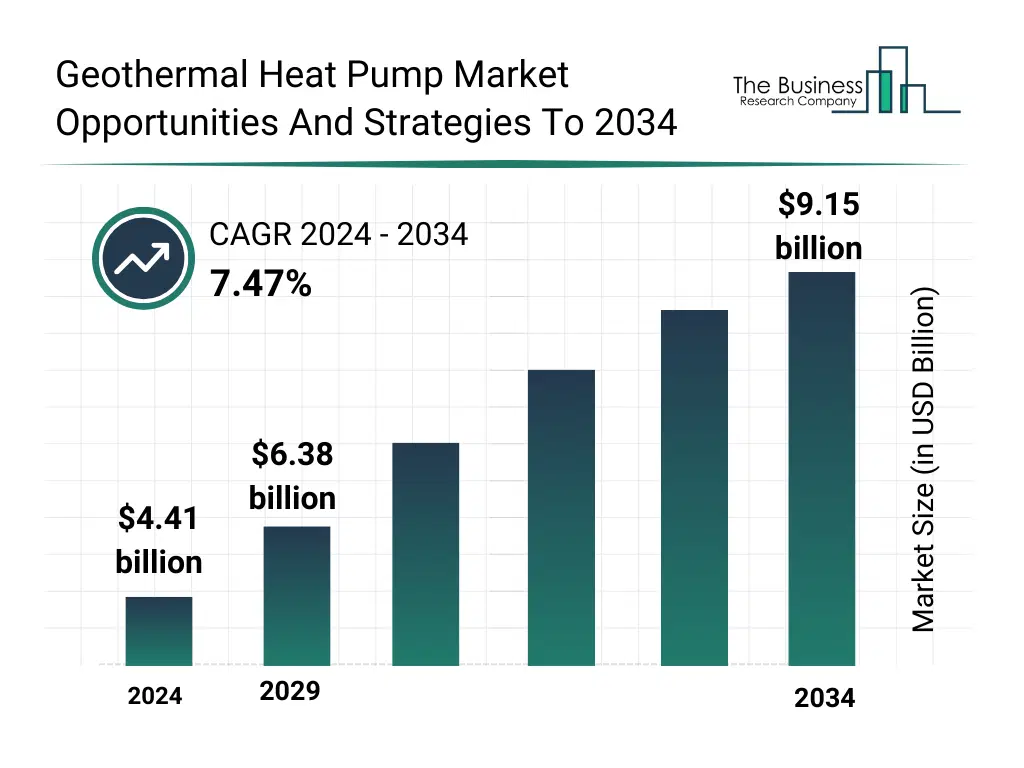
Geothermal Heat Pump Market Size
The global geothermal heat pump market reached a value of nearly $4,406.20 million in 2024, having grown at a compound annual growth rate (CAGR) of 5.70% since 2019. The market is expected to grow from $4,406.20 million in 2024 to $6,380.58 million in 2029 at a rate of 7.69%. The market is then expected to grow at a CAGR of 7.47% from 2029 and reach $9,145.87 million in 2034. Growth in the historic period resulted from expansion of smart city initiatives, increasing adoption of green certifications, government programs promoting renewable heating and cooling and increasing adoption in residential and commercial sectors. Factors that negatively affected growth in the historic period were the high installation cost and limited awareness and technical expertise. Going forward, growing focus on reducing carbon emissions, increasing government incentives and subsidies for renewable technologies, rising demand for energy-efficient heating and cooling systems and rising popularity of net-zero and passive buildings will drive growth. Factors that could hinder the growth of the geothermal heat pump market in the future include site-specific geological and land constraints, lengthy payback period for return on investment and impact or trade war and tariffs.Geothermal Heat Pump Market Drivers
The key drivers of the geothermal heat pump market include: Growing Focus On Reducing Carbon Emissions Growing focus on reducing carbon emissions is expected to be a key driver of the growth of the geothermal heat pump market in the forecast period. The growing global focus on reducing carbon emissions is driving increased adoption of geothermal heat pumps, as they offer a clean and energy-efficient alternative to traditional fossil fuel-based heating and cooling systems. Governments, businesses and consumers are prioritizing low-carbon technologies to meet climate goals and sustainability targets. Geothermal systems significantly reduce greenhouse gas emissions by leveraging renewable thermal energy from the earth, resulting in lower operational emissions and long-term environmental benefits. As decarbonization efforts intensify across residential, commercial and industrial sectors, the demand for geothermal heat pumps continues to rise, supporting the global transition toward a low-carbon energy future. The growing focus on reducing carbon emissions growth during the forecast period in 2024 is 2.00%.Geothermal Heat Pump Market Restraints
The key restraints on the geothermal heat pump market include: Site-Specific Geological And Land Constraints Site-specific geological and land constraints is restricting the growth of the geothermal heat pump market during the forecast period. The efficiency and feasibility of geothermal systems depend heavily on local ground conditions, soil composition, rock type and the availability of sufficient land for borehole drilling or ground loop installation. In areas with dense urban development, rocky terrain, or limited open space, installing geothermal systems can be technically challenging and cost prohibitive. Additionally, unsuitable subsurface conditions such as groundwater contamination risks or unstable soil can further restrict deployment. As a result, despite the strong environmental and energy-saving potential of geothermal heat pumps, these site-specific limitations continue to hinder large-scale adoption, especially in regions where land availability and geological suitability are not favorable. Growth affected by site-specific geological and land constraints during the forecast period in 2024 is -2.00%.Geothermal Heat Pump Market Trends
Major trends shaping the geothermal heat pump market include: Revolutionary Geothermal System Optimized For High-Temperature Applications Major companies in the geothermal heat pump market are focusing on the development of specialized systems designed to meet the unique heating and cooling needs of residential, commercial and industrial applications. These innovations aim to improve energy efficiency, system performance and user convenience, while also offering customizable configurations that cater to diverse climatic and operational requirements. For instance, in June 2025, Johnson Controls, an Ireland-based heat pump solutions company launched YORK CYK Water-to-Water Compound Centrifugal Heat Pump. It is a high-efficiency geothermal system designed for industrial, institutional and municipal applications. It delivers hot water up to 180°F (82°C) and operates with up to four times the efficiency of traditional boiler–chiller systems. Featuring compound compression and variable-speed drive (VSD) technology, it ensures stable, quiet and energy-efficient operation. Compatible with low-GWP refrigerants, the CYK model provides a sustainable, high-performance solution for large-scale heating and decarbonization projects. Strategic Collaborations To Accelerate Residential Geothermal Deployment Companies in the geothermal heat pump market are adopting strategic partnerships approach to deliver integrated geothermal heating and cooling solutions to residential and commercial customers. Strategic partnerships refer to a process in which companies leverage each other's strengths and resources to achieve mutual benefits and success. For instance, in April 2025, Enertech Global, a US-based geothermal heat pumps company, partnered with Dandelion Energy, a US-based company that offers geothermal heat pumps to integrate the solutions for customers. With this partnership they aim to accelerate large-scale adoption of residential geothermal heating and cooling by deploying over 1,500 systems across 14 Lennar communities in Colorado, promoting affordable, energy-efficient and U.S.-manufactured clean energy solutions.Opportunities And Recommendations In The Geothermal Heat Pump Market
Opportunities – The top opportunities in the geothermal heat pump market segmented by technology will arise in the closed loop system segment, which will gain $1,715.82 million of global annual sales by 2029. The top opportunities in the geothermal heat pump market segmented by application will arise in the residential segment, which will gain $1,252.22 million of global annual sales by 2029. The geothermal heat pump market size will gain the most in the USA at $351.04 million. Recommendations- To take advantage of the opportunities, The Business Research Company recommends the geothermal heat pump companies to focus on developing high-efficiency, customizable systems, focus on high-efficiency solutions and market accessibility, focus on expanding product efficiency and technological innovation, focus on next-generation high-efficiency geothermal systems, focus on closed loop systems for growth, expand in emerging markets, continue to focus on developed markets, focus on expanding distribution through strategic partnerships, focus on competitive and value-based pricing, focus on targeted digital campaigns, focus on industry partnerships and events, focus on strengthening residential customer engagement.Geothermal Heat Pump Market Segmentation
The geothermal heat pump market is segmented by technology and by application.By Technology –
The geothermal heat pump market is segmented by technology into:
- a) Open Loop System
- b) Closed Loop System
By Application –
The geothermal heat pump market is segmented by application into:
- a) Residential
- b) Commercial
- c) Industrial
By Geography - The geothermal heat pump market is segmented by geography into:
- • China
- • India
- • Japan
- • Australia
- • Indonesia
- • South Korea
- • Bangladesh
- • Thailand
- • Vietnam
- • Malaysia
- • Singapore
- • Phillipines
- • Hong kong
- • New Zealand
- • USA
- • Canada
- • Mexico
- • Brazil
- • Argentina
- • Chile
- • Colombiia
- • Peru
- • France
- • Germany
- • UK
- • Italy
- • Spain
- • Austria
- • Belgium
- • Denmark
- • Finland
- • Ireland
- • Netherland
- • Norway
- • Portugal
- • Sweden
- • Switzerland
- • Russia
- • Czech Republic
- • Poland
- • Romania
- • Ukraine
- • Saudi Arabia
- • Israel
- • Iran
- • Turkey
- • UAE o Africa
- • Egypt
- • Nigeria
- • South Africa
-
o Asia Pacific