
Genome Sequencing Market Report 2026
Global Outlook – By Product (Consumables, Systems And Software, Services), By Technology (Polymerase Chain Reaction (PCR), Sequencing, Microarray, Nucleic Acid Extraction, Purification, Other Technologies), By Applications (Diagnostics, Drug Discovery, Precision Medicine, Environmental Genomics, Research, Other Applications), By End-User (Hospitals And Clinics, Biotechnology And Pharmaceutical Companies, Contract Research Organizations (CROs), Government, Research Centers, Academic And Government Institutes, Other End-Users) – Market Size, Trends, Strategies, and Forecast to 2035
Genome Sequencing Market Overview
• Genome Sequencing market size has reached to $11.78 billion in 2025 • Expected to grow to $28.07 billion in 2030 at a compound annual growth rate (CAGR) of 18.9% • Growth Driver: Rising Cancer Incidence Fuels Growth In The Genome Sequencing Market • Market Trend: Advancements In NGS-Based Assays Enhance Genetic Analysis And Personalized Medicine • North America was the largest region in 2025 and Asia-Pacific is the fastest growing region.What Is Covered Under Genome Sequencing Market?
Genome sequencing is the process of determining the complete DNA sequence of an organism's genome. It involves identifying the precise order of nucleotides (adenine, cytosine, guanine, and thymine) in the genome, which includes all of an organism's genetic material. Genome sequencing provides comprehensive information about the genetic blueprint of an organism, enabling scientists to understand genetic variations, identify mutations, and study the relationships between genes and traits or diseases. The main types of genome sequencing products are consumables, systems, software, and services. Consumables refer to the single-use items necessary for preparing DNA samples, facilitating reactions, and capturing sequencing data that are used in each step of the sequencing process to ensure accurate and efficient results. They offer various technologies such as polymerase chain reaction (PCR), sequencing, microarray, nucleic acid extraction, purification, and others for several applications, including diagnostics, drug discovery, precision medicine, environmental genomics, research, and others. They are used by various end-users, such as hospitals and clinics, biotechnology and pharmaceutical companies, contract research organizations (CROs), government and research centers, academic and government institutes, and others.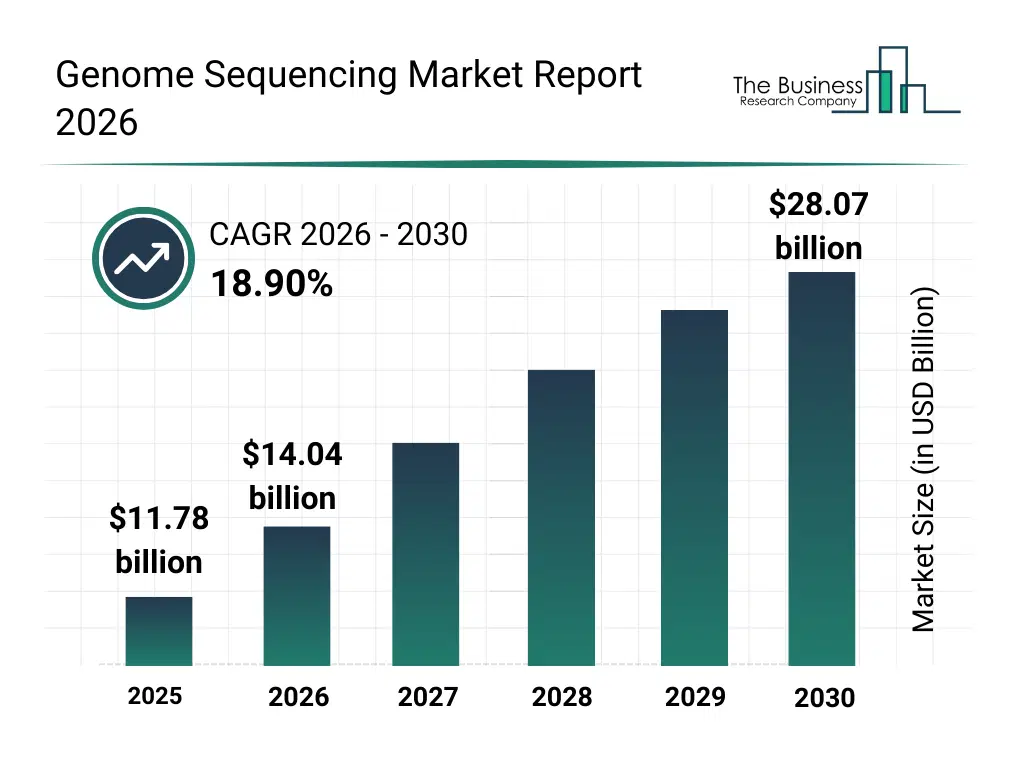
What Is The Genome Sequencing Market Size and Share 2026?
The genome sequencing market size has grown rapidly in recent years. It will grow from $11.78 billion in 2025 to $14.04 billion in 2026 at a compound annual growth rate (CAGR) of 19.2%. The growth in the historic period can be attributed to limited availability of advanced sequencing systems, reliance on conventional sanger sequencing, growing genomics research initiatives, increasing government funding for genome projects, rising awareness of personalized medicine.What Is The Genome Sequencing Market Growth Forecast?
The genome sequencing market size is expected to see rapid growth in the next few years. It will grow to $28.07 billion in 2030 at a compound annual growth rate (CAGR) of 18.9%. The growth in the forecast period can be attributed to development of next-generation sequencing systems, expansion of bioinformatics platforms, increasing adoption of precision medicine programs, rising collaborations between biotech and pharmaceutical companies, growth in genomic data storage and management solutions. Major trends in the forecast period include increasing adoption of next-generation sequencing (ngs) technologies, rising demand for precision medicine and personalized therapies, expansion of bioinformatics and data analysis services, growth in environmental and microbiome genomics applications, integration of custom genome sequencing solutions in research.
Global Genome Sequencing Market Segmentation
1) By Product: Consumables, Systems And Software, Services 2) By Technology: Polymerase Chain Reaction (PCR), Sequencing, Microarray, Nucleic Acid Extraction, Purification, Other Technologies 3) By Applications: Diagnostics, Drug Discovery, Precision Medicine, Environmental Genomics, Research, Other Applications 4) By End-User: Hospitals And Clinics, Biotechnology And Pharmaceutical Companies, Contract Research Organizations (CROs), Government, Research Centers, Academic And Government Institutes, Other End-Users Subsegments: 1) By Consumables: Reagents And Kits, Sequencing Chips And Plates, Sample Preparation Products, Library Preparation Kits, DNA And RNA Extraction Kits 2) By Systems And Software: Next-Generation Sequencing (NGS) Systems, Sanger Sequencing Systems, Bioinformatics Software And Analysis Tools, Data Management And Storage Solutions, Laboratory Information Management Systems (LIMS) 3) By Services: Sequencing Services, Bioinformatics Analysis Services, Consultation And Support Services, Custom Genome Sequencing Solutions, Sample Collection And Preparation Services.What Is The Driver Of The Genome Sequencing Market?
The increasing occurrence of cancer is expected to propel the growth of the genome sequencing market going forward. Cancer is a group of diseases characterized by the uncontrolled growth and spread of abnormal cells, which can lead to death if not controlled. The occurrence of cancer is rising due to several factors, including the aging population, lifestyle factors, environmental exposures, and genetic predispositions. Genome sequencing helps identify genetic mutations and predispositions to cancer, enabling early detection and personalized treatment plans. It reveals inherited cancer risks and assists in tracking the development of cancerous cells. For instance, in February 2024, according to the World Health Organization, a Switzerland-based intergovernmental organization, new cancer cases are projected to reach over 35 million by 2050, representing a 77% increase compared to 20 million cases in 2022. Therefore, the increasing occurrence of cancer is driving the growth of the genome sequencing industry.Key Players In The Global Genome Sequencing Market
Major companies operating in the genome sequencing market are F. Hoffmann-La Roche Ltd., Thermo Fisher Scientific Inc., Abbott Laboratories, Danaher Corporation, Merck KGaA, Siemens Healthineers, Becton Dickinson and Company, Eurofins Genomics, Agilent Technologies Inc., PerkinElmer, Illumina Inc., bioMérieux, Bio-Rad Laboratories Inc., QIAGEN N.V., 10x Genomics Inc., BGI Group, Oxford Nanopore Technologies plc, Pacific Biosciences of California Inc., GENEWIZ Inc., LI-COR Inc., CENTOGENE N.V., Bioneer Corporation, Strand Life Sciences Pvt Ltd., Nebula GenomicsGlobal Genome Sequencing Market Trends and Insights
Major companies operating in the genome sequencing market are focused on developing advanced solutions, such as next-generation sequencing (NGS)-based assays, to enhance the accuracy of genetic analysis and enable personalized medicine approaches. Next-generation sequencing (NGS)-based assays refer to advanced genomic technologies that will allow rapid and high-throughput sequencing of DNA or RNA to analyze genetic material. NGS allows for the simultaneous sequencing of millions of fragments of DNA or RNA, generating large volumes of data quickly and at a lower cost. For instance, in April 2023, Centogene N.V., a Germany-based provider of genetic diagnostics for rare diseases, launched CentoGenome, an enhanced Next Generation Sequencing (NGS)-based assay. It offers lifelong diagnostic support with proactive diagnosis confirmation and reclassification programs at no extra cost, ensuring continuous patient care and precise disease management. Utilizing a PCR-free approach, CentoGenome reduces bias and enhances sequencing quality, providing better coverage of challenging genomic regions and improving insights into coding, regulatory, and intronic areas. The platform features an automated bioinformatics pipeline and medical expert analysis, utilizing CENTOGENE's extensive bio databank of data from about 700,000 patients in over 120 countries. This comprehensive dataset boosts the detection of disease-causing variants, including those associated with spinal muscular atrophy and Parkinson's disease.What Are Latest Mergers And Acquisitions In The Genome Sequencing Market?
In January 2023, QIAGEN N.V., a Germany-based provider of sample and assay technologies for research, acquired Verogen Inc. for an undisclosed amount. The acquisition enables QIAGEN to provide a comprehensive and integrated variety of forensic solutions based on PCR, digital PCR, and NGS technologies and gain exclusive distribution rights. Verogen Inc. is a US-based provider of next-generation sequencing (NGS) solutions for forensic genomics.Regional Insights
North America was the largest region in the genome sequencing market in 2025. Asia-Pacific is expected to be the fastest-growing region in the forecast period. The regions covered in this market report are Asia-Pacific, South East Asia, Western Europe, Eastern Europe, North America, South America, Middle East, Africa. The countries covered in this market report are Australia, Brazil, China, France, Germany, India, Indonesia, Japan, Taiwan, Russia, South Korea, UK, USA, Canada, Italy, Spain.What Defines the Genome Sequencing Market?
The genome sequencing market consists of revenues earned by entities by providing services such as whole genome sequencing, targeted sequencing, and agri-genomics. The market value includes the value of related goods sold by the service provider or included within the service offering. The genome sequencing market also includes sales of reagents, automated pipettors, and genotyping kits. Values in this market are ‘factory gate’ values, that is, the value of goods sold by the manufacturers or creators of the goods, whether to other entities (including downstream manufacturers, wholesalers, distributors, and retailers) or directly to end customers. The value of goods in this market includes related services sold by the creators of the goods.How is Market Value Defined and Measured?
The market value is defined as the revenues that enterprises gain from the sale of goods and/or services within the specified market and geography through sales, grants, or donations in terms of the currency (in USD unless otherwise specified). The revenues for a specified geography are consumption values that are revenues generated by organizations in the specified geography within the market, irrespective of where they are produced. It does not include revenues from resales along the supply chain, either further along the supply chain or as part of other products.What Key Data and Analysis Are Included in the Genome Sequencing Market Report 2026?
The genome sequencing market research report is one of a series of new reports from The Business Research Company that provides market statistics, including industry global market size, regional shares, competitors with the market share, detailed market segments, market trends and opportunities, and any further data you may need to thrive in the genome sequencing industry. The market research report delivers a complete perspective of everything you need, with an in-depth analysis of the current and future state of the industry.Genome Sequencing Market Report Forecast Analysis
| Report Attribute | Details |
|---|---|
| Market Size Value In 2026 | $14.04 billion |
| Revenue Forecast In 2035 | $28.07 billion |
| Growth Rate | CAGR of 19.2% from 2026 to 2035 |
| Base Year For Estimation | 2025 |
| Actual Estimates/Historical Data | 2020-2025 |
| Forecast Period | 2026 - 2030 - 2035 |
| Market Representation | Revenue in USD Billion and CAGR from 2026 to 2035 |
| Segments Covered | Product, Technology, Applications, End-User |
| Regional Scope | Asia-Pacific, Western Europe, Eastern Europe, North America, South America, Middle East, Africa |
| Country Scope | The countries covered in the report are Australia, Brazil, China, France, Germany, India, ... |
| Key Companies Profiled | F. Hoffmann-La Roche Ltd., Thermo Fisher Scientific Inc., Abbott Laboratories, Danaher Corporation, Merck KGaA, Siemens Healthineers, Becton Dickinson and Company, Eurofins Genomics, Agilent Technologies Inc., PerkinElmer, Illumina Inc., bioMérieux, Bio-Rad Laboratories Inc., QIAGEN N.V., 10x Genomics Inc., BGI Group, Oxford Nanopore Technologies plc, Pacific Biosciences of California Inc., GENEWIZ Inc., LI-COR Inc., CENTOGENE N.V., Bioneer Corporation, Strand Life Sciences Pvt Ltd., Nebula Genomics |
| Customization Scope | Request for Customization |
| Pricing And Purchase Options | Explore Purchase Options |