
Gas Separation Membrane Market 2026
Gas Separation Membrane Market 2026
By Product Type (Polyaramide, Polysulfone, Cellulose Acetate, Other Products), By Module (Hollow Fiber, Spiral Wound, Plate And Frame, Other Modules), By Application (Nitrogen Generation And Oxygen Enrichment, Hydrogen Recovery, Carbon Dioxide Removal, Vapor/Gas Separation, Vapor/Vapor Separation, Air Dehydration, Other Applications), By End-User Industry (Chemical, Oil And Gas Industry, Electric Power, Food And Beverages, Other End Use Industry), And By Region, Opportunities And Strategies – Global Forecast To 2035
Gas Separation Membranes Market Definition
Gas separation membranes refer to semi-permeable barrier materials used to separate specific gases or vapors from a mixture based on differences in molecular properties such as size, solubility, and diffusivity. These membranes are predominantly used by industrial operators in sectors like oil and gas, chemicals, energy, food and beverage, and pharmaceuticals, where separation and purification of gases are critical to production processes. They are used continuously or periodically for applications such as nitrogen generation, oxygen enrichment, hydrogen recovery, carbon dioxide removal, and dehydration of air or gases. The gas separation membrane market consists of sales, by entities (organizations, sole traders, or partnerships), of gas separation membranes that are designed to enable efficient separation of gases such as hydrogen, oxygen, nitrogen, and carbon dioxide. The market includes membranes used in chemical processing, energy and power generation, biogas upgrading, food and beverage applications, and waste-to-energy systems, all aimed at improving process efficiency, reducing energy consumption, and supporting cleaner and more sustainable industrial operations.

Gas Separation Membranes Market Size
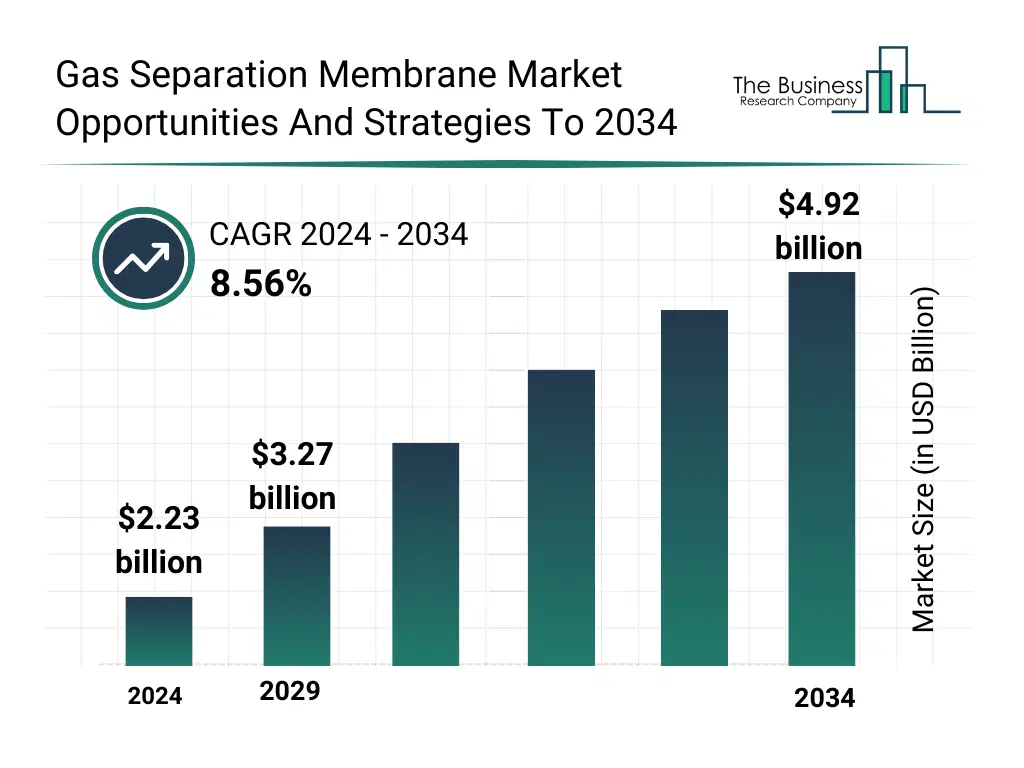
The global gas separation membrane market reached a value of nearly $2,231.89 million in 2024, having grown at a compound annual growth rate (CAGR) of 6.39% since 2019. The market is expected to grow from $2,231.89 million in 2024 to $3,265.02 million in 2029 at a rate of 7.91%. The market is then expected to grow at a CAGR of 8.56% from 2029 and reach $4,922.50 million in 2034. Growth in the historic period resulted from growth of the pharmaceutical industry, expansion of the oil and gas industry, growing food and beverage industry and increasing industrialization. Factors that negatively affected growth in the historic period were high initial investment costs and membrane fouling, degradation and limited durability. Going forward, increasing demand for renewable energy sources, growing demand for biogas and natural gas, growth of the chemical industry and environmental consciousness in manufacturing will drive the growth. Factors that could hinder the growth of the gas separation membrane market in the future include strong competition from mature separation technologies, high energy requirements for certain applications and impact of trade war and tariff.Gas Separation Membranes Market Drivers
The key drivers of the gas separation membranes market include: Increasing Demand For Renewable Energy Sources During the forecast period, the rising growth of the automotive industry will propel the The global transition toward renewable energy is poised to significantly boost the gas separation membrane market in the coming years. As nations intensify efforts to decarbonize their energy systems, demand is growing for technologies that enable efficient gas purification, recovery, and conversion within renewable energy processes. Gas separation membranes are crucial in applications such as biogas upgrading, hydrogen production, and carbon capture—all key components of sustainable energy generation. Their capability to selectively separate gases with low energy use and minimal environmental impact makes them highly suitable for renewable energy initiatives. Moreover, the modular and scalable design of membrane systems supports flexible implementation in both distributed and small-scale renewable energy installations. The increasing demand for renewable energy sources growth contribution during the forecast period in 2024 is 1.50%.Gas Separation Membranes Market Restraints
The key restraints on the gas separation membranes market include: Strong Competition From Mature Separation Technologies Intense competition from well-established separation technologies is expected to limit the growth of the gas separation membrane market during the forecast period. Traditional methods such as cryogenic distillation, absorption, and pressure swing adsorption have been in use for decades and are trusted for their high separation efficiency and proven reliability in large-scale industrial processes. Many end-users remain hesitant to replace these systems due to their familiarity, existing infrastructure, and strong operational track records. In comparison, gas separation membranes are still viewed as an emerging technology, particularly for complex gas mixtures or high-pressure applications. This perception contributes to industry reluctance in adopting membrane-based systems, especially when conventional technologies continue to deliver satisfactory performance. Growth affected by strong competition from mature separation technologies production during the forecast period in 2024 is -2.63%.Gas Separation Membranes Market Trends
Major trends shaping the gas separation membranes market include: Integration of Strategic Polymer-Membrane Partnerships for CO₂ Capture Key players operating in the gas separation membrane market are focusing on forming strategic partnerships to combine advanced polymer material expertise with innovative membrane module design to accelerate downstream adoption of membrane-based CO₂ (carbon dioxide) capture solutions. These efforts are enhancing membrane performance (in terms of CO₂ selectivity and throughput), reducing total system cost and enabling more compact, field-deployable carbon-capture units. For example, in January 2025, Arkema S.A., a France-based multinational company that specializes in specialty materials and chemicals, and OOYOO LTD., signed a memorandum of understanding (MOU) to jointly develop high-performance gas-separation membranes focused on CO₂ separation. Arkema brings its advanced polymer material portfolio (including Pebax® elastomers, polyimide, PEKK and PVDF resins) while OOYOO contributes its proprietary membrane and module design technology aimed at reducing CO₂ extraction and recovery costs. OOYOO LTD. is a Japan-based deep-tech startup originating from Kyoto University. Development of Advanced Membrane Technologies for Enhanced Efficiency and Sustainability Major companies in the gas separation membrane market are developing advanced membrane technologies aimed at improving process efficiency and sustainability. Companies are increasingly focusing on innovative membrane solutions that enhance gas purity, reduce energy consumption, and lower operational costs to support cleaner industrial applications. For example, in May 2024, Air Products Membrane Solutions, a US-based division of Air Products and Chemicals, Inc., a leading global industrial gases company, launched the PRISM® GreenSep LNG Membrane Separator for bio-LNG production, which eliminates intermediate purification technologies such as amine scrubbing or thermal swing adsorption, thereby increasing bio-LNG yield while reducing operating costs and energy use.Opportunities And Recommendations In The Gas Separation Membranes Market
Opportunities – The top opportunities in the gas separation membrane market segmented by product type will arise in the polyimide and polyaramide segment, which will gain $445.27 million of global annual sales by 2029. The top opportunities in the gas separation membrane market segmented by module will arise in the hollow fiber segment, which will gain $564.45 million of global annual sales by 2029. The top opportunities in the gas separation membrane market segmented by application will arise in the nitrogen generation and oxygen enrichment segment, which will gain $283.72 million of global annual sales by 2029. The top opportunities in the gas separation membrane market segmented by end use industry will arise in the oil and gas industry segment, which will gain $346.88 million of global annual sales by 2029. The gas separation membrane market size will gain the most in China at $212.82 million. Recommendations- To take advantage of the opportunities, The Business Research Company recommends the gas separation membrane companies to focus on strategic polymer membrane partnerships for co₂ capture, focus on advanced membrane technologies for efficient and sustainable gas separation, focus on mixed matrix membranes for carbon capture and hydrogen recovery, focus on sustainable biogas upgrading with high performance membrane systems, focus on hydrogen purification membranes for ammonia based hydrogen supply chains, focus on polyimide and polyaramide membrane materials for high-growth gas separation applications, focus on advanced and customized gas separation membrane modules, expand in emerging markets , continue to focus on developed markets, provide competitively priced offerings, continue to use b2b promotions, participate in trade shows and events, focus on carbon dioxide removal applications in gas separation membranes, focus on expanding into other end-user industries with specialized gas separation needs.Gas Separation Membranes Market Segmentation
The gas separation membranes market is segmented by product type, by module, by application, and by end-use industry.By Product Type –
The gas separation membranes market is segmented by product type into:
- a) Polyimide And Polyaramide
- b) Polysulfone
- c) Cellulose Acetate
- d) Other Products
By Module –
The gas separation membranes market is segmented by module into:
- a) Hollow Fiber
- b) Spiral Wound
- c) Plate And Frame
- d) Other Modules
By Application –
The gas separation membranes market is segmented by application into:
- a) Nitrogen Generation And Oxygen Enrichment
- b) Hydrogen Recovery
- c) Carbon Dioxide Removal
- d) Vapor/Gas Separation
- e) Vapor/Vapor Separation
- f) Air Dehydration
- g) Other Applications
By End-Use Industry –
The gas separation membranes market is segmented by end-use industry into:
- a) Chemical
- b) Oil And Gas Industry
- c) Electric Power
- d) Food And Beverages
- e) Other End Use Industry
By Geography - The gas separation membranes market is segmented by geography into:
- • China
- • India
- • Japan
- • Australia
- • Indonesia
- • South Korea
- • Bangladesh
- • Thailand
- • Vietnam
- • Malaysia
- • Singapore
- • Phillipines
- • Hong kong
- • New Zealand
- • USA
- • Canada
- • Mexico
- • Brazil
- • Argentina
- • Chile
- • Colombiia
- • Peru
- • France
- • Germany
- • UK
- • Italy
- • Spain
- • Austria
- • Belgium
- • Denmark
- • Finland
- • Ireland
- • Netherland
- • Norway
- • Portugal
- • Sweden
- • Switzerland
- • Russia
- • Czech Republic
- • Poland
- • Romania
- • Ukraine
- • Saudi Arabia
- • Israel
- • Iran
- • Turkey
- • UAE o Africa
- • Egypt
- • Nigeria
- • South Africa
-
o Asia Pacific