
Fertility Tracking Sensor Market Report 2026
Fertility Tracking Sensor Market Report 2026
Global Outlook – By Product Type (Wearable Sensors, Implantable Sensors, Patch Sensors, Other Product Types), By Technology (Temperature Sensors, Hormone Sensors, Electrochemical Sensors, Optical Sensors, Other Technologies), By Application (Ovulation Prediction, Menstrual Cycle Tracking, Pregnancy Detection, Other Applications), By Distribution Channel (Online, Pharmacies, Retail Stores, Other Distribution Channels), By End-User (Homecare Settings, Hospitals And Clinics, Fertility Centers, Other End-Users) – Market Size, Trends, Strategies, and Forecast to 2035
Fertility Tracking Sensor Market Overview
• Fertility Tracking Sensor market size has reached to $1.55 billion in 2025 • Expected to grow to $3.32 billion in 2030 at a compound annual growth rate (CAGR) of 16.6% • Growth Driver: Increasing Infertility Rates Boost The Market Growth Due To Growing Demand For Ovulation Monitoring And Fertility Support Solutions • Market Trend: Innovative Wrist-Worn Devices Enhance Real-Time Fertility And Reproductive Health Tracking • North America was the largest region in 2025 and Asia-Pacific is the fastest growing region.

What Is Covered Under Fertility Tracking Sensor Market?
A fertility tracking sensor is a wearable or insertable electronic device that continuously monitors physiological indicators such as basal body temperature, hormone levels, or biometric patterns related to the reproductive cycle. It uses sensors and algorithms to analyze fertile and non-fertile phases with high precision. Its primary purpose is to accurately predict ovulation and fertile windows for family planning, conception support, or reproductive health management. The main product types of fertility tracking sensors include wearable sensors, implantable sensors, patch sensors, and other product types. Wearable sensors refer to devices worn on the body that continuously monitor physiological parameters to track fertility and predict ovulation. These sensors use technologies such as Temperature Sensors, hormone sensors, electrochemical sensors, Optical Sensors, and other technologies. They are applied across areas including ovulation prediction, menstrual cycle tracking, pregnancy detection, and other applications. They are distributed through online channels, pharmacies, retail stores, and other distribution channels, and are used by end users including homecare settings, hospitals and clinics, fertility centers, and other end users.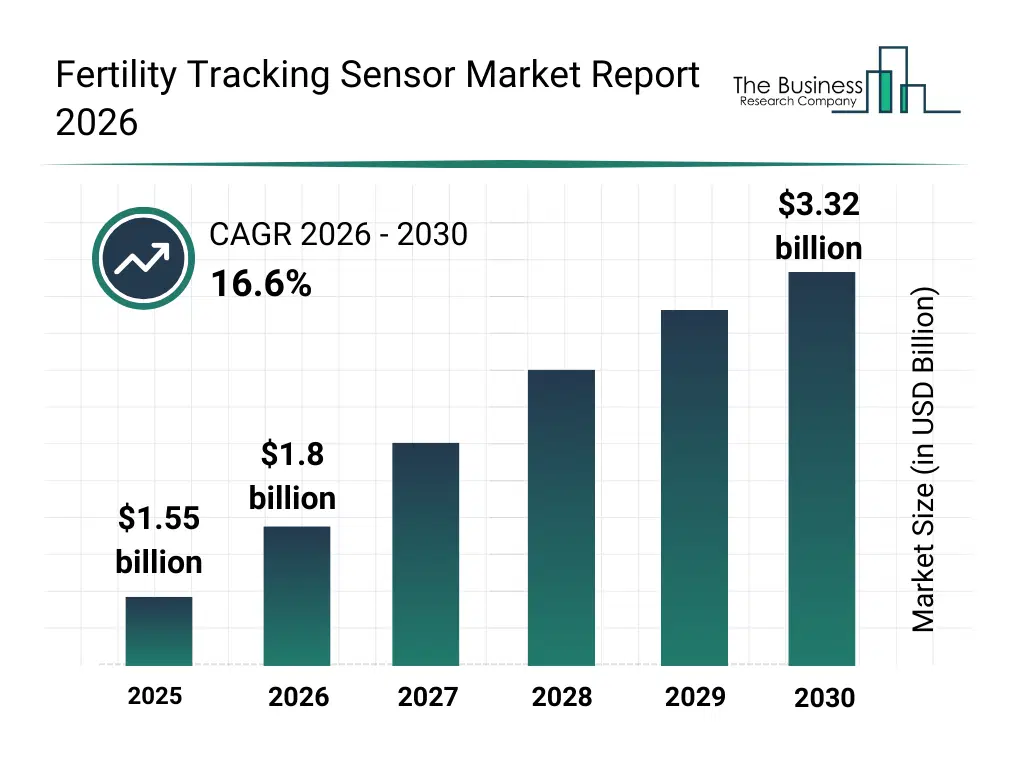
What Is The Fertility Tracking Sensor Market Size and Share 2026?
The fertility tracking sensor market size has grown rapidly in recent years. It will grow from $1.55 billion in 2025 to $1.8 billion in 2026 at a compound annual growth rate (CAGR) of 16.4%. The growth in the historic period can be attributed to rising awareness of reproductive health management, increased adoption of digital health wearables, growing demand for natural family planning tools, expansion of women-focused health technology, availability of affordable sensor technologies.What Is The Fertility Tracking Sensor Market Growth Forecast?
The fertility tracking sensor market size is expected to see rapid growth in the next few years. It will grow to $3.32 billion in 2030 at a compound annual growth rate (CAGR) of 16.6%. The growth in the forecast period can be attributed to increasing use of AI-powered fertility analytics, rising demand for personalized reproductive health insights, expansion of telehealth-supported fertility management, growing adoption of remote patient monitoring, increasing integration of fertility data platforms with healthcare systems. Major trends in the forecast period include increasing adoption of continuous ovulation monitoring devices, rising use of wearable fertility sensors, growing integration of AI-based cycle prediction algorithms, expansion of smartphone-connected fertility tracking solutions, enhanced focus on non-invasive monitoring technologies.Global Fertility Tracking Sensor Market Segmentation
1) By Product Type: Wearable Sensors; Implantable Sensors; Patch Sensors; Other Product Types 2) By Technology: Temperature Sensors; Hormone Sensors; Electrochemical Sensors; Optical Sensors; Other Technologies 3) By Application: Ovulation Prediction; Menstrual Cycle Tracking; Pregnancy Detection; Other Applications 4) By Distribution Channel: Online; Pharmacies; Retail Stores; Other Distribution Channels 5) By End-User: Homecare Settings; Hospitals And Clinics; Fertility Centers; Other End-Users Subsegments: 1) By Wearable Sensors: Smart Wristbands; Smart Rings; Smart Patches; Smart Garments 2) By Implantable Sensors: Subcutaneous Implants; Intrauterine Devices; Microchip Implants 3) By Patch Sensors: Adhesive Skin Patches; Transdermal Patches; Disposable Patches 4) By Other Product Types: Portable Monitors; Smartphone Compatible Devices; Non Invasive DevicesWhat Is The Driver Of The Fertility Tracking Sensor Market?
The increasing infertility prevalence is expected to propel the growth of the fertility tracking sensor market going forward. Infertility refers to a reproductive condition in which a couple is unable to conceive naturally despite consistent attempts over a prolonged period. Infertility is increasing largely due to delayed parenthood, as more individuals choose to have children later in life, when natural fertility declines and the risk of reproductive health issues rises. Fertility tracking sensors help with infertility by continuously monitoring key reproductive indicators, such as basal body temperature and hormone-related changes, enabling couples to accurately identify the fertile window and improve the chances of conception. For instance, in April 2023, according to the World Health Organization (WHO), a Switzerland-based intergovernmental organization, approximately 17.5% of the adult population, or about 1 in 6 people globally, face infertility, highlighting the pressing need to improve access to affordable, high-quality fertility care for those affected. Therefore, the increasing infertility prevalence is driving the growth of the fertility tracking sensor industry.Key Players In The Global Fertility Tracking Sensor Market
Major companies operating in the fertility tracking sensor market are Swiss Precision Diagnostics GmbH, Natural Cycles Nordic AB, Alfa Scientific Designs Inc., kegg Inc., Quidel Corporation, Tempdrop Ltd., Valley Electronics AG., Babystart Ltd., Bongmi Technology, Fairhaven Health LLC, Femometer Inc., Inito Health Tech Private Limited, Oura Health Oy, Prima-Temp LLC, Quanovate Tech Inc., Raiing Medical Company, Samplytics Technologies Pvt. Ltd., YONO Labs Inc., bioZhena Corporation, Welltwigs.Global Fertility Tracking Sensor Market Trends and Insights
Major companies operating in the fertility tracking sensor market are focusing on developing innovative solutions, such as wrist-worn wearables, to provide real-time fertility tracking, improve cycle accuracy, and support women’s reproductive health management through data-driven insights. A wrist-worn wearable refers to a compact electronic device worn on the wrist that collects and analyzes physiological data, such as temperature, heart rate, or hormone-related signals, to track health metrics and provide actionable insights, including fertility and reproductive health information. For instance, in January 2026, Natural Cycles, a Sweden-based digital health company, launched an NC° Band that simplifies fertility tracking by automatically measuring temperature overnight. It is designed for seamless fertility tracking, replacing manual thermometers by automatically measuring overnight skin temperature, heart rate, and movement. Its purpose is to power the app's NC° Fertility algorithm for detecting fertile windows, enabling hormone-free birth control (93% typical effectiveness), pregnancy planning, postpartum, and perimenopause support.What Are Latest Mergers And Acquisitions In The Fertility Tracking Sensor Market?
In August 2025, Ultrahuman Labs Pvt. Ltd., an India-based health-tech company, acquired viO HealthTech for an undisclosed amount. Through this acquisition, Ultrahuman seeks to strengthen its fertility tracking sensor capabilities by incorporating viO’s clinically validated ovulation-tracking technology into the Ultrahuman Ring Air, allowing for more precise cycle and ovulation insights through continuous physiological and temperature biomarkers. viO HealthTech Limited is a UK-based company specializing in fertility tracking sensors and ovulation-detection algorithms.Regional Insights
North America was the largest region in the fertility tracking sensor market in 2025. Asia-Pacific is expected to be the fastest-growing region in the forecast period. The regions covered in this market report are Asia-Pacific, South East Asia, Western Europe, Eastern Europe, North America, South America, Middle East, Africa. The countries covered in this market report are Australia, Brazil, China, France, Germany, India, Indonesia, Japan, Taiwan, Russia, South Korea, UK, USA, Canada, Italy, Spain.What Defines the Fertility Tracking Sensor Market?
The fertility tracking sensor market consists of sales of ovulation prediction sensors, smart rings and patches, integrated biosensors, and associated sensor hardware components. Values in this market are ‘factory gate’ values, that is, the value of goods sold by the manufacturers or creators of the goods, whether to other entities (including downstream manufacturers, wholesalers, distributors, and retailers) or directly to end customers. The value of goods in this market includes related services sold by the creators of the goods.How is Market Value Defined and Measured?
The market value is defined as the revenues that enterprises gain from the sale of goods and/or services within the specified market and geography through sales, grants, or donations in terms of the currency (in USD unless otherwise specified). The revenues for a specified geography are consumption values that are revenues generated by organizations in the specified geography within the market, irrespective of where they are produced. It does not include revenues from resales along the supply chain, either further along the supply chain or as part of other products.What Key Data and Analysis Are Included in the Fertility Tracking Sensor Market Report 2026?
The fertility tracking sensor market research report is one of a series of new reports from The Business Research Company that provides market statistics, including industry global market size, regional shares, competitors with the market share, detailed market segments, market trends and opportunities, and any further data you may need to thrive in the fertility tracking sensor industry. The market research report delivers a complete perspective of everything you need, with an in-depth analysis of the current and future state of the industry.Fertility Tracking Sensor Market Report Forecast Analysis
| Report Attribute | Details |
|---|---|
| Market Size Value In 2026 | $1.8 billion |
| Revenue Forecast In 2035 | $3.32 billion |
| Growth Rate | CAGR of 16.4% from 2026 to 2035 |
| Base Year For Estimation | 2025 |
| Actual Estimates/Historical Data | 2020-2025 |
| Forecast Period | 2026 - 2030 - 2035 |
| Market Representation | Revenue in USD Billion and CAGR from 2026 to 2035 |
| Segments Covered | Product Type, Technology, Application, Distribution Channel, End-User |
| Regional Scope | Asia-Pacific, Western Europe, Eastern Europe, North America, South America, Middle East, Africa |
| Country Scope | The countries covered in the report are Australia, Brazil, China, France, Germany, India, ... |
| Key Companies Profiled | Swiss Precision Diagnostics GmbH, Natural Cycles Nordic AB, Alfa Scientific Designs Inc., kegg Inc., Quidel Corporation, Tempdrop Ltd., Valley Electronics AG., Babystart Ltd., Bongmi Technology, Fairhaven Health LLC, Femometer Inc., Inito Health Tech Private Limited, Oura Health Oy, Prima-Temp LLC, Quanovate Tech Inc., Raiing Medical Company, Samplytics Technologies Pvt. Ltd., YONO Labs Inc., bioZhena Corporation, Welltwigs. |
| Customization Scope | Request for Customization |
| Pricing And Purchase Options | Explore Purchase Options |
Frequently Asked Questions
The Fertility Tracking Sensor market was valued at $1.55 billion in 2025, increased to $1.8 billion in 2026, and is projected to reach $3.32 billion by 2030.
request a sample hereThe global Fertility Tracking Sensor market is expected to grow at a CAGR of 16.6% from 2026 to 2035 to reach $3.32 billion by 2035.
request a sample hereSome Key Players in the Fertility Tracking Sensor market Include, Swiss Precision Diagnostics GmbH, Natural Cycles Nordic AB, Alfa Scientific Designs Inc., kegg Inc., Quidel Corporation, Tempdrop Ltd., Valley Electronics AG., Babystart Ltd., Bongmi Technology, Fairhaven Health LLC, Femometer Inc., Inito Health Tech Private Limited, Oura Health Oy, Prima-Temp LLC, Quanovate Tech Inc., Raiing Medical Company, Samplytics Technologies Pvt. Ltd., YONO Labs Inc., bioZhena Corporation, Welltwigs. .
request a sample hereMajor trend in this market includes: Innovative Wrist-Worn Devices Enhance Real-Time Fertility And Reproductive Health Tracking. For further insights on this market.
request a sample hereNorth America was the largest region in the fertility tracking sensor market in 2025. Asia-Pacific is expected to be the fastest-growing region in the forecast period. The regions covered in the fertility tracking sensor market report are Asia-Pacific, South East Asia, Western Europe, Eastern Europe, North America, South America, Middle East, Africa.
request a sample here