
Environmental, Social, And Governance (ESG)-Linked Insurance Market Report 2026
Global Outlook – By Product Type (Climate Risk Insurance, Green Property Insurance, Renewable Energy Project Insurance, Sustainable Supply Chain Insurance, Environmental, Social, And Governance (ESG) Performance-Linked Liability Insurance, Carbon Reduction-Linked Insurance, Sustainable Agriculture Insurance, Clean Energy Technology Insurance), By Coverage (Liability And Litigation Coverage, Reputational Risk Coverage, New Technology Performance), By Distribution Channel (Direct Sales, Brokers And Agents, Online Platforms, Bancassurance, Corporate Partnerships), By Application (Other Applications), By End User (Financial Institutions And Asset Managers, Renewable Energy Projects) – Market Size, Trends, Strategies, and Forecast to 203
Environmental, Social, And Governance (ESG)-Linked Insurance Market Overview
• Environmental, Social, And Governance (ESG)-Linked Insurance market size has reached to $5.74 billion in 2025 • Expected to grow to $17.57 billion in 2030 at a compound annual growth rate (CAGR) of 25% • Growth Driver: Surge In Investor Demand For Sustainable Investment Products Fueling The Growth Of The Market Due To Increasing Focus On Environmental, Social, And Governance Integration • Market Trend: Empowering Enterprises With Advisory And Risk Transfer Services To Advance Sustainable Business Practices • North America was the largest region in 2025 and Asia-Pacific is the fastest growing region.What Is Covered Under Environmental, Social, And Governance (ESG)-Linked Insurance Market?
Environmental, social, and governance (ESG)-linked insurance refers to insurance products that incorporate environmental, social, and governance (ESG) criteria into their structure, pricing, or coverage terms. These policies incentivize sustainable practices by offering benefits, discounts, or coverage adjustments based on an organization’s environmental, social, and governance performance. The approach encourages responsible business behavior while managing risks and aligning financial protection with sustainability goals. The main product types of esg-linked insurance include climate risk insurance, green property insurance, renewable energy project insurance, sustainable supply chain insurance, environmental, social, and governance performance-linked liability insurance, carbon reduction-linked insurance, sustainable agriculture insurance, clean energy technology insurance. Climate risk insurance is a financial protection product that helps individuals, businesses, or governments manage losses caused by climate-related events such as floods, storms, droughts, or extreme weather conditions. Different coverage types are transition risk coverage, physical climate risk coverage, liability and litigation coverage, reputational risk coverage, new technology performance coverage, and others. Multiple distribution channels are direct sales, brokers and agents, online platforms, bancassurance, corporate partnerships, and others. Various applications include corporate environmental, social, and governance compliance, green investments, renewable energy projects, sustainable supply chains, and others, and they are used by several end users include large corporations and multinationals, small and medium enterprises, financial institutions and asset managers, renewable energy projects, infrastructure and real estate.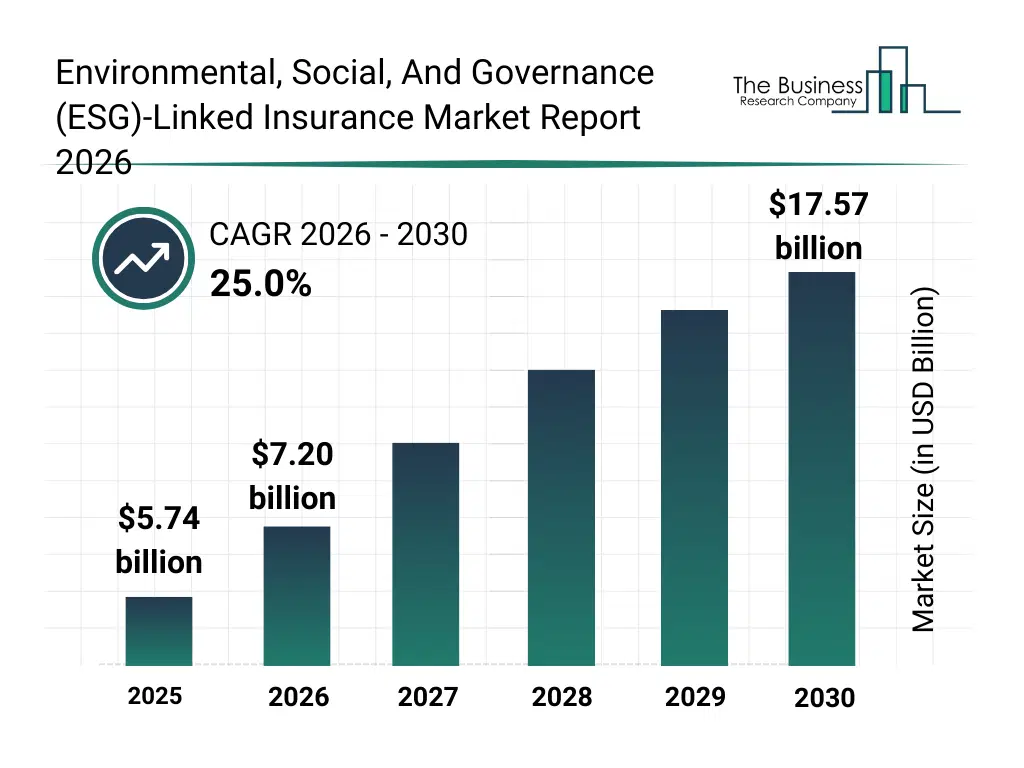
What Is The Environmental, Social, And Governance (ESG)-Linked Insurance Market Size and Share 2026?
The environmental, social, and governance (ESG)-linked insurance market size has grown exponentially in recent years. It will grow from $5.74 billion in 2025 to $7.20 billion in 2026 at a compound annual growth rate (CAGR) of 25.3%. The growth in the historic period can be attributed to increasing demand for sustainable insurance offerings, growing adoption of climate risk assessment, rising corporate focus on environmental, social, and governance (ESG) compliance, expanding integration of environmental metrics in underwriting, and increasing insurer participation in sustainable finance.What Is The Environmental, Social, And Governance (ESG)-Linked Insurance Market Growth Forecast?
The environmental, social, and governance (ESG)-linked insurance market size is expected to see exponential growth in the next few years. It will grow to $17.57 billion in 2030 at a compound annual growth rate (CAGR) of 25.0%. The growth in the forecast period can be attributed to growing investments in renewable energy projects, rising emphasis on climate resilience strategies, increasing regulatory support for environmental, social, and governance (ESG)-linked insurance, expanding adoption of data-driven sustainability analytics, and rapid growth in governance-focused insurance models. Major trends in the forecast period include technology advancements in climate risk modeling, innovations in environmental, social, and governance (ESG) scoring platforms, developments in real-time environmental monitoring tools, research and development in green insurance products, and advancements in artificial intelligence (AI)-driven sustainability analytics.
Global Environmental, Social, And Governance (ESG)-Linked Insurance Market Segmentation
1) By Product Type: Climate Risk Insurance, Green Property Insurance, Renewable Energy Project Insurance, Sustainable Supply Chain Insurance, Environmental, Social, And Governance (ESG) Performance-Linked Liability Insurance, Carbon Reduction-Linked Insurance, Sustainable Agriculture Insurance, Clean Energy Technology Insurance 2) By Coverage: Transition Risk Coverage, Physical Climate Risk Coverage, Liability And Litigation Coverage, Reputational Risk Coverage, New Technology Performance 3) By Distribution Channel: Direct Sales, Brokers And Agents, Online Platforms, Bancassurance, Corporate Partnerships 4) By Application: Corporate Environmental, Social, And Governance (ESG) Compliance, Green Investments, Renewable Energy Projects, Sustainable Supply Chains, Other Applications 5) By End User: Large Corporations And Multinationals, Small And Medium Enterprises (SMEs), Financial Institutions And Asset Managers, Renewable Energy Projects, Infrastructure And Real Estate Subsegments: 1) By Climate Risk Insurance: Extreme Weather Coverage, Flood And Storm Protection, Drought And Heatwave Coverage, Sea Level Rise Protection, Natural Disaster Loss Mitigation 2) By Green Property Insurance: Eco Building Coverage, Energy Efficient Property Protection, Sustainable Renovation Coverage, Green Retrofit Insurance, Low Carbon Footprint Property Coverage 3) By Renewable Energy Project Insurance: Solar Energy Project Coverage, Wind Energy Project Protection, Hydropower Project Insurance, Geothermal Project Coverage, Bioenergy Project Protection 4) By Sustainable Agriculture Insurance: Organic Farming Coverage, Crop Diversification Protection, Water Conservation Insurance, Soil Health Risk Coverage, Eco Friendly Farming Practices Insurance 5) By Environmental, Social, and Governance (ESG) Performance Linked Liability Insurance: Environmental Liability Coverage, Social Responsibility Liability Protection, Governance Risk Liability Coverage, Compliance And Regulatory Liability Insurance, Reputation Risk Protection 6) By Carbon Reduction Linked Insurance: Carbon Offset Project Coverage, Emission Reduction Initiative Insurance, Low Carbon Technology Protection, Carbon Credit Risk Coverage, Greenhouse Gas Mitigation Insurance 7) By Sustainable Supply Chain Insurance: Supplier Risk Protection, Logistics And Transportation Coverage, Sustainable Procurement Insurance, Ethical Sourcing Risk Coverage, Circular Economy Supply Chain Insurance 8) By Clean Energy Technology Insurance: Renewable Technology Equipment Coverage, Smart Grid Technology Protection, Energy Storage System Insurance, Sustainable Transport Technology Coverage, Low Emission Technology ProtectionWhat Are The Drivers Of The Environmental, Social, And Governance (ESG)-Linked Insurance Market?
The increasing investor demand for sustainable investment products is expected to propel the growth of the environmental, social, and governance (ESG)-linked insurance market going forward. Demand for sustainable investment products refers to the rising interest from individual and institutional investors in allocating capital to funds, bonds, or investment vehicles that explicitly integrate Environmental, Social, and Governance (ESG) criteria. The rise in investor demand for sustainable investment products is due to growing awareness of social responsibility and the desire for long-term value creation aligned with ethical and sustainable practices. The ESG‑linked insurance market supports this trend by offering insurance products that align with ESG principles or provide incentives for ESG‑compliant behaviour, thereby embedding sustainability into financial and risk-management strategies. For instance, in April 2025, according to the Morgan Stanley Institute for Sustainable Investing, a US-based research organization, 88% of global individual investors expressed interest in sustainable investing, with 99% of Gen Z and 97% of millennial investors showing interest, and 59% of those investors plan to increase their allocation to sustainable investments over the next year. Therefore, the increasing demand for sustainable investment products is driving the growth of the environmental, social, and governance (ESG)-linked insurance industry. The rising awareness of climate-related risks is expected to propel the growth of the environmental, social, and governance (ESG)-linked insurance market going forward. Climate-related risks refer to the financial, operational, and environmental threats posed by climate change, including extreme weather events, rising sea levels, and shifting regulatory and market pressures related to sustainability. The rise in awareness of climate-related risks is due to increasing visibility of extreme weather events and scientific reports clearly linking them to human-driven climate change. ESG-linked insurance supports awareness of climate-related risks by offering policies that integrate environmental, social, and governance (ESG) criteria, incentivizing sustainable practices, and providing financial protection against climate-related losses. For instance, in October 2025, according to the Ministry of Energy Security and Net Zero, a UK-based public administration authority, overall awareness of Net Zero greenhouse gas emission targets reached 91% in Summer 2025, up from 89% in Spring 2025, while general knowledge had risen to 53% by Spring 2024 and has remained stable. Therefore, the rising awareness of climate-related risks is driving the growth of the environmental, social, and governance (ESG)-linked insurance industry.Key Players In The Global Environmental, Social, And Governance (ESG)-Linked Insurance Market
Major companies operating in the environmental, social, and governance (esg)-linked insurance market are Allianz SE, AXA SA, Zurich Insurance Group Ltd., Assicurazioni Generali S.p.A., The Allstate Corporation, Chubb Limited, Liberty Mutual Holding Company, Tokio Marine Holdings, Münchener Rückversicherungs-Gesellschaft AG (Munich Reinsurance Company), Aviva plc, The Travelers Companies Inc., American International Group Inc., Sompo Holdings Inc., Swiss Reinsurance Company Ltd., Moody’s Corporation, The Hartford Financial Services Group, MSCI Inc., Berkshire Hathaway Specialty Insurance Inc., SCOR SE, CNA Financial Corporation, Society of Lloyd’s, Concirrus Ltd.Global Environmental, Social, And Governance (ESG)-Linked Insurance Market Trends and Insights
Major companies operating in the ESG‑linked insurance market are focusing on technological and strategic advancements, such as advisory and risk transfer services, to help organizations manage environmental, social, and governance risks while aligning insurance solutions with sustainability objectives. Advisory and risk transfer services encompass expert guidance on ESG risk assessment, strategic planning, and tailored insurance products that transfer or mitigate financial exposure related to sustainability challenges, enabling companies to improve resilience and achieve long‑term sustainable outcomes. For instance, in May 2025, Tokio Marine Holdings Inc., a Japan‑based global insurance group, launched a dedicated Green Unit aimed at expanding its ESG‑linked insurance offerings and supporting sustainable business practices. The unit is designed to provide comprehensive advisory services on climate and ESG risk management and develop innovative risk transfer solutions that align with clients’ environmental and social objectives. The initiative targets significant growth, with an eye toward generating USD 1 billion in revenues by 2030, reflecting rising demand for insurance products that integrate sustainability criteria into underwriting, risk management, and strategic planning.Regional Insights
North America was the largest region in the environmental, social, and governance (ESG)-linked insurance market in 2025. Asia-Pacific is expected to be the fastest-growing region in the forecast period. The regions covered in this market report are Asia-Pacific, South East Asia, Western Europe, Eastern Europe, North America, South America, Middle East, Africa. The countries covered in this market report are Australia, Brazil, China, France, Germany, India, Indonesia, Japan, Taiwan, Russia, South Korea, UK, USA, Canada, Italy, Spain.What Defines the Environmental, Social, And Governance (ESG)-Linked Insurance Market?
The environmental, social, and governance (ESG)-linked insurance market includes revenues earned by entities through the sustainability consulting services, policy customization services, claims management services, regulatory compliance advisory services, and premium optimization services. The market value includes the value of related goods sold by the service provider or included within the service offering. Only goods and services traded between entities or sold to end consumers are included.How is Market Value Defined and Measured?
The market value is defined as the revenues that enterprises gain from the sale of goods and/or services within the specified market and geography through sales, grants, or donations in terms of the currency (in USD unless otherwise specified). The revenues for a specified geography are consumption values that are revenues generated by organizations in the specified geography within the market, irrespective of where they are produced. It does not include revenues from resales along the supply chain, either further along the supply chain or as part of other products.What Key Data and Analysis Are Included in the Environmental, Social, And Governance (ESG)-Linked Insurance Market Report 2026?
The environmental, social, and governance (esg)-linked insurance market research report is one of a series of new reports from The Business Research Company that provides market statistics, including industry global market size, regional shares, competitors with the market share, detailed market segments, market trends and opportunities, and any further data you may need to thrive in the environmental, social, and governance (esg)-linked insurance industry. The market research report delivers a complete perspective of everything you need, with an in-depth analysis of the current and future state of the industry.Environmental, Social, And Governance (ESG)-Linked Insurance Market Report Forecast Analysis
| Report Attribute | Details |
|---|---|
| Market Size Value In 2026 | $7.20 billion |
| Revenue Forecast In 2035 | $17.57 billion |
| Growth Rate | CAGR of 25.3% from 2026 to 2035 |
| Base Year For Estimation | 2025 |
| Actual Estimates/Historical Data | 2020-2025 |
| Forecast Period | 2026 - 2030 - 2035 |
| Market Representation | Revenue in USD Billion and CAGR from 2026 to 2035 |
| Segments Covered | Product Type, Coverage, Distribution Channel, Application, End User |
| Regional Scope | Asia-Pacific, Western Europe, Eastern Europe, North America, South America, Middle East, Africa |
| Country Scope | The countries covered in the report are Australia, Brazil, China, France, Germany, India, ... |
| Key Companies Profiled | Allianz SE, AXA SA, Zurich Insurance Group Ltd., Assicurazioni Generali S.p.A., The Allstate Corporation, Chubb Limited, Liberty Mutual Holding Company, Tokio Marine Holdings, Münchener Rückversicherungs-Gesellschaft AG (Munich Reinsurance Company), Aviva plc, The Travelers Companies Inc., American International Group Inc., Sompo Holdings Inc., Swiss Reinsurance Company Ltd., Moody’s Corporation, The Hartford Financial Services Group, MSCI Inc., Berkshire Hathaway Specialty Insurance Inc., SCOR SE, CNA Financial Corporation, Society of Lloyd’s, Concirrus Ltd. |
| Customization Scope | Request for Customization |
| Pricing And Purchase Options | Explore Purchase Options |