
Energy Efficient Devices Market 2026
Energy Efficient Devices Market 2026
By Component (Hardware, Software, Services), By System Type (Industrial Energy Management Systems, Building Energy Management Systems, Home Energy Management Systems), By Vertical (Residential, Energy And Power, Telecom And IT (Information Technology), Manufacturing, Retail, Healthcare, Other Verticals), And By Region, Opportunities And Strategies – Global Forecast To 2035
Energy Efficient Devices Market Definition
Energy-efficient devices are electrical or electronic products designed to perform their functions using minimal energy while maintaining or improving performance compared to conventional alternatives. These devices incorporate advanced technologies, including smart sensors, efficient motors, power-saving circuits, and automation, to reduce electricity consumption and minimize environmental impact. The primary purpose of energy-efficient devices is to lower energy consumption, reduce greenhouse gas emissions, and decrease operational costs for consumers and businesses. The energy efficient devices market consists of sales, by entities (organizations, sole traders and partnerships), of energy efficient devices hardware, software and services that are integral in both residential and commercial settings, assisting users in managing and reducing their energy usage effectively.

Energy Efficient Devices Market Size
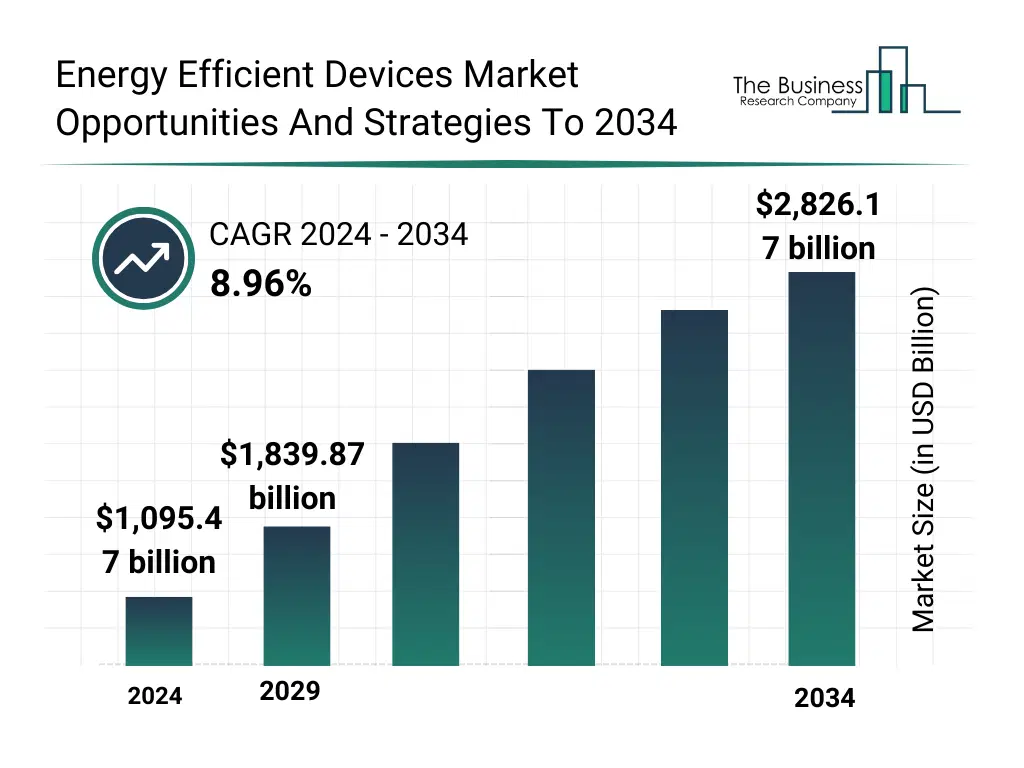
The global energy efficient devices market reached a value of nearly $1,095,469.83 million in 2024, having grown at a compound annual growth rate (CAGR) of 8.78% since 2019. The market is expected to grow from $1,095,469.83 million in 2024 to $1,839,865.38 million in 2029 at a rate of 10.93%. The market is then expected to grow at a CAGR of 8.96% from 2029 and reach $2,826,166.35 million in 2034. Growth in the historic period resulted from rising government initiatives for energy efficiency, strong rise in residential building construction, increasing number of smart meters and growing investments in the energy sector. Factors that negatively affected growth in the historic period were data privacy and cybersecurity concerns and lack of awareness and technical knowledge. Going forward, increasing demand for renewable energy, growing adoption of connected and smart homes, growing adoption of microgrids and surge in electricity cost will drive the growth. Factors that could hinder the growth of the energy efficient devices market in the future include impact of trade war and tariff, high initial investment and installation costs and fragmented standards and regulatory inconsistencies.Energy Efficient Devices Market Drivers
The key drivers of the energy efficient devices market include: Growing Adoption Of Connected And Smart Homes During the forecast period, the increasing adoption of connected and smart homes is expected to drive the growth of the energy-efficient devices market. As consumers prioritize convenience, automation, and energy conservation, the demand for smart home technologies continues to rise. These solutions such as smart thermostats, intelligent lighting systems, and energy-efficient appliances allow users to monitor and manage their energy consumption more effectively. The integration of artificial intelligence (AI) and the Internet of Things (IoT) further enhance these systems, enabling personalized energy optimization and predictive maintenance. With ongoing technological advancements and growing consumer awareness, the adoption of smart home solutions is set to accelerate, fueling demand for energy-efficient devices. The growing adoption of connected and smart homes growth contribution during the forecast period in 2024 is 2.00%.Energy Efficient Devices Market Restraints
The key restraints on the energy efficient devices market include: High Initial Investment and Installation Costs During the forecast period, the high upfront investment and installation costs associated with energy-efficient devices are expected to hinder the growth of the energy-efficient devices market. Transitioning to technologies such as heat pumps, solar panels, and electric vehicles often involves considerable initial expenses. Although government incentives and rebates are available, they often fall short of covering the full cost, reducing their effectiveness in overcoming the financial hurdle. As a result, high initial costs remain a key barrier to widespread market growth during the forecast period. Growth affected by high initial investment and installation costs during the forecast period in 2024 is -2.00%..Energy Efficient Devices Market Trends
Major trends shaping the energy efficient devices market include: Integration Of Smart Home Devices With Distributed Energy Resources (DERs) Major companies in the market are focusing on integrating smart home devices with Distributed Energy Resources (DERs) to enhance energy efficiency and system control. This integration enables real-time monitoring, automated energy optimization, and seamless interaction between devices like smart thermostats and solar batteries. As consumers seek more control over energy consumption and costs, such innovations are driving demand for intelligent, energy-efficient solutions. The ability to manage power use dynamically also supports grid stability and encourages wider adoption of DERs, further fueling market growth. For example, in May 2025, Generac Holdings Inc, a US-based leader in energy solutions, launched ecobee by Generac Smart Thermostat Enhanced with Home Energy Management, an all-new smart thermostat that integrates with Generac Home Standby Generators and Generac PWRcell 2 Solar Battery Storage Solutions to improve real-time system visibility and make home energy management more seamless for homeowners. Adoption Of AI-Powered Smart Home Energy Management Systems Major companies in the energy-efficient devices market are focusing on the development of AI-powered smart home energy management systems to optimize energy consumption and enhance user convenience. These innovations aim to provide real-time insights, predictive analytics, and seamless integration with existing home devices, while also promoting energy efficiency and sustainability. For instance, in January 2025, EcoFlow, a China-based company specializing in portable power stations and home energy solutions, launched its Oasis smart home energy management system. The system utilizes artificial intelligence to monitor electricity usage, solar generation, and weather patterns, providing homeowners with data-driven recommendations to reduce energy costs and maximize efficiency. By integrating Oasis with its existing home power technologies, EcoFlow aims to deliver a unified, efficient, and reliable energy management experience, meeting the evolving needs of energy-conscious consumers in both domestic and international markets.Opportunities And Recommendations In The Energy Efficient Devices Market
Opportunities – The top opportunities in the energy efficient devices market segmented by component will arise in the hardware segment, which will gain $391,774.75 million of global annual sales by 2029. The top opportunities in the energy efficient devices market segmented by system type will arise in the industrial energy management systems (IEMS) segment, which will gain $292,662.42 million of global annual sales by 2029. The top opportunities in the energy efficient devices market segmented by vertical will arise in the energy and power segment, which will gain $202,213.13 million of global annual sales by 2029. The energy efficient devices market size will gain the most in China at $140,581.49 million. Recommendations- To take advantage of the opportunities, The Business Research Company recommends the energy efficient devices companies to focus on integrating smart devices with distributed energy resources, focus on AI-powered smart home energy management, focus on Peltier-based hybrid cooling in refrigerators, focus on AI-powered home energy management features, focus on smart thermostats with demand response, focus on high-performance, energy-efficient home appliances, focus on software-driven energy efficiency solutions, focus on home energy management systems, focus on expanding distribution channels for energy-efficient devices, focus on competitive and value-based pricing for energy-efficient devices, focus on targeted digital and offline promotion for energy-efficient devices, focus on incentive-based and partnership promotion for energy-efficient devices and focus on residential energy efficiency solutions.Energy Efficient Devices Market Segmentation
The energy efficient devices market is segmented by component, by system type and by vertical.By Component –
The energy efficient devices market is segmented by component into:
- a) Hardware
- b) Software
- c) Services
By System Type –
The energy efficient devices market is segmented by system type into:
- a) Industrial Energy Management Systems (IEMS)
- b) Building Energy Management Systems (BEMS)
- c) Home Energy Management Systems (HEMS)
By Vertical –
The energy efficient devices market is segmented by vertical into:
- a) Residential
- b) Energy And Power
- c) Telecom And Information Technology (IT)
- d) Manufacturing
- e) Retail
- f) Healthcare
- g) Other Verticals
By Geography - The energy efficient devices market is segmented by geography into:
- • China
- • India
- • Japan
- • Australia
- • Indonesia
- • South Korea
- • USA
- • Canada
- • Brazil
- • France
- • Germany
- • UK
- • Italy
- • Spain
- • Russia
-
o Asia Pacific
o Africa