
Embodied Artificial Intelligence (AI) Market Report 2026
Global Outlook – By Component (Hardware, Software, Services), By Function (Real-Time, Standalone, Mobile, Networked), By System Size (Small Size, Medium Size, Large Size), By End-Use Industry (Automotive, Consumer Electronics, Aerospace And Defense, Healthcare, Telecommunication, Industrial, Other End-Use Industries) – Market Size, Trends, Strategies, and Forecast to 2035
Embodied Artificial Intelligence (AI) Market Overview
• Embodied Artificial Intelligence (AI) market size has reached to $3.22 billion in 2025 • Expected to grow to $7.24 billion in 2030 at a compound annual growth rate (CAGR) of 17.5% • Growth Driver: Automation And Its Impact On The Expansion Of The Market Due To Increasing Efficiency And Global Adoption Of Industrial Robots • Market Trend: Revolutionizing Human-Robot Interaction With Advanced Semi-Humanoid Service Robots For Complex Commercial Tasks • North America was the largest region in 2025.What Is Covered Under Embodied Artificial Intelligence (AI) Market?
Embodied artificial intelligence (AI) refers to AI systems integrated into physical entities, such as robots, drones, or other devices, allowing them to interact with the physical world. The embodied AI uses sensors, actuators, and other hardware to perceive, process, and act within real-world contexts. This AI is capable of physical actions, learning from its environment, and adapting to changes, making it more akin to human-like intelligence, where perception and action are tightly coupled. The main products in embodied artificial intelligence (AI) are robots, exoskeletons, autonomous systems, and smart appliances. Robots are programmable machines designed to perform tasks autonomously with minimal human input. The core technologies driving these products include machine learning, deep learning, robotic perception, and various hardware components for various end-user industries, including healthcare, industrial automation and manufacturing, automotive, logistics and supply chain, defense and security, retail, education, and others.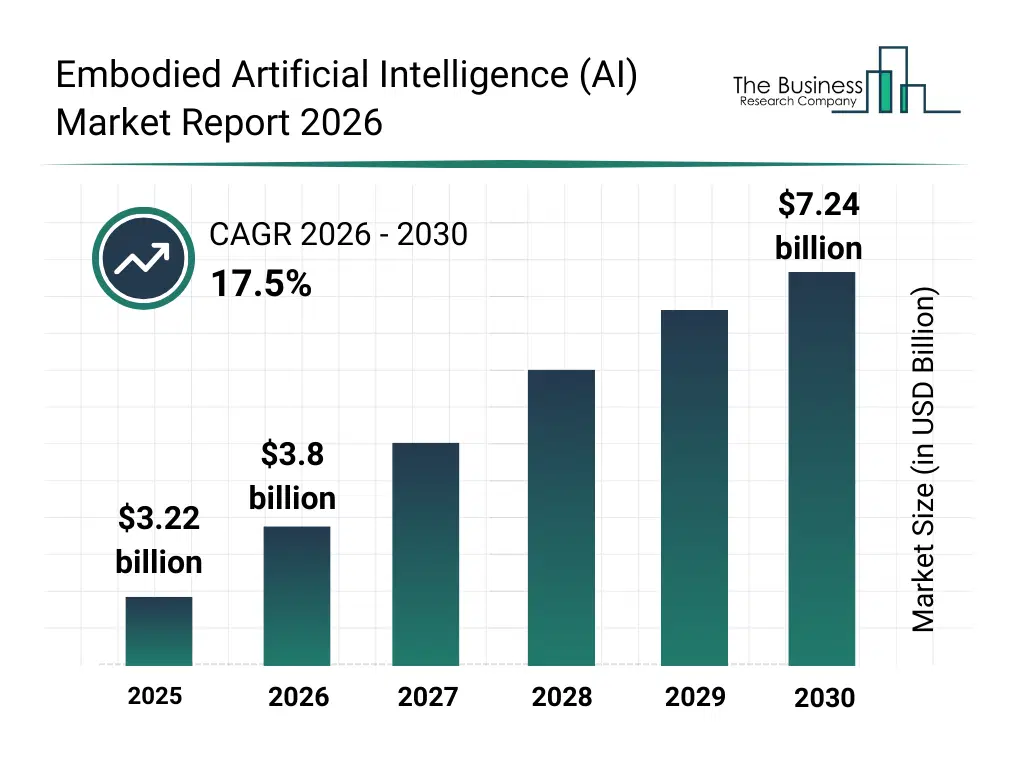
What Is The Embodied Artificial Intelligence (AI) Market Size and Share 2026?
The embodied artificial intelligence (AI) market size has grown rapidly in recent years. It will grow from $3.22 billion in 2025 to $3.8 billion in 2026 at a compound annual growth rate (CAGR) of 18.1%. The growth in the historic period can be attributed to growth in robotics adoption, increase in automation demand, expansion of AI research funding, advancement in embedded computing hardware, rising use of smart sensors.What Is The Embodied Artificial Intelligence (AI) Market Growth Forecast?
The embodied artificial intelligence (AI) market size is expected to see rapid growth in the next few years. It will grow to $7.24 billion in 2030 at a compound annual growth rate (CAGR) of 17.5%. The growth in the forecast period can be attributed to integration of next-generation robotics platforms, rising adoption of autonomous mobility systems, expansion of healthcare robotics applications, growth in intelligent logistics automation, adoption of human augmentation technologies. Major trends in the forecast period include advanced human-robot interaction, multi-sensor fusion integration, adaptive learning in physical environments, collaborative robot deployment, real-time environmental perception.
Global Embodied Artificial Intelligence (AI) Market Segmentation
1) By Component: Hardware, Software, Services 2) By Function: Real-Time, Standalone, Mobile, Networked 3) By System Size: Small Size, Medium Size, Large Size 4) By End-Use Industry: Automotive, Consumer Electronics, Aerospace And Defense, Healthcare, Telecommunication, Industrial, Other End-Use Industries Subsegments: 1) By Hardware: Microcontrollers (MCUs), Microprocessors (MPUs), Digital Signal Processors (DSPs), Application-Specific Integrated Circuits (ASICs), Field-Programmable Gate Arrays (FPGAs), Sensors, Power Management ICs 2) By Software: Real-Time Operating Systems (RTOS), Embedded Software Development Tools, Middleware, Firmware 3) By Services: Design And Development Services, Consulting Services, Maintenance And Support ServicesWhat Is The Driver Of The Embodied Artificial Intelligence (AI) Market?
The increasing demand for automation across industries is expected to propel the growth of the embodied artificial intelligence (AI) market going forward. Automation refers to using technology and control systems to perform tasks without human intervention, typically to improve efficiency, accuracy, and productivity. The increase in demand for automation is due to labor shortages, as many industries struggle to find skilled workers, prompting companies to invest in automated systems to maintain productivity and reduce dependence on human labor. Embodied artificial intelligence enhances automation by integrating physical presence and sensory perception, allowing machines to interact with and adapt to the environment in real time for more efficient and autonomous decision-making. For instance, in September 2023, according to the International Federation of Robotics, a Germany-based non-profit organization, annual industrial robot installations reached 290,258 units in 2023, surpassing the previous record set in 2021 with a 5% growth. Therefore, the increasing demand for automation across industries is driving the growth of the embodied artificial intelligence (AI) industry.Key Players In The Global Embodied Artificial Intelligence (AI) Market
Major companies operating in the embodied artificial intelligence (AI) market are Samsung Electronics Co. Ltd., DeepMind Technologies, Toshiba Corporation, NVIDIA Corporation, KUKA AG, Ocado Group plc, Unity Technologies Inc., UBTECH Robotics, Boston Dynamics Inc., Applied Intuition Inc., Avidbots Corp., Robotiq, Covariant.AI Inc., Apptronik Systems Inc., Keppler Robotics Inc., Agility Robotics Inc., Hanson Robotics Limited, Blue Frog Robotics SAS, PAL Robotics S.L.Global Embodied Artificial Intelligence (AI) Market Trends and Insights
Major companies in the embodied artificial intelligence (AI) market are focusing on developing technologically advanced solutions, such as the semi-humanoid embodied AI service robot, to enhance human-robot interaction and automation in various industries. A semi-humanoid embodied AI service robot is a robotic system designed with human-like features and capabilities, leveraging artificial intelligence to perform specific tasks or services in real-world environments with partial human-like appearance and interaction abilities. For instance, in March 2025, Pudu Robotics, a China-based commercial company, launched a FlashBot Arm designed to perform complex delivery and manipulation tasks autonomously in commercial settings, enhancing efficiency and user interaction. This robot features two 7-degree-of-freedom robotic arms with dexterous 11-degree-of-freedom hands, enabling precise manipulation tasks such as pressing buttons, grasping objects, and performing autonomous deliveries with an operational reach of up to 2 meters. It combines advanced embodied AI for real-time perception, decision-making, natural multimodal interaction, high-precision sensors, and whole-body control, making it highly adaptable and safe for complex commercial environments like hotels, offices, and healthcare facilities.What Are Latest Mergers And Acquisitions In The Embodied Artificial Intelligence (AI) Market?
In April 2024, Sanctuary Cognitive Systems Corporation, a Canada-based robotics company specializing in embodied AI, partnered with Magna International Inc. to build embodied AI robots. This partnership aims to integrate advanced humanoid robots into automotive manufacturing processes, enhancing operational efficiency, scalability, and adaptability by leveraging Sanctuary's AI-driven robots and Magna's extensive engineering and manufacturing expertise to optimize production workflows and address labor shortages. Magna International Inc. is a Canada-based mobility technology company specializing in designing, engineering, and manufacturing automotive parts and systems.Regional Insights
North America was the largest region in the embodied artificial intelligence (AI) market in 2025. The regions covered in this market report are Asia-Pacific, South East Asia, Western Europe, Eastern Europe, North America, South America, Middle East, Africa. The countries covered in this market report are Australia, Brazil, China, France, Germany, India, Indonesia, Japan, Taiwan, Russia, South Korea, UK, USA, Canada, Italy, Spain.What Defines the Embodied Artificial Intelligence (AI) Market?
The embodied artificial intelligence (AI) market consists of revenues earned by entities by providing services such as personal assistance, healthcare support, human-robot interaction, context-aware decision-making, and logistics and warehousing. The market value includes the value of related goods sold by the service provider or included within the service offering. The embodied artificial intelligence (AI) market also consists of sales of products including intelligent virtual assistants, AI-enhanced drones, social robots, smart consumer appliances, and smart wearables. Values in this market are ‘factory gate’ values, that is, the value of goods sold by the manufacturers or creators of the goods, whether to other entities (including downstream manufacturers, wholesalers, distributors, and retailers) or directly to end customers. The value of goods in this market includes related services sold by the creators of the goods.How is Market Value Defined and Measured?
The market value is defined as the revenues that enterprises gain from the sale of goods and/or services within the specified market and geography through sales, grants, or donations in terms of the currency (in USD unless otherwise specified). The revenues for a specified geography are consumption values that are revenues generated by organizations in the specified geography within the market, irrespective of where they are produced. It does not include revenues from resales along the supply chain, either further along the supply chain or as part of other products.What Key Data and Analysis Are Included in the Embodied Artificial Intelligence (AI) Market Report 2026?
The embodied artificial intelligence (ai) market research report is one of a series of new reports from The Business Research Company that provides market statistics, including industry global market size, regional shares, competitors with the market share, detailed market segments, market trends and opportunities, and any further data you may need to thrive in the embodied artificial intelligence (ai) industry. The market research report delivers a complete perspective of everything you need, with an in-depth analysis of the current and future state of the industry.Embodied Artificial Intelligence (AI) Market Report Forecast Analysis
| Report Attribute | Details |
|---|---|
| Market Size Value In 2026 | $3.8 billion |
| Revenue Forecast In 2035 | $7.24 billion |
| Growth Rate | CAGR of 18.1% from 2026 to 2035 |
| Base Year For Estimation | 2025 |
| Actual Estimates/Historical Data | 2020-2025 |
| Forecast Period | 2026 - 2030 - 2035 |
| Market Representation | Revenue in USD Billion and CAGR from 2026 to 2035 |
| Segments Covered | Component, Function, System Size, End-Use Industry |
| Regional Scope | Asia-Pacific, Western Europe, Eastern Europe, North America, South America, Middle East, Africa |
| Country Scope | The countries covered in the report are Australia, Brazil, China, France, Germany, India, ... |
| Key Companies Profiled | Samsung Electronics Co. Ltd., DeepMind Technologies, Toshiba Corporation, NVIDIA Corporation, KUKA AG, Ocado Group plc, Unity Technologies Inc., UBTECH Robotics, Boston Dynamics Inc., Applied Intuition Inc., Avidbots Corp., Robotiq, Covariant.AI Inc., Apptronik Systems Inc., Keppler Robotics Inc., Agility Robotics Inc., Hanson Robotics Limited, Blue Frog Robotics SAS, PAL Robotics S.L. |
| Customization Scope | Request for Customization |
| Pricing And Purchase Options | Explore Purchase Options |