
Electrical Digital Twin Market Report 2026
Electrical Digital Twin Market Report 2026
Global Outlook – By Component (Software Platforms, Digital Twin Models And Simulation Tools, Integrated Software And Implementation Packages), By Deployment Mode (Cloud, On-Premises), By Usage Type (Product Digital Twin, Process Digital Twin, System Digital Twin), By Application (Asset Performance Management, Business And Operations Optimization, Fault Detection And Predictive Maintenance, Performance Optimization, Other Applications), By End-User (Utilities, Grid Infrastructure Operators, Other End-Users) – Market Size, Trends, Strategies, and Forecast to 2035
Electrical Digital Twin Market Overview
• Electrical Digital-twin-global-market-report" target="_blank">Digital Twin market size has reached to $7.21 billion in 2025 • Expected to grow to $19.31 billion in 2030 at a compound annual growth rate (CAGR) of 21.8% • Growth Driver: Increasing Demand For Real-Time Electrical System Monitoring Driving Market Growth • Market Trend: Innovations In Real-Time Grid Monitoring Technologies Enhance Operational Visibility And Performance • North America was the largest region in 2025 and Asia-Pacific is the fastest growing region.

What Is Covered Under Electrical Digital Twin Market?
An electrical digital twin is a virtual representation of electrical systems that integrates real-time operational data with simulation models and advanced analytics to continuously monitor, evaluate, and enhance system performance. This technology supports improved reliability, higher efficiency, predictive maintenance, and more informed decision-making across electrical networks and infrastructure. The main components of electrical digital twin include software platforms, digital twin models and simulation tools, and integrated software and implementation packages. Software platforms refer to digital systems that create virtual replicas of electrical assets and infrastructure for monitoring and analysis. These are deployed through cloud and on-premises modes and are categorized into product digital twin, process digital twin, and system digital twin. These are used for asset performance management, business and operations optimization, fault detection and predictive maintenance, performance optimization, and other applications and are adopted by utilities, grid infrastructure operators, and other end-users.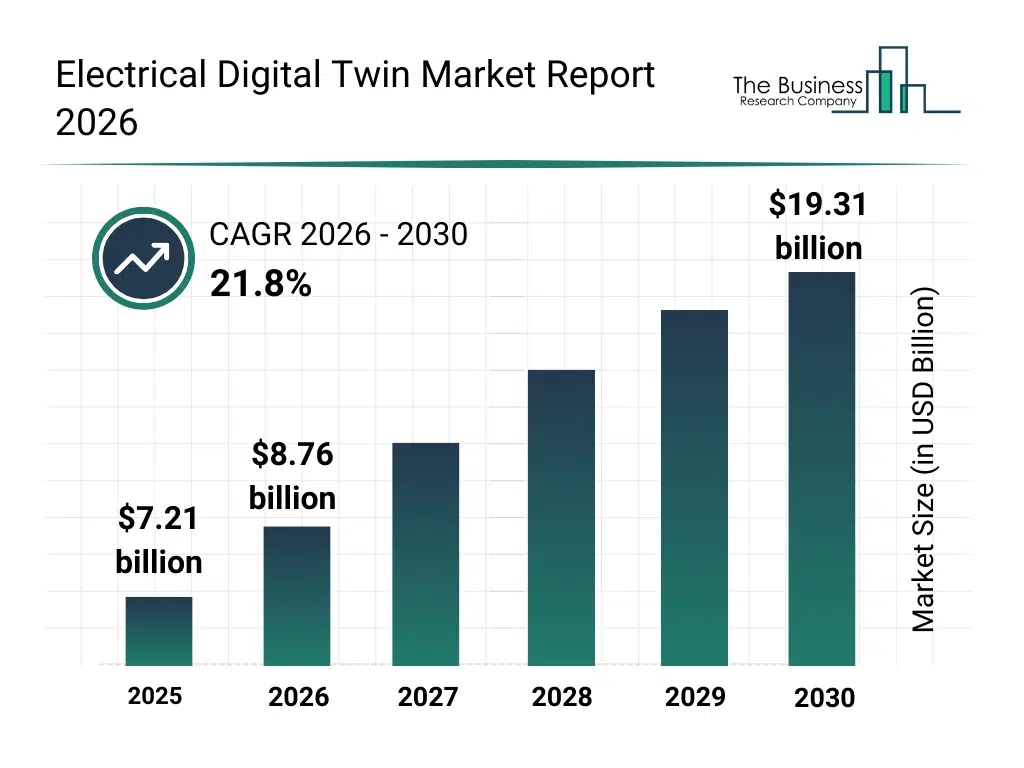
What Is The Electrical Digital Twin Market Size and Share 2026?
The electrical digital twin market size has grown exponentially in recent years. It will grow from $7.21 billion in 2025 to $8.76 billion in 2026 at a compound annual growth rate (CAGR) of 21.6%. The growth in the historic period can be attributed to increasing demand for reliable grid infrastructure, rising investment in electrical network modernization, adoption of real-time monitoring technologies, growth in industrial automation, need for enhanced operational efficiency.What Is The Electrical Digital Twin Market Growth Forecast?
The electrical digital twin market size is expected to see exponential growth in the next few years. It will grow to $19.31 billion in 2030 at a compound annual growth rate (CAGR) of 21.8%. The growth in the forecast period can be attributed to expansion of smart grid and microgrid systems, increasing adoption of ai-driven analytics for fault detection, rising deployment of cloud-based digital twin platforms, growing demand for predictive maintenance in utilities, integration of energy management systems with digital twin solutions. Major trends in the forecast period include rising adoption of predictive maintenance solutions, increasing integration of real-time monitoring platforms, growth in cloud-based digital twin deployments, expansion of energy management and optimization tools, rising focus on customization and lifecycle management solutions.Global Electrical Digital Twin Market Segmentation
1) By Component: Software Platforms, Digital Twin Models And Simulation Tools, Integrated Software And Implementation Packages 2) By Deployment Mode: Cloud, On-Premises 3) By Usage Type: Product Digital Twin, Process Digital Twin, System Digital Twin 4) By Application: Asset Performance Management, Business And Operations Optimization, Fault Detection And Predictive Maintenance, Performance Optimization, Other Applications 5) By End-User: Utilities, Grid Infrastructure Operators, Other End-Users Subsegments: 1) By Software Platforms: Real Time Monitoring Platforms, Asset Performance Management Platforms, Energy Management Platforms, Data Integration And Visualization Platforms, Cloud Based Digital Twin Platforms 2) By Digital Twin Models And Simulation Tools: Electrical Network Simulation Tools, Load Flow Analysis Models, Fault Detection And Diagnosis Models, Predictive Maintenance Simulation Tools, Scenario Planning And Optimization Models 3) By Integrated Software And Implementation Packages: System Integration Packages, End To End Digital Twin Deployment Packages, Customization And Configuration Packages, Lifecycle Management Solutions, Support And Maintenance PackagesWhat Is The Driver Of The Electrical Digital Twin Market?
The expansion of renewable energy is expected to propel the growth of the electrical digital twin market going forward. Renewable energy expansion refers to the increase in power generation capacity from renewable sources such as solar, wind, hydropower, and other clean energy technologies. The growing deployment of renewable energy is primarily driven by declining equipment costs and favorable government policies, as lower installation expenses and tax incentives make renewable projects increasingly economically viable. This expansion creates higher demand for digital twin solutions that enable real-time monitoring, predictive maintenance, and performance optimization of renewable energy infrastructure. For instance, in January 2024, according to the U.S. Energy Information Administration, a US-based federal agency responsible for collecting and analyzing energy information, planned solar initiatives are expected to boost the electric power sector's solar capacity by 38%, rising from 95 gigawatts (GW) at the close of 2023 to 131 GW by the end of 2024. Therefore, the expansion of renewable energy is driving the growth of the electrical digital twin industry.Key Players In The Global Electrical Digital Twin Market
Major companies operating in the electrical digital twin market are Microsoft Corporation, Robert Bosch GmbH, Siemens Aktiengesellschaft, Hitachi Ltd., International Business Machines Corporation, NVIDIA Corporation, Cisco Systems Inc., Oracle Corporation, Schneider Electric SE, Honeywell International Inc., SAP SE, GE Vernova Inc., Eaton Corporation plc, Fujitsu Limited, Emerson Electric Co., Wipro Limited, Rockwell Automation Inc., Dassault Systemes SE, Synopsys Inc., Autodesk Inc., SAS Institute Inc., Bentley Systems Incorporated, and Etteplan Oyj.Global Electrical Digital Twin Market Trends and Insights
Major companies operating in the electrical digital twin market are focusing on developing advanced solutions, such as real-time grid monitoring systems, to deliver detailed real-time insights into electrical network conditions. Real-time grid monitoring systems refer to advanced hardware and software solutions that continuously capture, analyze, and visualize electrical parameters such as voltage, current, frequency, and phase angle across transmission and distribution networks to support rapid decision-making and system stability. Electrical digital twin solutions leverage these technologies to feed real-time data into virtual models, enabling utilities to improve situational awareness, forecast potential issues, and optimize network performance. For instance, in August 2024, Hitachi Energy, a Switzerland-based energy technology company, introduced its modernized Network Manager Wide Area Monitoring System (WAMS), which integrates high-frequency phasor measurement unit data with supervisory control and data acquisition platforms, provides unified real-time visualization through a common interface, and enhances proactive control room operations to detect and address disturbances before they escalate.What Are Latest Mergers And Acquisitions In The Electrical Digital Twin Market?
In October 2024, SP Energy Networks, a UK-based electricity network operator, acquired Derryherk for an undisclosed amount. With this acquisition, SP Energy Networks sought to accelerate advanced electrical digital twin deployment and strengthen grid monitoring, modelling, and operations by integrating Derryherk’s technology for real-time data connectivity, fault detection, load forecasting, and active low-voltage network management in support of its net-zero strategy. Derryherk is a UK-based private digital twin technology company that specializes in digital twin modelling and associated software to improve electrical network visibility and performance analysis.Regional Insights
North America was the largest region in the electrical digital twin market in 2025. Asia-Pacific is expected to be the fastest-growing region in the forecast period. The regions covered in this market report are Asia-Pacific, South East Asia, Western Europe, Eastern Europe, North America, South America, Middle East, Africa. The countries covered in this market report are Australia, Brazil, China, France, Germany, India, Indonesia, Japan, Taiwan, Russia, South Korea, UK, USA, Canada, Italy, Spain.What Defines the Electrical Digital Twin Market?
The electrical digital twin market consists of revenues earned by entities by providing services such as real-time electrical system monitoring, predictive maintenance and fault detection, performance analysis, and optimization. The market value includes the value of related goods sold by the service provider or included within the service offering. The electrical digital twin market also includes sales of smart sensors, smart meters, programmable logic controllers (PLCs), remote terminal units (RTUs), industrial IoT gateways. Values in this market are ‘factory gate’ values, that is, the value of goods sold by the manufacturers or creators of the goods, whether to other entities (including downstream manufacturers, wholesalers, distributors, and retailers) or directly to end customers. The value of goods in this market includes related services sold by the creators of the goods.How is Market Value Defined and Measured?
The market value is defined as the revenues that enterprises gain from the sale of goods and/or services within the specified market and geography through sales, grants, or donations in terms of the currency (in USD unless otherwise specified). The revenues for a specified geography are consumption values that are revenues generated by organizations in the specified geography within the market, irrespective of where they are produced. It does not include revenues from resales along the supply chain, either further along the supply chain or as part of other products.What Key Data and Analysis Are Included in the Electrical Digital Twin Market Report 2026?
The electrical digital twin market research report is one of a series of new reports from The Business Research Company that provides electrical digital twin market statistics, including electrical digital twin industry global market size, regional shares, competitors with a electrical digital twin market share, detailed electrical digital twin market segments, market trends and opportunities, and any further data you may need to thrive in the electrical digital twin industry. This electrical digital twin market research report delivers a complete perspective of everything you need, with an in-depth analysis of the current and future scenario of the industry.Electrical Digital Twin Market Report Forecast Analysis
| Report Attribute | Details |
|---|---|
| Market Size Value In 2026 | $8.76 billion |
| Revenue Forecast In 2035 | $19.31 billion |
| Growth Rate | CAGR of 21.6% from 2026 to 2035 |
| Base Year For Estimation | 2025 |
| Actual Estimates/Historical Data | 2020-2025 |
| Forecast Period | 2026 - 2030 - 2035 |
| Market Representation | Revenue in USD Billion and CAGR from 2026 to 2035 |
| Segments Covered | Component, Deployment Mode, Usage Type, Application, End-User |
| Regional Scope | Asia-Pacific, Western Europe, Eastern Europe, North America, South America, Middle East, Africa |
| Country Scope | The countries covered in the report are Australia, Brazil, China, France, Germany, India, ... |
| Key Companies Profiled | Microsoft Corporation, Robert Bosch GmbH, Siemens Aktiengesellschaft, Hitachi Ltd., International Business Machines Corporation, NVIDIA Corporation, Cisco Systems Inc., Oracle Corporation, Schneider Electric SE, Honeywell International Inc., SAP SE, GE Vernova Inc., Eaton Corporation plc, Fujitsu Limited, Emerson Electric Co., Wipro Limited, Rockwell Automation Inc., Dassault Systemes SE, Synopsys Inc., Autodesk Inc., SAS Institute Inc., Bentley Systems Incorporated, and Etteplan Oyj. |
| Customization Scope | Request for Customization |
| Pricing And Purchase Options | Explore Purchase Options |
Frequently Asked Questions
The Electrical Digital Twin market was valued at $7.21 billion in 2025, increased to $8.76 billion in 2026, and is projected to reach $19.31 billion by 2030.
request a sample hereThe global Electrical Digital Twin market is expected to grow at a CAGR of 21.8% from 2026 to 2035 to reach $19.31 billion by 2035.
request a sample hereSome Key Players in the Electrical Digital Twin market Include, Microsoft Corporation, Robert Bosch GmbH, Siemens Aktiengesellschaft, Hitachi Ltd., International Business Machines Corporation, NVIDIA Corporation, Cisco Systems Inc., Oracle Corporation, Schneider Electric SE, Honeywell International Inc., SAP SE, GE Vernova Inc., Eaton Corporation plc, Fujitsu Limited, Emerson Electric Co., Wipro Limited, Rockwell Automation Inc., Dassault Systemes SE, Synopsys Inc., Autodesk Inc., SAS Institute Inc., Bentley Systems Incorporated, and Etteplan Oyj..
request a sample hereMajor trend in this market includes: Innovations In Real-Time Grid Monitoring Technologies Enhance Operational Visibility And Performance. For further insights on this market.
request a sample hereNorth America was the largest region in the electrical digital twin market in 2025. Asia-Pacific is expected to be the fastest-growing region in the forecast period. The regions covered in the electrical digital twin market report are Asia-Pacific, South East Asia, Western Europe, Eastern Europe, North America, South America, Middle East, Africa.
request a sample here