
Electric Bikes And Scooters (Excluding E-Mopeds Or 2 Wheelers) Market 2026
Electric Bikes And Scooters (Excluding E-Mopeds Or 2 Wheelers) Market 2026
By Product Type (Electric Bikes, Electric Scooters), By Battery (Lead Acid, Lithium Ion (Li-Ion), Nickel-Metal Hydride (Nimh), Other Batteries.), By Voltage Capacity (48-59v, 60-72v, 73-96v, Above 96v), By Power Range (Low Power (Up To 250 Watts), Medium Power (251 Watts To 750 Watts), High Power (Above 750 Watts)), By Application (Consumer, Commercial), And By Region, Opportunities And Strategies – Global Forecast To 2035
Electric Bikes And Scooters (Excluding E-Mopeds Or 2 Wheelers) Market Definition
The electric bikes and scooters (excluding e-mopeds or 2 wheelers) refers to a category of light electric vehicles designed primarily for individual mobility and small-scale commercial use. These vehicles include electric bicycles, which integrate electric motors with pedaling mechanisms and electric scooters, which are powered solely by electric motors but do not include-mopeds or larger two-wheeled vehicles that resemble motorcycles. The primary users of electric bikes and scooters are individual consumers who use them for commuting, errands and recreation, as well as commercial entities that utilize them for fleet-based services such as food delivery, parcel logistics and ride-sharing or rental platforms. The electric bikes and scooters (excluding e-mopeds or 2 wheelers) market consists of sales, by entities (organizations, sole traders, or partnerships), of electric bikes and scooters (excluding e-mopeds or 2 wheelers) that are typically used in urban, suburban and campus settings, where their compact form factor and low operating costs make them an efficient alternative to cars or public transportation for short to medium distances.
%20Market%202026&content_id=d03097df-74b9-48eb-93eb-dcd1ddad7b07&price=4490&discount=0&image=https%3A%2F%2Fd1lt5802h39cn9.cloudfront.net%2Fcoverimages%2FONS_electric_bikes_and_scooters_excluding_e_mopeds_or_2_wheelers_market.webp)
Electric Bikes And Scooters (Excluding E-Mopeds Or 2 Wheelers) Market Size
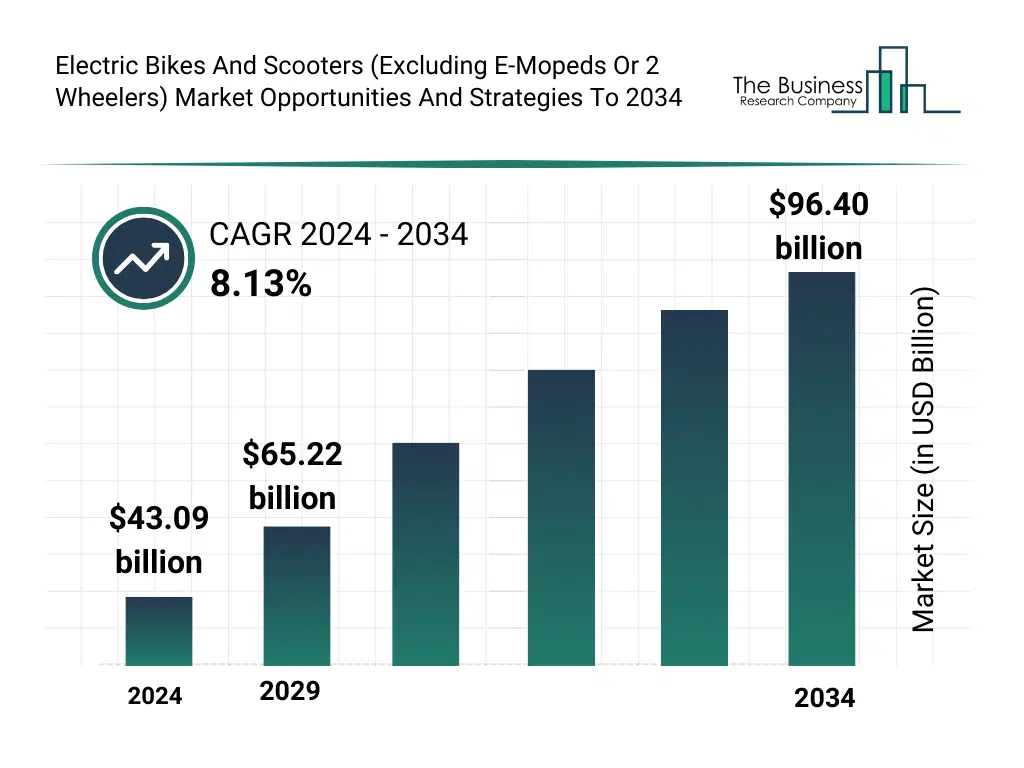
The global electric bikes and scooters (excluding e-mopeds or 2 wheelers) market reached a value of nearly $43,093.10 million in 2024, having grown at a compound annual growth rate (CAGR) of 12.12% since 2019. The market is expected to grow from $43,093.10 million in 2024 to $65,221.42 million in 2029 at a rate of 8.64%. The market is then expected to grow at a CAGR of 8.13% from 2029 and reach $96,399.67 million in 2034. Growth in the historic period resulted from the expansion of smart city initiatives, rising traffic congestion, growth in shared mobility services and rising environmental awareness. Factors that negatively affected growth in the historic period were safety concerns and risk perception and inadequate public facilities. Going forward, the expansion of charging infrastructure, increased focus on last-mile connectivity, increasing demand for sustainable transportation and rising fuel prices will drive the growth. Factor that could hinder the growth of the electric bikes and scooters (excluding e-mopeds or 2 wheelers) market in the future include competition from alternatives, high upfront cost and impact of trade war and tariff.Electric Bikes And Scooters (Excluding E-Mopeds Or 2 Wheelers) Market Drivers
The key drivers of the electric bikes and scooters (excluding e-mopeds or 2 wheelers) market include: Increasing Demand For Sustainable Transportation During the forecast period, the increasing demand for sustainable transportation will significantly drive the growth of the electric bikes and scooters (excluding e-mopeds or two-wheelers) market. Sustainable transport aims to minimize greenhouse gas emissions and environmental impacts while ensuring safety, affordability and equitable access to mobility for all. This approach integrates technology, infrastructure, planning, policy and behavior change to reduce emissions while enhancing connectivity. Electric bikes and scooters align with these objectives by offering low-emission alternatives to traditional vehicles, thereby contributing to climate change mitigation efforts. As countries and cities prioritize sustainable transport solutions, the adoption of electric micromobility options is expected to increase, further propelling market growth. The increasing demand for sustainable transportation contribution during the forecast period in 2024 is 1.25%.Electric Bikes And Scooters (Excluding E-Mopeds Or 2 Wheelers) Market Restraints
The key restraints on the electric bikes and scooters (excluding e-mopeds or 2 wheelers) market include: High Upfront Cost High upfront cost is restricting the growth of the electric bikes and scooters (excluding e-mopeds or two-wheelers) market during the forecast period. Electric bikes and scooters often come with a higher purchase price compared to traditional bicycles or scooters, which can be a significant barrier for potential buyers. This high cost is compounded by the additional expenses for batteries, maintenance and accessories. From a consumer perspective, affordability remains a key factor, particularly in regions where disposable income is limited or where government subsidies for electric mobility are minimal. As a result, many potential users are delaying or avoiding the adoption of electric bikes and scooters, despite their environmental and convenience benefits. This cost barrier is gradually limiting the market’s growth, particularly in areas where upfront affordability is a primary consideration. Growth affected by high upfront cost during the forecast period in 2024 is -3.64%.Electric Bikes And Scooters (Excluding E-Mopeds Or 2 Wheelers) Market Trends
Major trends shaping the electric bikes and scooters (excluding e-mopeds or 2 wheelers) market include: Introduction Of High-Performance All-Terrain Electric Scooters With Enhanced Suspension Systems Companies manufacturing electric bikes and scooters (excluding e-mopeds or 2 wheelers) are focusing on developing high-performance all-terrain electric scooters with enhanced suspension systems for improved ride quality. These scooters, designed for both urban commuting and off-road adventures, feature advanced technology such as powerful motors, enhanced suspension systems and larger all-terrain tires, making them suitable for various terrains. For instance, in October 2024, Segway, a US-based company specializing in electric bikes and scooters, launched the ZT3 Pro All-Terrain Electric Scooter, designed for both urban commuting and off-road exploration. This innovative scooter is powered by a robust 1600-watt motor, enabling it to reach speeds of up to 25 km/h and tackle steep inclines of up to 25%. The ZT3 Pro features advanced suspension systems, including a telescopic front fork and rear coil suspension, ensuring a smooth ride over rugged terrain. It is equipped with impressive specifications, such as 11-inch all-terrain tubeless tires, a 152 mm ground clearance and a maximum range of 70 km in Eco Mode. Additionally, the scooter incorporates smart technology, including the AirLock System for autonomous locking and integration with Apple’s Find My network for easy tracking. With its durable design and comprehensive safety features, the ZT3 Pro aims to provide riders with a confident and versatile experience across various terrains. Technological Advancements To Improve Safety And Performance Major companies operating in the electric bikes and scooters (excluding e-mopeds or 2 wheelers) market are focusing on advanced technological solutions to strengthen their position in the market. For example, in March 2023, Cube, a German bicycle brand that offers e-bikes, launched four different e-bikes with advanced technology from Bosch’s e-bike ABS system. The advanced technology is designed to provide cyclists with improved safety and performance, ensuring a comfortable, safe and stress-free ride. Bosch’s second-generation ABS is fully compatible with Magura’s MT-C ABS brakes, to modulate front brake power for optimal braking performance and rider safety. Further, in February 2023, Niche Mobility, a Spain-based start-up, introduced regenerative breaking as part of a radical new e-bike system called the Automatic Digital Transmission System (ADTC). ADTC offers an automatic transmission for e-bikes, giving riders greater autonomy and more power, increasing engine torque, saving weight, regenerative braking and an anti-theft system. These features offer a cycling as transport-based user group more safety and comfort when riding an e- bike, as well as a much lower maintenance cost.Opportunities And Recommendations In The Electric Bikes And Scooters (Excluding E-Mopeds Or 2 Wheelers) Market
Opportunities – The top opportunities in the electric bikes and scooters (excluding e-mopeds or 2 wheelers) markets segmented by product will arise in the electric bikes segment, which will gain $17,426.69 million of global annual sales by 2029. The top opportunities in the electric bikes and scooters (excluding e-mopeds or 2 wheelers) markets segmented by battery will arise in the lithium-ion (Li-ion) segment, which will gain $22,452.60 million of global annual sales by 2029. The top opportunities in the electric bikes and scooters (excluding e-mopeds or 2 wheelers) markets segmented by voltage capacity will arise in the 48–59V segment, which will gain $16,534.23 million of global annual sales by 2029. The top opportunities in the electric bikes and scooters (excluding e-mopeds or 2 wheelers) markets segmented by power range will arise in the medium power (251–750 watts) segment, which will gain $9,440.10 million of global annual sales by 2029. The top opportunities in the electric bikes and scooters (excluding e-mopeds or 2 wheelers) markets segmented by application will arise in the consumer segment, which will gain $12,986.27 million of global annual sales by 2029. Recommendations- To take advantage of the opportunities, The Business Research Company recommends the electric bikes and scooters (excluding e-mopeds or 2 wheelers) companies to focus on iot-led security and service integration to build scale and trust , focus on high-performance electric mountain bikes to capture premium demand, focus on high-performance all-terrain electric scooters to expand use cases, focus on smart e-bikes to enhance urban mobility and user engagement, focus on ai-enabled e-bikes and e-scooters to improve safety and efficiency, focus on advanced safety and performance technologies to strengthen market position, focus on expanding electric bike offerings to capture the fastest-growing segment, focus on lithium-ion battery adoption for growth in electric bikes and scooters, focus on above 96v electric bikes and scooters for high-growth opportunities, focus on high-power electric bikes and scooters for performance-driven growth, focus on expanding omnichannel distribution for electric bikes and scooters, focus on strategic and tiered pricing for electric bikes and scooters, focus on integrated digital and experiential promotion, focus on targeted segmentation and data-driven campaigns, focus on commercial electric bikes and scooters for rapid market expansion.Electric Bikes And Scooters (Excluding E-Mopeds Or 2 Wheelers) Market Segmentation
The electric bikes and scooters (excluding e-mopeds or 2 wheelers) market is segmented by by product, by battery, by voltage capacity, by power range and by application.By Product –
The electric bikes and scooters (excluding e-mopeds or 2 wheelers) market is segmented by product into:
- a) Electric Bikes
- b) Electric Scooters
By Battery –
The electric bikes and scooters (excluding e-mopeds or 2 wheelers) market is segmented by battery into:
- a) Lead Acid
- b) Lithium Ion (Li-Ion)
- c) Nickel-Metal Hydride (Nimh)
- d) Other Batteries s
By Voltage Capacity –
The electric bikes and scooters (excluding e-mopeds or 2 wheelers) market is segmented by voltage capacity into:
- a) 48-59V
- b) 60-72V
- c) 73-96V
- d) Above 96V
By Power Range –
The electric bikes and scooters (excluding e-mopeds or 2 wheelers) market is segmented by power range into:
- a) Low Power (Up To 250 Watts)
- b) Medium Power (251 Watts To 750 Watts)
- c) High Power (Above 750 Watts)
By Application –
The electric bikes and scooters (excluding e-mopeds or 2 wheelers) market is segmented by application into:
- a) Consumer
- b) Commercial
By Geography - The electric bikes and scooters (excluding e-mopeds or 2 wheelers) market is segmented by geography into:
- • China
- • India
- • Japan
- • Australia
- • Indonesia
- • South Korea
- • Bangladesh
- • Thailand
- • Vietnam
- • Malaysia
- • Singapore
- • Phillipines
- • Hong kong
- • New Zealand
- • USA
- • Canada
- • Mexico
- • Brazil
- • Argentina
- • Chile
- • Colombiia
- • Peru
- • France
- • Germany
- • UK
- • Italy
- • Spain
- • Austria
- • Belgium
- • Denmark
- • Finland
- • Ireland
- • Netherland
- • Norway
- • Portugal
- • Sweden
- • Switzerland
- • Russia
- • Czech Republic
- • Poland
- • Romania
- • Ukraine
- • Saudi Arabia
- • Israel
- • Iran
- • Turkey
- • UAE o Africa
- • Egypt
- • Nigeria
- • South Africa
-
o Asia Pacific