
Digital Twin Railway Market Report 2026
Digital Twin Railway Market Report 2026
Global Outlook – By Component Type (Software, Hardware, Services), By Railway Type (Passenger Rail, Freight Rail, Urban Transit, Other Railway Types), By Deployment Mode (On-Premises, Cloud), By Application Type (Asset Management, Predictive Maintenance, Performance Monitoring, Simulation And Modeling, Other Applications), By End-User Type (Railway Operators, Infrastructure Managers, Rolling Stock Manufacturers, Other End-Users) – Market Size, Trends, Strategies, and Forecast to 2035
Digital Twin Railway Market Overview
• Digital Twin Railway market size has reached to $1.69 billion in 2025 • Expected to grow to $3.15 billion in 2030 at a compound annual growth rate (CAGR) of 13.3% • Growth Driver: Expansion Of Smart City Projects Driving The Market Growth Due To Increasing Government Infrastructure Investment • Market Trend: Advancing Smart Rail Infrastructure Through Real-Time Simulation And Predictive Intelligence • North America was the largest region in 2025 and Asia-Pacific is the fastest growing region.

What Is Covered Under Digital Twin Railway Market?
A digital twin railway is a virtual representation of a Railway System that mirrors its physical assets, operations, and conditions using real-time and historical data. It enables simulation, monitoring, and analysis of infrastructure and train behavior across the entire network. The digital model supports better planning, optimization, risk reduction, and predictive maintenance throughout the railway lifecycle. The main component types of digital twin railway include software, hardware, and services. Software refers to simulation and analytics platforms that generate digital replicas of railway assets and operations for monitoring and optimization. The railway types include passenger rail, freight rail, urban transit, and other railway types and are deployed through on-premises and cloud modes. These are used for asset management, predictive maintenance, performance monitoring, simulation and modeling, and other applications and are adopted by railway operators, infrastructure managers, rolling stock manufacturers, and other end-users.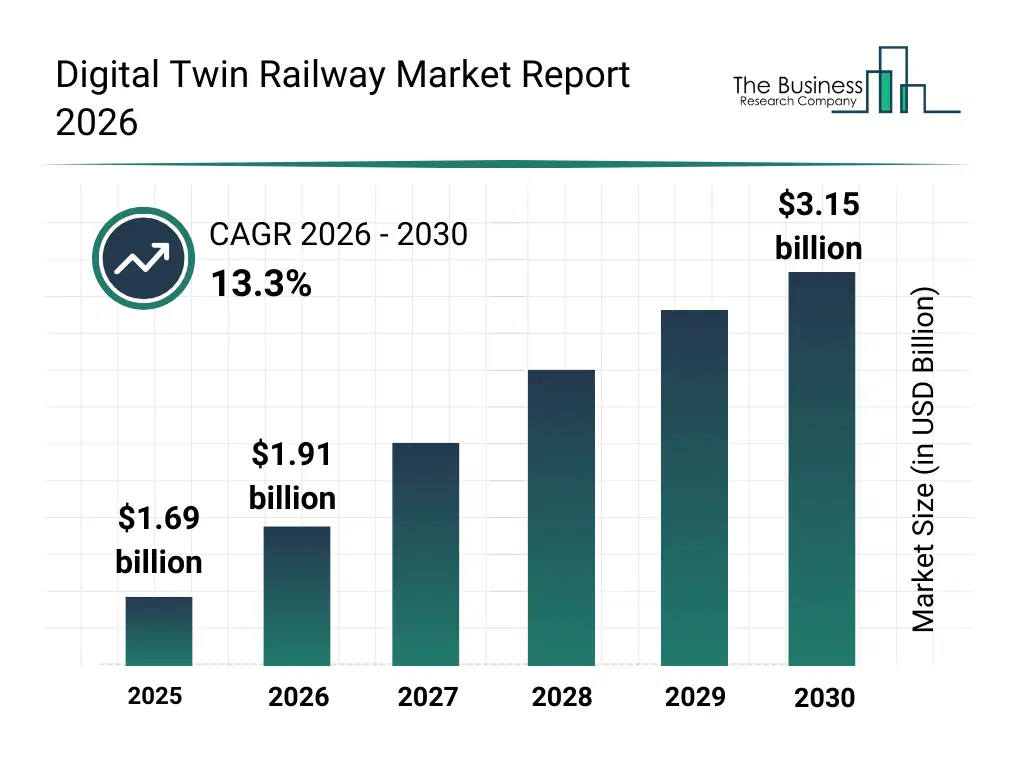
What Is The Digital Twin Railway Market Size and Share 2026?
The digital twin railway market size has grown rapidly in recent years. It will grow from $1.69 billion in 2025 to $1.91 billion in 2026 at a compound annual growth rate (CAGR) of 13.0%. The growth in the historic period can be attributed to increasing railway infrastructure investments, rising adoption of basic monitoring and control systems, growth in passenger and freight rail traffic, advances in sensor and data acquisition technologies, increasing demand for operational efficiency.What Is The Digital Twin Railway Market Growth Forecast?
The digital twin railway market size is expected to see rapid growth in the next few years. It will grow to $3.15 billion in 2030 at a compound annual growth rate (CAGR) of 13.3%. The growth in the forecast period can be attributed to expansion of high-speed rail networks, rising deployment of predictive maintenance and ai-based analytics, growth in smart urban transit systems, increasing integration of cloud-based and iot platforms, adoption of autonomous and remotely monitored railway operations. Major trends in the forecast period include increasing adoption of predictive maintenance solutions, growing demand for real-time railway simulation and optimization, expansion of cloud-based digital twin platforms, rising focus on training and capacity building services, integration of advanced communication and monitoring devices.Global Digital Twin Railway Market Segmentation
1) By Component Type: Software, Hardware, Services 2) By Railway Type: Passenger Rail, Freight Rail, Urban Transit, Other Railway Types 3) By Deployment Mode: On-Premises, Cloud 4) By Application Type: Asset Management, Predictive Maintenance, Performance Monitoring, Simulation And Modeling, Other Applications 5) By End-User Type: Railway Operators, Infrastructure Managers, Rolling Stock Manufacturers, Other End-Users Subsegments: 1) By Software: Simulation Software, Data Analytics Software, Asset Management Software 2) By Hardware: Sensors, Controllers, Communication Devices 3) By Services: Consulting Services, Implementation Services, Maintenance ServicesWhat Is The Driver Of The Digital Twin Railway Market?
The expansion of smart city projects is expected to propel the growth of the digital twin railway market going forward. Smart city projects are urban development initiatives that utilize advanced technologies such as Internet of Things (IoT), artificial intelligence, and data analytics to improve transportation efficiency, safety, and overall quality of life. Smart city projects are rising due to rapid urbanization because growing urban populations put pressure on infrastructure and services, driving cities to adopt smart technologies to improve efficiency, sustainability, and quality of life. Digital twin railway drives smart city projects by creating a real-time, data-driven virtual replica of rail infrastructure and operations that enables predictive maintenance, optimized mobility, energy efficiency, and seamless integration with urban systems to improve sustainability, safety, and quality of life across the city. For instance, in January 2024, the Institute of the Americas, a US-based non-profit organization, reported that global investment in smart city initiatives was projected to top $190 billion in 2023. Therefore, the expansion of smart city projects is driving the growth of the digital twin railway industry.Key Players In The Global Digital Twin Railway Market
Major companies operating in the digital twin railway market are Siemens AG, Hitachi Ltd., IBM Corporation, Cisco Systems Inc., Schneider Electric SE, SAP SE, ABB Ltd., Toshiba Infrastructure Systems & Solutions Corporation, Thales S.A., Alstom SA, Emerson Electric Co., Wabtec Corporation, Rockwell Automation Inc., Dassault Systèmes SE, Autodesk Inc., Indra Sistemas S.A., Bentley Systems Incorporated, Cyient Ltd., SimPlan AG, and The AnyLogic Company LLC.Global Digital Twin Railway Market Trends and Insights
Major companies operating in the digital twin railway market are focusing on developing innovative solutions such as real-time digital twin platforms integrated with simulation to enable predictive maintenance, optimize energy use, enhance safety, and improve overall railway operational efficiency. Real-time digital twin platforms integrated with simulation are virtual replicas of railway assets that continuously ingest live sensor and operational data to model, predict, and optimize system behavior, helping operators proactively manage maintenance, energy consumption, safety risks, and passenger flows. For instance, in June 2025, Akila, a France-based digital twin and AI platform provider, partnered with SNCF, a France-based railway company, to launch an AI-powered real-time digital twin platform at the Monte-Carlo train station in Monaco. The platform integrates high-fidelity 3D simulation, AI model training, and real-time AI agent deployment using NVIDIA Omniverse technologies, enabling SNCF to visualize and interact with station operations in a unified digital environment. It consolidates data from IoT sensors, computer vision systems, energy and thermal systems, crowd movement analytics, and airflow modeling to deliver real-time operational intelligence. Key benefits include up to 20% energy reduction, 50% faster operational interventions, 50% downtime reduction through predictive maintenance, enhanced emergency response simulations, and improved crowd safety and security management. The solution supports both on-premise and cloud deployment, ensuring data sovereignty, cybersecurity compliance, and scalability across global rail and transport hubs.What Are Latest Mergers And Acquisitions In The Digital Twin Railway Market?
In January 2023, Loram Technologies Inc., a US-based rail technology and maintenance services company, acquired the rail digital twin business of Sentient Science Corporation for an undisclosed amount. With this acquisition, Loram Technologies, Inc. sought to expand its digital and predictive maintenance capabilities by incorporating advanced digital twin and economic modeling technologies to improve rail asset performance, lifecycle management, and data-driven maintenance decision-making. Sentient Science Corporation is a US-based technology company that specializes in providing digital twin, physics-based simulation, and predictive analytics solutions.Regional Insights
North America was the largest region in the digital twin railway market in 2025. Asia-Pacific is expected to be the fastest-growing region in the forecast period. The regions covered in this market report are Asia-Pacific, South East Asia, Western Europe, Eastern Europe, North America, South America, Middle East, Africa. The countries covered in this market report are Australia, Brazil, China, France, Germany, India, Indonesia, Japan, Taiwan, Russia, South Korea, UK, USA, Canada, Italy, Spain.What Defines the Digital Twin Railway Market?
The digital twin railway market consists of revenues earned by entities by providing services such as system integration and implementation, predictive maintenance and remote monitoring, simulation and optimization, training and capacity building, and ongoing support and managed services. The market value includes the value of related goods sold by the service provider or included within the service offering. The digital twin railway market also includes sales of communication devices, signaling equipment, monitoring devices, servers, data-storage systems, and predictive maintenance hardware. Values in this market are ‘factory gate’ values, that is the value of goods sold by the manufacturers or creators of the goods, whether to other entities (including downstream manufacturers, wholesalers, distributors and retailers) or directly to end customers. The value of goods in this market includes related services sold by the creators of the goods.How is Market Value Defined and Measured?
The market value is defined as the revenues that enterprises gain from the sale of goods and/or services within the specified market and geography through sales, grants, or donations in terms of the currency (in USD unless otherwise specified). The revenues for a specified geography are consumption values that are revenues generated by organizations in the specified geography within the market, irrespective of where they are produced. It does not include revenues from resales along the supply chain, either further along the supply chain or as part of other products.What Key Data and Analysis Are Included in the Digital Twin Railway Market Report 2026?
The digital twin railway market research report is one of a series of new reports from The Business Research Company that provides digital twin railway market statistics, including digital twin railway industry global market size, regional shares, competitors with a digital twin railway market share, detailed digital twin railway market segments, market trends and opportunities, and any further data you may need to thrive in the digital twin railway industry. This digital twin railway market research report delivers a complete perspective of everything you need, with an in-depth analysis of the current and future scenario of the industry.Digital Twin Railway Market Report Forecast Analysis
| Report Attribute | Details |
|---|---|
| Market Size Value In 2026 | $1.91 billion |
| Revenue Forecast In 2035 | $3.15 billion |
| Growth Rate | CAGR of 13.0% from 2026 to 2035 |
| Base Year For Estimation | 2025 |
| Actual Estimates/Historical Data | 2020-2025 |
| Forecast Period | 2026 - 2030 - 2035 |
| Market Representation | Revenue in USD Billion and CAGR from 2026 to 2035 |
| Segments Covered | Component Type, Railway Type, Deployment Mode, Application Type, End-User Type |
| Regional Scope | Asia-Pacific, Western Europe, Eastern Europe, North America, South America, Middle East, Africa |
| Country Scope | The countries covered in the report are Australia, Brazil, China, France, Germany, India, ... |
| Key Companies Profiled | Siemens AG, Hitachi Ltd., IBM Corporation, Cisco Systems Inc., Schneider Electric SE, SAP SE, ABB Ltd., Toshiba Infrastructure Systems & Solutions Corporation, Thales S.A., Alstom SA, Emerson Electric Co., Wabtec Corporation, Rockwell Automation Inc., Dassault Systèmes SE, Autodesk Inc., Indra Sistemas S.A., Bentley Systems Incorporated, Cyient Ltd., SimPlan AG, and The AnyLogic Company LLC. |
| Customization Scope | Request for Customization |
| Pricing And Purchase Options | Explore Purchase Options |
Frequently Asked Questions
The Digital Twin Railway market was valued at $1.69 billion in 2025, increased to $1.91 billion in 2026, and is projected to reach $3.15 billion by 2030.
request a sample hereThe global Digital Twin Railway market is expected to grow at a CAGR of 13.3% from 2026 to 2035 to reach $3.15 billion by 2035.
request a sample hereSome Key Players in the Digital Twin Railway market Include, Siemens AG, Hitachi Ltd., IBM Corporation, Cisco Systems Inc., Schneider Electric SE, SAP SE, ABB Ltd., Toshiba Infrastructure Systems & Solutions Corporation, Thales S.A., Alstom SA, Emerson Electric Co., Wabtec Corporation, Rockwell Automation Inc., Dassault Systèmes SE, Autodesk Inc., Indra Sistemas S.A., Bentley Systems Incorporated, Cyient Ltd., SimPlan AG, and The AnyLogic Company LLC..
request a sample hereMajor trend in this market includes: Advancing Smart Rail Infrastructure Through Real-Time Simulation And Predictive Intelligence. For further insights on this market.
request a sample hereNorth America was the largest region in the digital twin railway market in 2025. Asia-Pacific is expected to be the fastest-growing region in the forecast period. The regions covered in the digital twin railway market report are Asia-Pacific, South East Asia, Western Europe, Eastern Europe, North America, South America, Middle East, Africa.
request a sample here