
Digital Twin In Aerospace And Defense Market Report 2026
Global Outlook – By Component (Software, Services, Hardware ), By Deployment (On-Premises, Cloud-Based ), By Technology (Artificial Intelligence, Internet Of Things (IoT), Big Data Analytics, Cloud Computing, Machine Learning ), By Application (Predictive Maintenance, Design And Development, Simulation And Testing, Supply Chain Management, Asset Management ), By End-User (Military, Civil Aviation, Space Exploration, Defense Contractors) – Market Size, Trends, Strategies, and Forecast to 2035
Digital Twin In Aerospace And Defense Market Overview
• Digital Twin In Aerospace And Defense market size has reached to $2.49 billion in 2025 • Expected to grow to $6.97 billion in 2030 at a compound annual growth rate (CAGR) of 22.8% • Growth Driver: Increasing Defense Expenditure Driving Market Growth Through Enhanced Simulation And Operational Efficiency • Market Trend: AI-Enabled Earth Digital Twin for Defense and Aerospace Applications • North America was the largest region in 2025 and Asia-Pacific is the fastest growing region.What Is Covered Under Digital Twin In Aerospace And Defense Market?
A digital twin in aerospace and defense is a dynamic digital model of a real-world aircraft or military system that uses live data and simulations to track, analyze, and improve performance, maintenance, and operational efficiency across its lifecycle. The main components in digital twin in aerospace and defense are software, services and hardware. Digital twin software encompasses tools and platforms used to create, visualize, and manage virtual representations of aircraft and related assets. These solutions can be deployed either on-premises or via cloud-based systems. Key technologies include artificial intelligence (AI), the Internet of Things (IoT), big data analytics, cloud computing, and machine learning. Major applications include predictive maintenance, design and development, simulation and testing, supply chain management, and asset management. This technology is utilized across military operations, civil aviation, space exploration, and by defense contractors.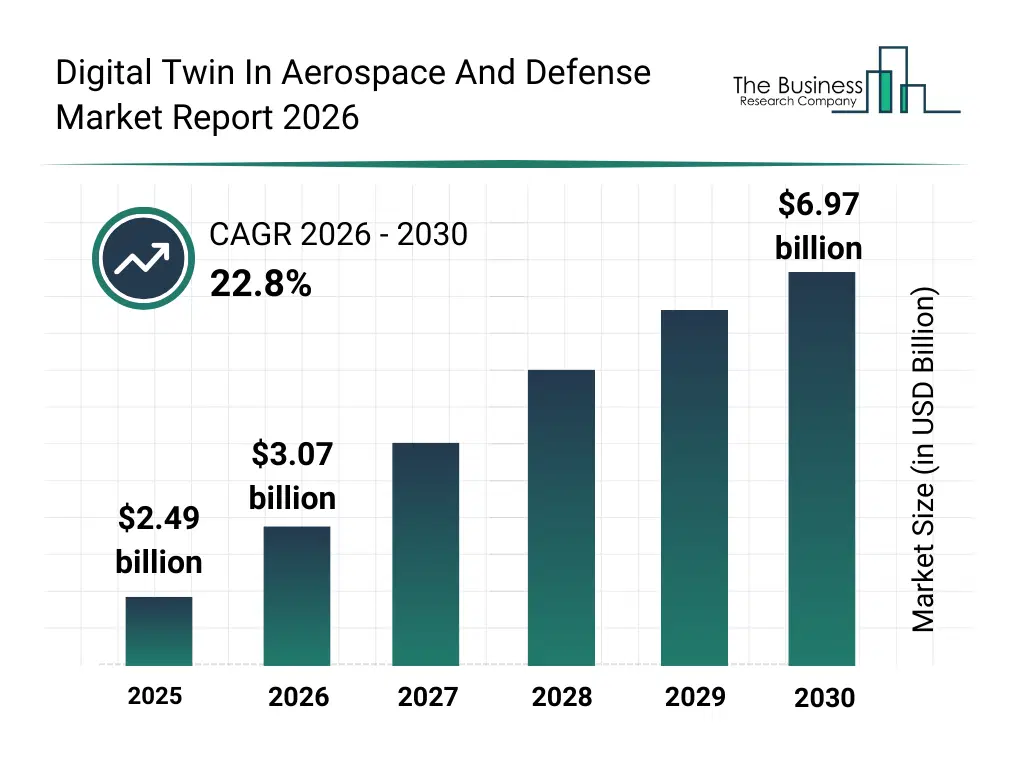
What Is The Digital Twin In Aerospace And Defense Market Size and Share 2026?
The digital twin in aerospace and defense market size has grown exponentially in recent years. It will grow from $2.49 billion in 2025 to $3.07 billion in 2026 at a compound annual growth rate (CAGR) of 23.3%. The growth in the historic period can be attributed to increasing adoption of simulation tools to enhance aircraft and defense system design accuracy, rising use of digital models for predictive maintenance and lifecycle management, expansion of real-time performance monitoring enabled by sensor integration across defense assets, deployment of digital twins for mission planning and training to improve operational readiness, development of engine and spacecraft digital replicas supporting optimization of complex systems.What Is The Digital Twin In Aerospace And Defense Market Growth Forecast?
The digital twin in aerospace and defense market size is expected to see exponential growth in the next few years. It will grow to $6.97 billion in 2030 at a compound annual growth rate (CAGR) of 22.8%. The growth in the forecast period can be attributed to growing integration of AI and machine learning to enhance digital twin analytics and automation, rising demand for fleet-wide digital twin platforms enabling unified asset management, expansion of digital twin applications in space systems including satellites and deep-space vehicles, increasing use of immersive training environments powered by real-time digital twin data, development of advanced multi-domain digital twins supporting joint military operations and system interoperability. Major trends in the forecast period include rising adoption of mission-ready digital twin models, increased lifecycle management and predictive mro usage, expansion of multi-domain operational simulation, growing integration into spacecraft and satellite operations, higher demand for digital twin–enabled supply chain optimization.
Global Digital Twin In Aerospace And Defense Market Segmentation
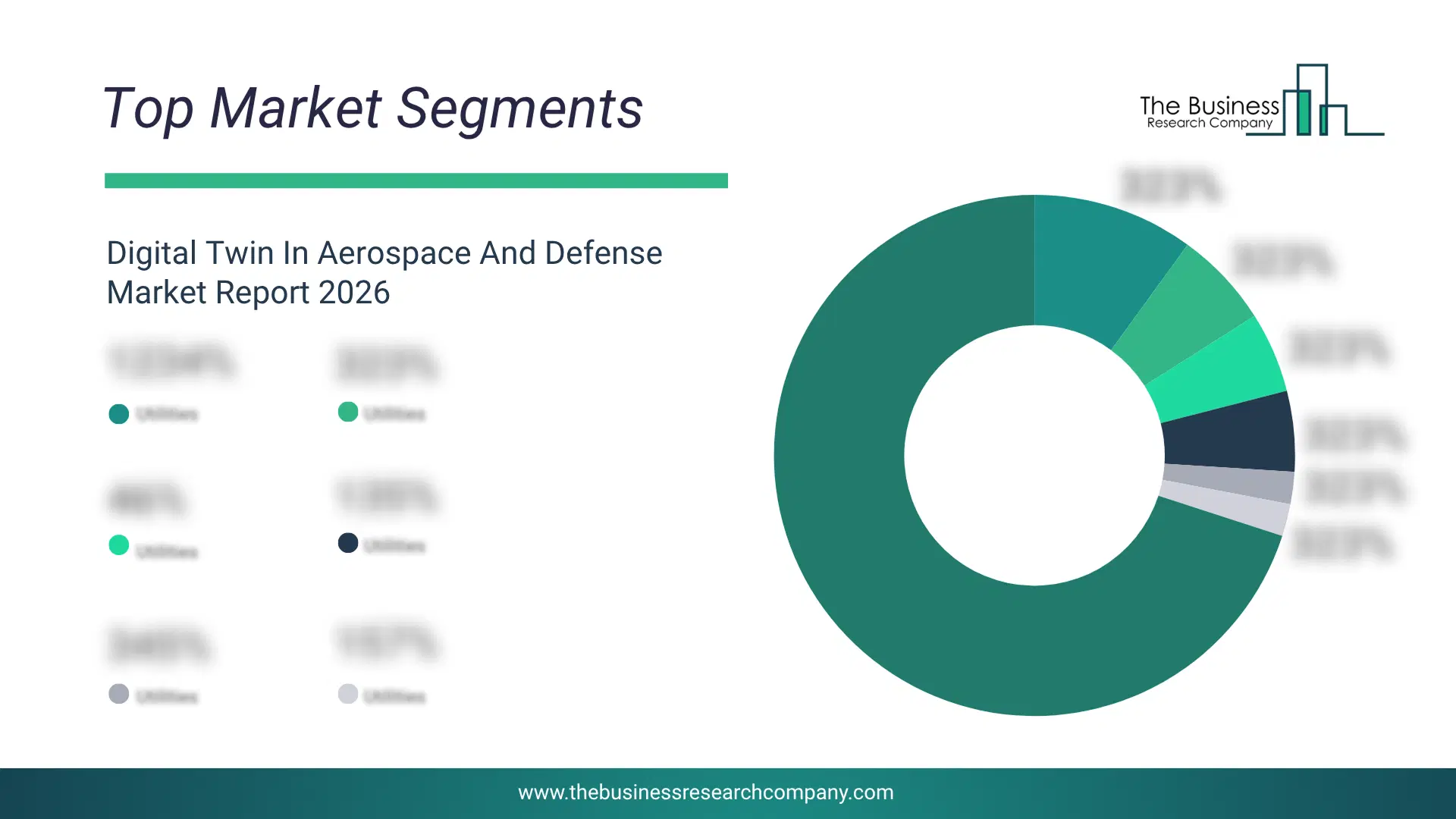
1) By Component: Software, Services, Hardware 2) By Deployment: On-Premises, Cloud-Based 3) By Technology: Artificial Intelligence, Internet Of Things (IoT), Big Data Analytics, Cloud Computing, Machine Learning 4) By Application: Predictive Maintenance, Design And Development, Simulation And Testing, Supply Chain Management, Asset Management 5) By End-User: Military, Civil Aviation, Space Exploration, Defense Contractors Subsegments: 1) By Software: Design Software, Simulation Software, Predictive Analytics Software, Visualization Software 2) By Services: Consulting Services, Implementation Services, Support and Maintenance Services, Managed Services 3) By Hardware: Sensors, Actuators, Communication Devices, Processors, Storage DevicesWhat Is Driver Of The Digital Twin In Aerospace And Defense Market?
The increase in defense expenditure is expected to propel the growth of the digital twin in aerospace and defense market going forward. Defense expenditure refers to the funds allocated by a nation's military to purchase, replenish, and maintain its stockpile of bullets, shells, missiles, and other munitions. Defense expenditure is increasing due to heightened geopolitical tensions, as nations strengthen their military forces to protect sovereignty, deter potential threats, modernize weapons systems, and maintain strategic influence in a volatile global environment. Defense expenditure supports advancing digital twin technology within the aerospace and defense sector by enabling sustained investment in cutting-edge simulation, real-time data integration, and lifecycle management tools. For instance, in October 2025, according to the UK Parliament's House of Commons Library, a UK-based government administration, Defence spending outlined in the 2025 Spending Review is expected to total USD 83.3 billion (£62.2 billion) in 2025/26, increasing to USD 98.2 billion (£73.5 billion) in 2028/29, which corresponds to an annual average real-terms growth rate of 3.8% over this period. Therefore, the increase in defense expenditure is driving the growth of digital twin in aerospace and defense industry.Key Players In The Global Digital Twin In Aerospace And Defense Market
Major companies operating in the digital twin in aerospace and defense market are Microsoft Corporation, Siemens AG, Boeing Company, Lockheed Martin Corporation, Airbus SE, International Business Machines Corporation, Oracle Corporation, Northrop Grumman Corporation, Honeywell International Inc., SAP SE, General Electric, Tata Consultancy Services, BAE Systems, Thales Group, L3Harris Technologies, Rolls-Royce Holdings plc, Dassault Systèmes, Hexagon AB, ANSYS Inc., PTC Inc.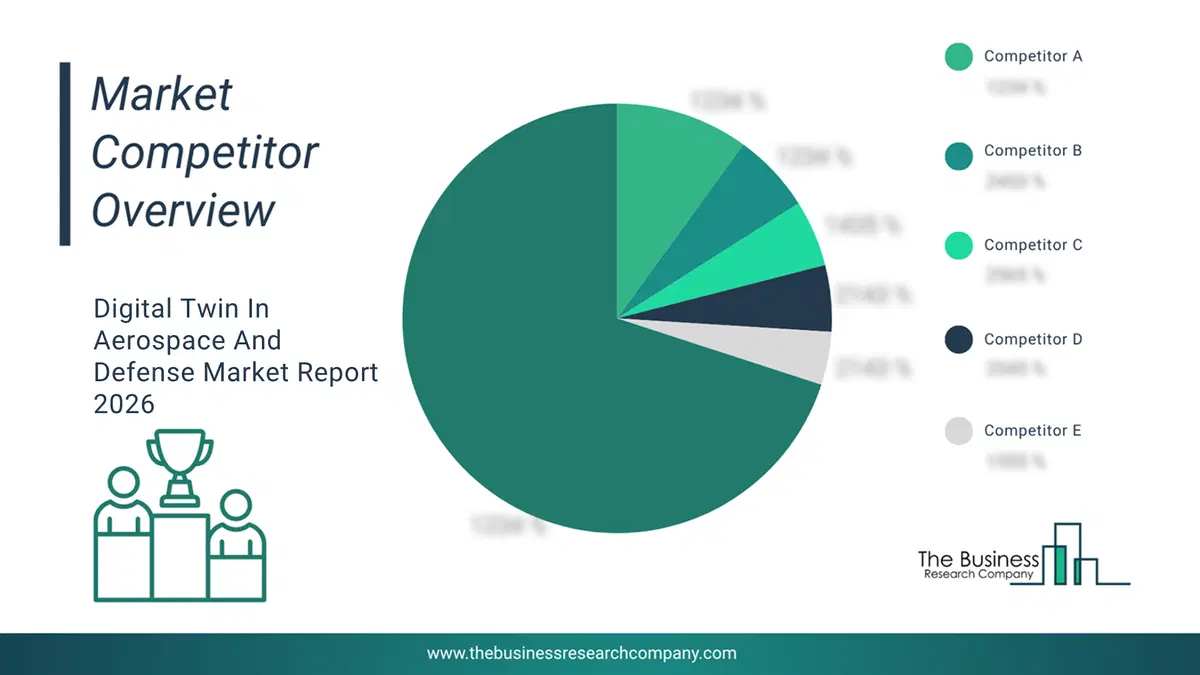
This chart is for illustrative purposes; the full report includes a detailed competitor analysis and comprehensive overview of the top 10 companies in the market.
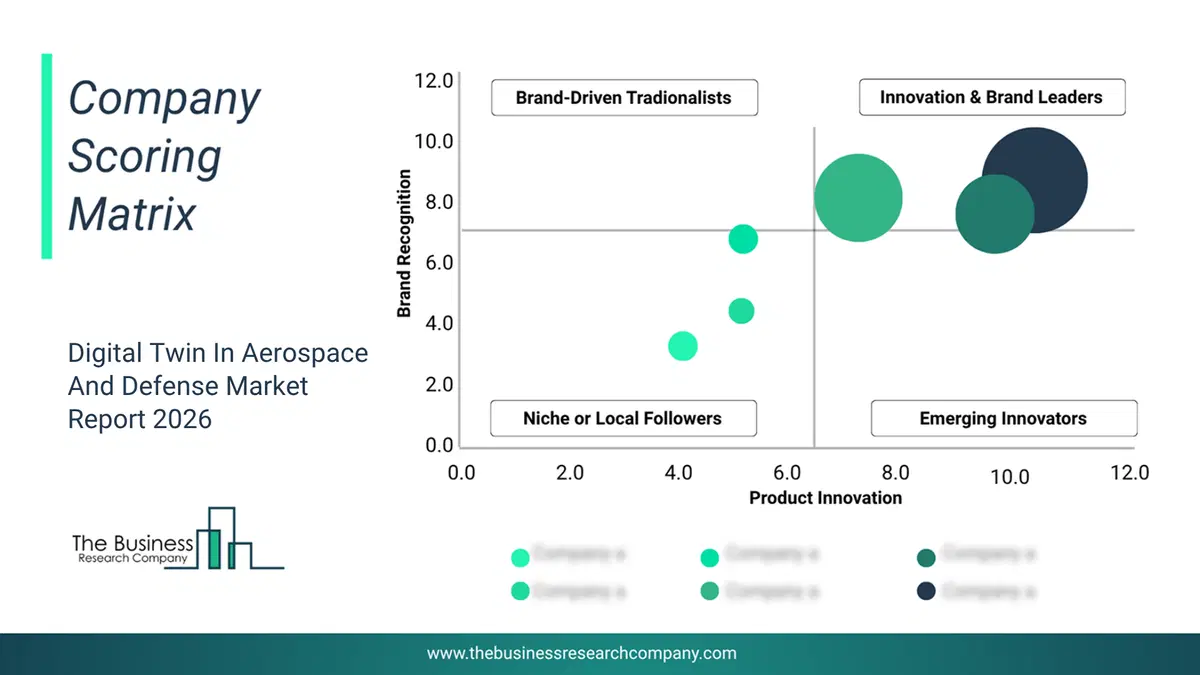
This chart maps companies by product innovation and brand strength, with bubble size indicating relative revenue, helping identify market leaders, challengers, and niche players. This is an illustrative chart; the full report provides a complete and accurate competitive analysis.
Global Digital Twin In Aerospace And Defense Market Trends and Insights
Major companies operating in the digital twin in aerospace and defense market are focusing on leveraging innovative technologies such as artificial intelligence (AI)-based simulation to enhance mission planning, optimize operations, and improve training accuracy. Artificial Intelligence (AI)-based simulation is a technology that uses AI algorithms to create realistic virtual models of systems or environments, helping predict outcomes, optimize operations, and improve decision-making in aerospace and defense. For instance, in September 2025, Aechelon Technology Inc., a US-based software development company, launched Project Orbion, the first AI-enabled digital twin of the Earth, in collaboration with Niantic Spatial, ICEYE, BlackSky, and Distance Technologies. The project integrates satellite imagery, radar, video photogrammetry, and AI to create a dynamic, real-time 3D model of the planet with physics-driven accuracy. While initially targeting defense and emergency response, the platform also offers dual-use potential for industries such as logistics, urban planning, disaster management, and autonomous navigation, providing organizations with a reliable foundation for training, fine-tuning, and validating AI systems using real-world, up-to-date data.What Are Latest Mergers And Acquisitions In The Digital Twin In Aerospace And Defense Market? Siemens AG Partners With JetZero To Develop Zero-Emission Blended-Wing Aircraft
In January 2025, Siemens AG, a Germany-based automation company, partnered with JetZero to design a fuel-efficient, zero-emission blended-wing aircraft using Siemens' digital tools. With this partnership, Siemens AG and JetZero aim to develop a sustainable, fuel-efficient blended-wing aircraft that leverages advanced digital tools to enhance performance and reduce environmental impact. JetZero is a US-based aerospace company that offers digital twin in aerospace and defense.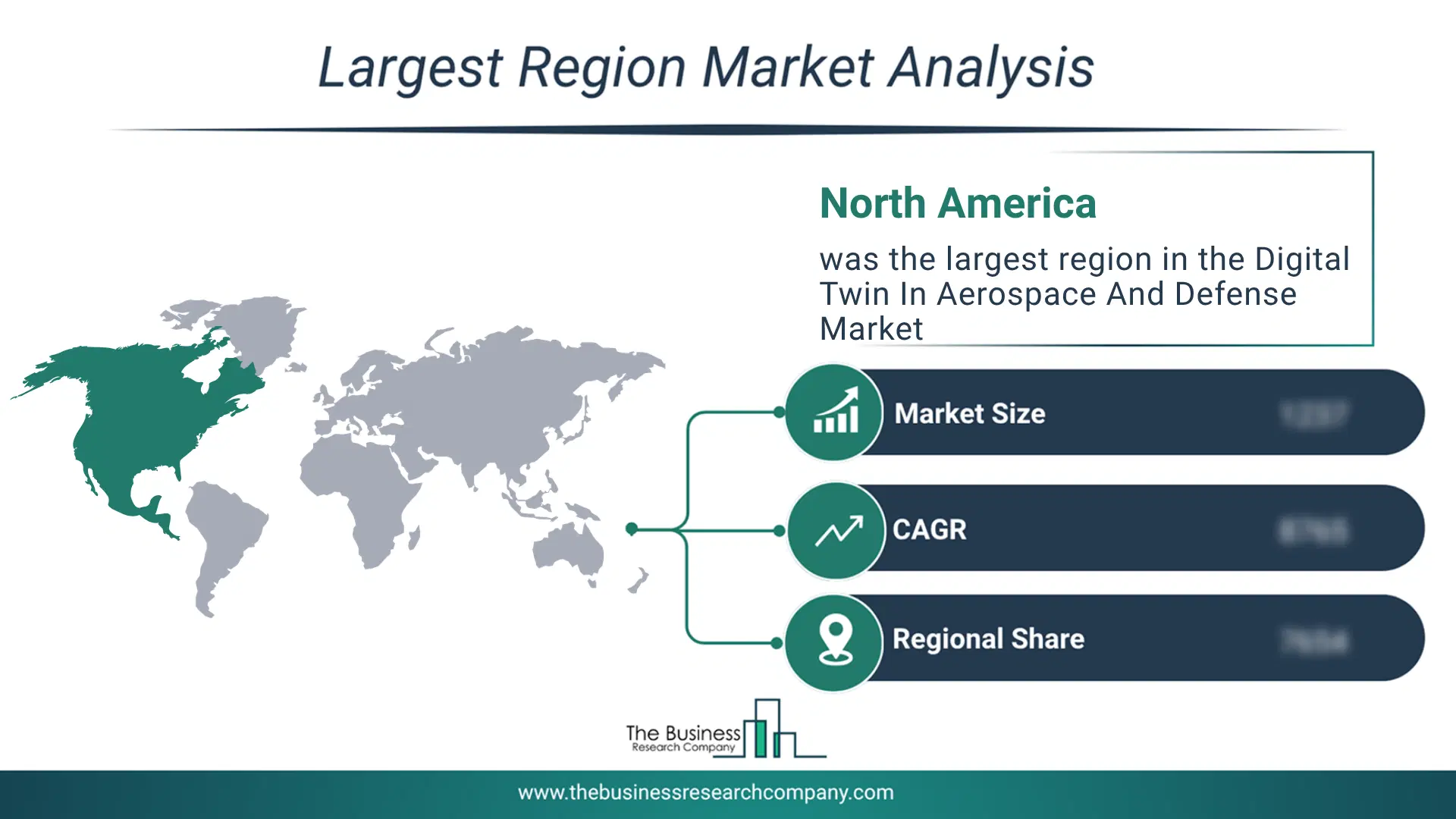
Regional Insights
North America was the largest region in the digital twin in aerospace and defense market in 2025. Asia-Pacific is expected to be the fastest-growing region in the forecast period. The regions covered in this market report are Asia-Pacific, South East Asia, Western Europe, Eastern Europe, North America, South America, Middle East, Africa. The countries covered in this market report are Australia, Brazil, China, France, Germany, India, Indonesia, Japan, Taiwan, Russia, South Korea, UK, USA, Canada, Italy, SpainWhat Defines the Digital Twin In Aerospace And Defense Market?
The digital twin in aerospace and defense market consists of revenues earned by entities by providing services such as real-time performance monitoring, mission planning and training, fleet management, and design and simulation. The market value includes the value of related goods sold by the service provider or included within the service offering. The digital twin in aerospace and defense market includes sales of aircraft digital twin platforms, spacecraft and satellite digital replicas, and engine digital twin models. Values in this market are ‘factory gate’ values, that is, the value of goods sold by the manufacturers or creators of the goods, whether to other entities (including downstream manufacturers, wholesalers, distributors, and retailers) or directly to end customers. The value of goods in this market includes related services sold by the creators of the goods.How is Market Value Defined and Measured?
The market value is defined as the revenues that enterprises gain from the sale of goods and/or services within the specified market and geography through sales, grants, or donations in terms of the currency (in USD unless otherwise specified). The revenues for a specified geography are consumption values that are revenues generated by organizations in the specified geography within the market, irrespective of where they are produced. It does not include revenues from resales along the supply chain, either further along the supply chain or as part of other products.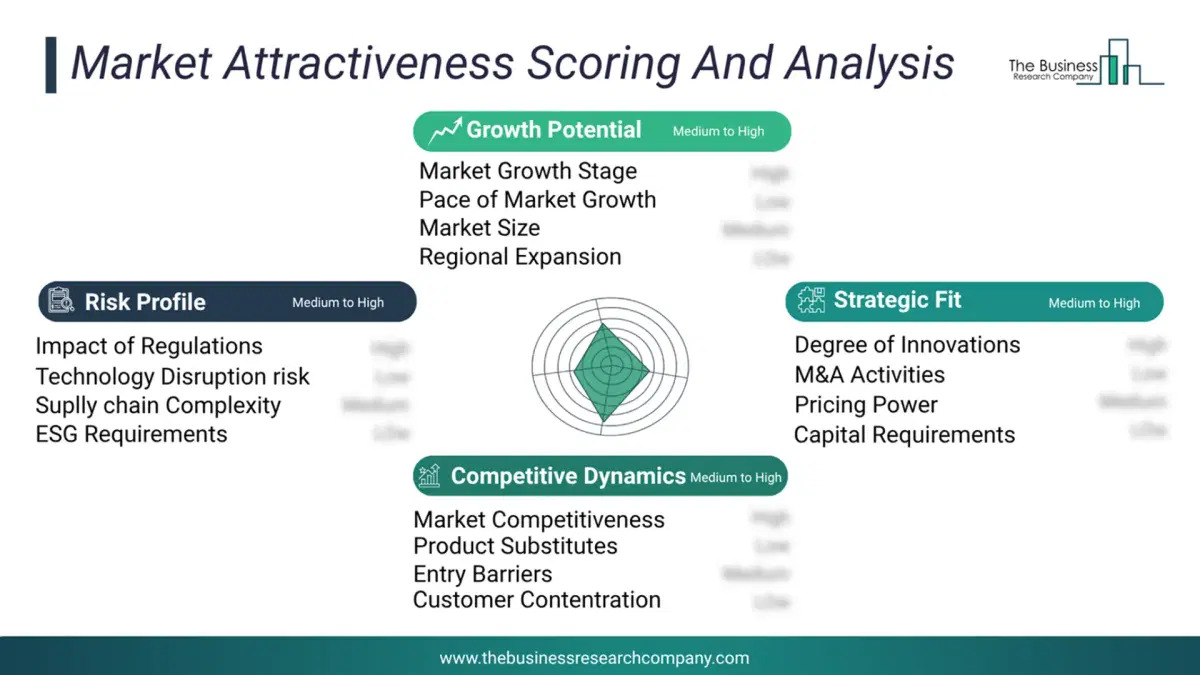
This chart presents market attractiveness based on a quantitative evaluation of growth, competition, strategic alignment, and risk, offering a clear view of opportunity areas for decision-making. This chart is for illustrative purposes; the full report contains the complete analysis.
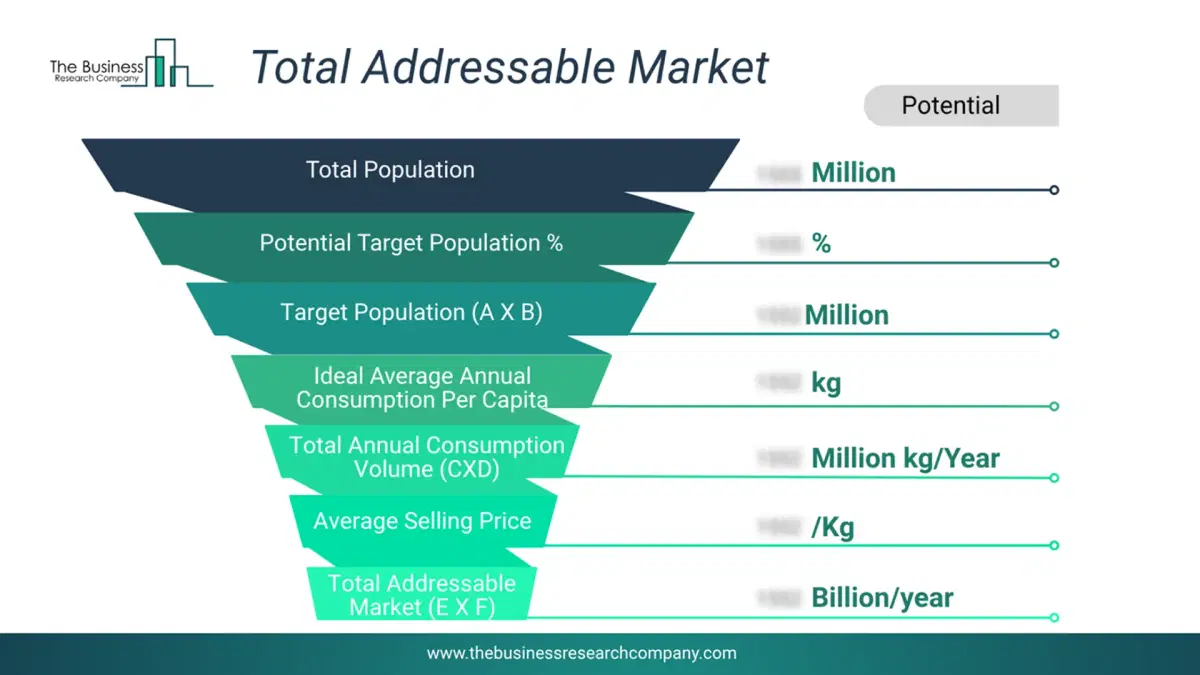
This chart highlights the Total Addressable Market (TAM) by estimating the maximum revenue opportunity using an assumption-driven approach, supporting strategic planning and opportunity sizing across markets. The chart is illustrative; the full report provides a more comprehensive analysis.
What Key Data and Analysis Are Included in the Digital Twin In Aerospace And Defense Market Report 2026?
The digital twin in aerospace and defense market research report is one of a series of new reports from The Business Research Company that provides market statistics, including industry global market size, regional shares, competitors with the market share, detailed market segments, market trends and opportunities, and any further data you may need to thrive in the digital twin in aerospace and defense industry. The market research report delivers a complete perspective of everything you need, with an in-depth analysis of the current and future state of the industry.Digital Twin In Aerospace And Defense Market Report Forecast Analysis
| Report Attribute | Details |
|---|---|
| Market Size Value In 2026 | $3.07 billion |
| Revenue Forecast In 2035 | $6.97 billion |
| Growth Rate | CAGR of 23.3% from 2026 to 2035 |
| Base Year For Estimation | 2025 |
| Actual Estimates/Historical Data | 2020-2025 |
| Forecast Period | 2026 - 2030 - 2035 |
| Market Representation | Revenue in USD Billion and CAGR from 2026 to 2035 |
| Segments Covered | Component, Deployment, Technology, Application, End-User |
| Regional Scope | Asia-Pacific, Western Europe, Eastern Europe, North America, South America, Middle East, Africa |
| Country Scope | The countries covered in the report are Australia, Brazil, China, France, Germany, India, ... |
| Key Companies Profiled | Microsoft Corporation, Siemens AG, Boeing Company, Lockheed Martin Corporation, Airbus SE, International Business Machines Corporation, Oracle Corporation, Northrop Grumman Corporation, Honeywell International Inc., SAP SE, General Electric, Tata Consultancy Services, BAE Systems, Thales Group, L3Harris Technologies, Rolls-Royce Holdings plc, Dassault Systèmes, Hexagon AB, ANSYS Inc., PTC Inc. |
| Customization Scope | Request for Customization |
| Pricing And Purchase Options | Explore Purchase Options |