
Digital Terrestrial Television Market Report 2026

Digital Terrestrial Television Market Report 2026
Global Outlook – By Component (Transmitters And Broadcast Equipment (TBE), Set‑Top Boxes (STBs), Integrated Digital Televisions (IDTVs), Receivers (RCVs), Antennas And Accessories (AA), Middleware And Content Management Solutions (MCMS)), By Broadcast Technology (Digital Video Broadcasting-Terrestrial (DVB‑T), Digital Video Broadcasting-Terrestrial 2 (DVB‑T, Advanced Television Systems Committee Or Advanced Television Systems Committee 3.0 Integrated Services Digital Broadcasting Or Integrated Services Digital Broadcasting-Terrestrial, Brazil (ISDB‑T Or ISDB‑Tb)), By Revenue Source, By End‑User (Residential Viewers (RV), Institutional Outlets (CIO), Public Or Government Broadcasters (PGB)) – Market Size, Trends, Strategies, and Forecast to 2035
Digital Terrestrial Television Market Overview
• Digital Terrestrial Television market size has reached to $29.22 billion in 2025 • Expected to grow to $42.75 billion in 2030 at a compound annual growth rate (CAGR) of 8% • Growth Driver: Increasing Digital Broadcasting Adoption Fueling The Growth Of The Market Due To Improved Transmission Efficiency And Free-To-Air Accessibility • Market Trend: Advancements In Digital Terrestrial Television (DTT) Technology Expand Broadcast Capacity And Viewing Quality • North America was the largest region in 2025 and Asia-Pacific is the fastest growing region.

What Is Covered Under Digital Terrestrial Television Market?
Digital terrestrial television (DTT) refers to a digital broadcasting method that transmits television signals through terrestrial transmitters instead of cable or satellite networks. It enhances audio and video quality, allows multiple channels to be carried on a single frequency, and supports services such as electronic program guides and subtitles. The main component types of digital terrestrial television solutions include transmitters and broadcast equipment (tbe), set?top boxes (stbs), integrated digital televisions (idTVs), receivers (rcvs), antennas and accessories (aa), and middleware and content management solutions (mcms). Transmitters and broadcast equipment refer to electronic devices and systems used to send audio, video, or data signals over radio, television, or other communication networks to reach a wide audience. The various broadcast technologies involved are digital video broadcasting-terrestrial (dvb?t), digital video broadcasting-terrestrial 2 (DVB-T2), advanced television systems committee (ATSC or ATSC 3.0), and integrated services digital broadcasting (ISDB-T or ISDB-Tb). The revenue sources include consumer hardware sales (chs), pay-tv or subscription services (pay-tv or ss), advertising and sponsorship revenue (asr), broadcast network services (bns), and maintenance and support services (mss) and serve various end users such as residential viewers, commercial or institutional outlets, public or government broadcasters, educational and community stations, and hospitality and entertainment venues.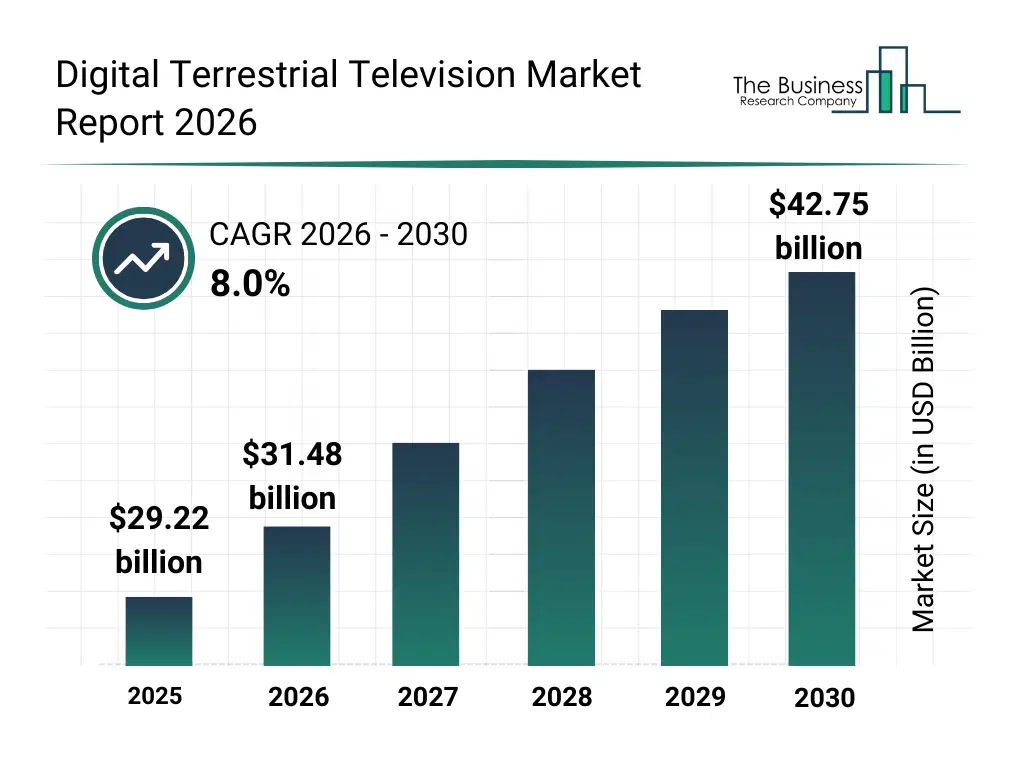
What Is The Digital Terrestrial Television Market Size and Share 2026?
The digital terrestrial television market size has grown strongly in recent years. It will grow from $29.22 billion in 2025 to $31.48 billion in 2026 at a compound annual growth rate (CAGR) of 7.7%. The growth in the historic period can be attributed to transition from analog to digital broadcasting, increasing consumer demand for high-definition content, expansion of pay-tv and subscription services, growth in residential television penetration, rising investment in broadcast infrastructure.What Is The Digital Terrestrial Television Market Growth Forecast?
The digital terrestrial television market size is expected to see strong growth in the next few years. It will grow to $42.75 billion in 2030 at a compound annual growth rate (CAGR) of 8.0%. The growth in the forecast period can be attributed to increasing adoption of internet protocol connected set-top boxes, growth in smart television and flat-screen displays, rising investment in interactive and personalized content delivery, expansion of advanced television systems (atsc 3.0 and dvb-t2), increasing deployment of digital rights management and content management solutions. Major trends in the forecast period include rising adoption of dvb-t2 and atsc 3.0 technologies, increasing deployment of smart set-top boxes, growth in integrated digital television (idtv) sales, expansion of interactive broadcasting solutions and middleware, increasing investment in broadcast network services.Global Digital Terrestrial Television Market Segmentation
1) By Component: Transmitters And Broadcast Equipment (TBE), Set?Top Boxes (STBs), Integrated Digital Televisions (IDTVs), Receivers (RCVs), Antennas And Accessories (AA), Middleware And Content Management Solutions (MCMS) 2) By Broadcast Technology: Digital Video Broadcasting-Terrestrial (DVB?T), Digital Video Broadcasting-Terrestrial 2 (DVB?T2), Advanced Television Systems Committee Or Advanced Television Systems Committee 3.0 (ATSC Or ATSC 3.0), Integrated Services Digital Broadcasting Or Integrated Services Digital Broadcasting-Terrestrial, Brazil (ISDB?T Or ISDB?Tb) 3) By Revenue Source: Consumer Hardware Sales (CHS), Pay?TV Or Subscription Services (Pay?TV Or SS), Advertising And Sponsorship Revenue (ASR), Broadcast Network Services (BNS), Maintenance And Support Services (MSS) 4) By End?User: Residential Viewers (RV), Commercial Or Institutional Outlets (CIO), Public Or Government Broadcasters (PGB), Educational And Community Stations (ECS), Hospitality And Entertainment Venues (HEV) Subsegments: 1) By Transmitters And Broadcast Equipment: Analog Transmitters, Digital Transmitters, High Power Transmitters, Low Power Transmitters 2) By Set Top Boxes: Cable Connected, Satellite Connected, Internet Protocol Connected, Portable 3) By Integrated Digital Televisions: Flat Screen, Smart Television, Curved Screen, LED Backlit 4) By Receivers: Single Tuner, Dual Tuner, Multi Tuner, Portable Receiver 5) By Antennas And Accessories: Indoor Antenna, Outdoor Antenna, Directional Antenna, Omni Directional Antenna 6) By Middleware And Content Management Solutions: Digital Rights Management Solutions, Electronic Program Guide Solutions, Content Delivery Management, Interactive Broadcasting SolutionsWhat Is The Driver Of The Digital Terrestrial Television Market?
The increasing digital broadcasting adoption is expected to propel the growth of the digital terrestrial television market going forward. Digital broadcasting refers to delivering audio, video, and data through digital signals, allowing improved quality, efficient spectrum utilization, and enhanced interactive and multi-channel capabilities. Digital broadcasting is expanding due to rising consumer expectations for better audio and video performance as it delivers clearer transmission and a more immersive viewing experience than conventional analog platforms. Digital terrestrial television supports increasing digital broadcasting adoption by providing free-to-air, widely accessible digital TV services with reliable coverage, enabling households to receive high-quality digital content without the need for internet connectivity or subscription fees. For instance, in October 2024, according to GOV.UK, a UK-based public sector information website, in 2023, 87% of UK households had an internet-enabled primary TV, and approximately 18% used the internet exclusively as their primary way to watch television. 17% of UK households were dependent on digital terrestrial television for their TV viewing. Therefore, the increasing digital broadcasting adoption is driving the growth of the digital terrestrial television industry.Key Players In The Global Digital Terrestrial Television Market
Major companies operating in the digital terrestrial television market are Samsung Electronics Co. Ltd., Huawei Technologies Co. Ltd., Sony Group Corporation, LG Electronics Inc., Panasonic Corporation, Broadcom Inc., Qualcomm Inc., NEC Corporation, Nokia Corporation, Sichuan Changhong Network Technologies Co. Ltd., Rohde & Schwarz GmbH & Co. KG, SES S.A., Arqiva Group Limited, StarTimes Group Co. Ltd., Televes Corporation S.A., Allegro DVT Limited, TDF Infrastructure SAS, MYTV Broadcasting Sdn Bhd, Axel Technology S.r.l., TELE System Digital S.r.l., Avateq Corp., Axing AG, and Cordiant Digital Infrastructure Limited.Global Digital Terrestrial Television Market Trends and Insights
Major companies operating in the digital terrestrial television market are focusing on developing advanced solutions, such as ultra-high-definition (UHD) broadcast capability, to deliver higher-quality content and improve spectrum efficiency. Ultra-high-definition (UHD) broadcast capability describes a broadcasting system’s capacity to deliver very high-resolution video and elevates the viewing experience by enabling advanced picture formats and more immersive content compared with standard and high-definition broadcasts. For instance, in March 2025, Ministerio para la Transformación Digital y de la Función Pública, a Spain-based government body, introduced a new National Technical Plan for Digital Terrestrial Television (DTT). The plan mandates the nationwide deployment of DVB-T2 transmission technology, enabling UHD content delivery, optimizing spectrum utilization through increased multiplex efficiency, maintaining current DTT networks without channel loss, and reorganizing state-level channels to broaden digital terrestrial television offerings, thereby allowing terrestrial broadcasters to compete more effectively with satellite and internet-based platforms.What Are Latest Mergers And Acquisitions In The Digital Terrestrial Television Market?
In January 2024, České Radiokomunikace a.s., a Czechia-based digital infrastructure and telecommunications provider, acquired Prague Digital TV, s.r.o. for an undisclosed amount. With this acquisition, CRA aims to expand its digital broadcasting network portfolio, increase capacity for television and radio broadcasting in Prague and Central Bohemia, and enhance technological capabilities for innovative television services. Prague Digital TV, s.r.o. is a Czech Republic-based operator of digital television broadcasting networks, delivering DVB-T2 standard broadcasts over regional network 4, covering Prague and 41% of central Bohemia, including the metropolitan station Prague TV.Regional Insights
North America was the largest region in the digital terrestrial television in 2025. Asia-Pacific is expected to be the fastest-growing region in the forecast period. The regions covered in this market report are Asia-Pacific, South East Asia, Western Europe, Eastern Europe, North America, South America, Middle East, Africa. The countries covered in this market report are Australia, Brazil, China, France, Germany, India, Indonesia, Japan, Taiwan, Russia, South Korea, UK, USA, Canada, Italy, Spain.What Defines the Digital Terrestrial Television Market?
The digital terrestrial television (DTT) market consists of revenues earned by entities by providing services such as digital television broadcasting, set-top box provisioning, transmission network management, and related broadcasting infrastructure solutions. The market value includes the value of related goods sold by the service provider or included within the service offering. The digital terrestrial television (DTT) market also includes sales of modulators, encoders, multiplexers, repeaters, signal amplifiers, power supply units, monitoring and measurement equipment. Values in this market are ‘factory gate’ values, that is, the value of goods sold by the manufacturers or creators of the goods, whether to other entities (including downstream manufacturers, wholesalers, distributors, and retailers) or directly to end customers. The value of goods in this market includes related services sold by the creators of the goods.How is Market Value Defined and Measured?
The market value is defined as the revenues that enterprises gain from the sale of goods and/or services within the specified market and geography through sales, grants, or donations in terms of the currency (in USD unless otherwise specified). The revenues for a specified geography are consumption values that are revenues generated by organizations in the specified geography within the market, irrespective of where they are produced. It does not include revenues from resales along the supply chain, either further along the supply chain or as part of other products.What Key Data and Analysis Are Included in the Digital Terrestrial Television Market Report 2026?
The digital terrestrial television market research report is one of a series of new reports from The Business Research Company that provides digital terrestrial television market statistics, including digital terrestrial television industry global market size, regional shares, competitors with a digital terrestrial television market share, detailed digital terrestrial television market segments, market trends and opportunities, and any further data you may need to thrive in the digital terrestrial television industry. This digital terrestrial television market research report delivers a complete perspective of everything you need, with an in-depth analysis of the current and future scenario of the industry.Digital Terrestrial Television Market Report Forecast Analysis
| Report Attribute | Details |
|---|---|
| Market Size Value In 2026 | $31.48 billion |
| Revenue Forecast In 2035 | $42.75 billion |
| Growth Rate | CAGR of 7.7% from 2026 to 2035 |
| Base Year For Estimation | 2025 |
| Actual Estimates/Historical Data | 2020-2025 |
| Forecast Period | 2026 - 2030 - 2035 |
| Market Representation | Revenue in USD Billion and CAGR from 2026 to 2035 |
| Segments Covered | Component, Broadcast Technology, Revenue Source, End‑User |
| Regional Scope | Asia-Pacific, Western Europe, Eastern Europe, North America, South America, Middle East, Africa |
| Country Scope | The countries covered in the report are Australia, Brazil, China, France, Germany, India, ... |
| Key Companies Profiled | Samsung Electronics Co. Ltd., Huawei Technologies Co. Ltd., Sony Group Corporation, LG Electronics Inc., Panasonic Corporation, Broadcom Inc., Qualcomm Inc., NEC Corporation, Nokia Corporation, Sichuan Changhong Network Technologies Co. Ltd., Rohde & Schwarz GmbH & Co. KG, SES S.A., Arqiva Group Limited, StarTimes Group Co. Ltd., Televes Corporation S.A., Allegro DVT Limited, TDF Infrastructure SAS, MYTV Broadcasting Sdn Bhd, Axel Technology S.r.l., TELE System Digital S.r.l., Avateq Corp., Axing AG, and Cordiant Digital Infrastructure Limited. |
| Customization Scope | Request for Customization |
| Pricing And Purchase Options | Explore Purchase Options |