
Digital Glass Military Aircraft Cockpit Systems Market Report 2026
Global Outlook – By Component (Displays, Sensors, Software, Other Components), By Platform (Fighter Aircraft, Transport Aircraft, Military Helicopters, Trainer Aircraft, Unmanned Aerial Vehicles), By Installation Type (Line Fit, Retrofit), By Application (Navigation, Communication, Surveillance, Other Applications), By End-Users (Defense And Aerospace, General Aviation, Commercial Aviation) – Market Size, Trends, Strategies, and Forecast to 2035
Digital Glass Military Aircraft Cockpit Systems Market Overview
• Digital Glass Military Aircraft Cockpit Systems market size has reached to $1.94 billion in 2025 • Expected to grow to $2.68 billion in 2030 at a compound annual growth rate (CAGR) of 6.7% • Growth Driver: Rising Global Defense Expenditure Driving The Growth Of The Market Due To Increasing Military Modernization Programs • Market Trend: Advanced Artificial Intelligence (AI)-Driven Augmented Reality (AR) Integrated Cockpit Systems Enhancing Situational Awareness And Flight Safety • North America was the largest region in 2025 and Asia-Pacific is the fastest growing region.What Is Covered Under Digital Glass Military Aircraft Cockpit Systems Market?
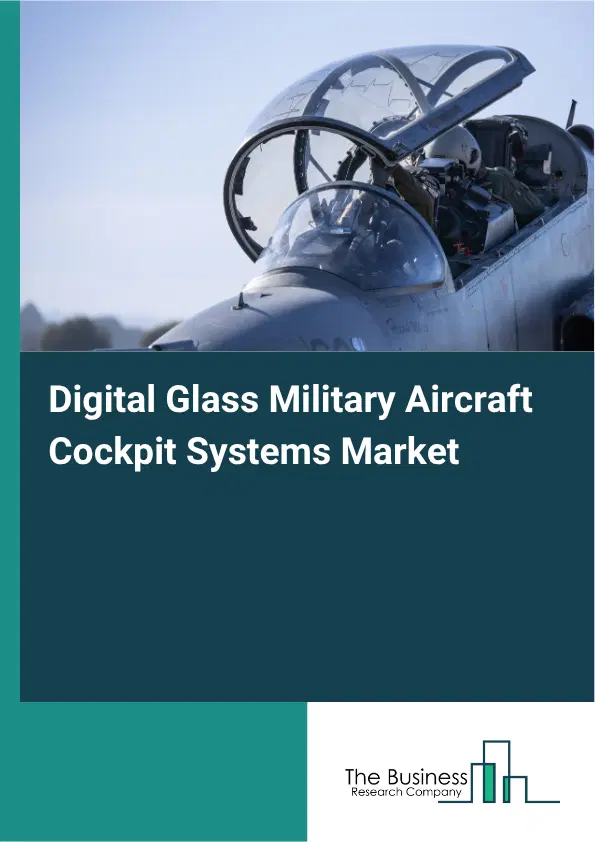
Digital glass military aircraft cockpit systems are advanced avionics platforms that replace conventional analog instruments with integrated digital displays, combining flight, navigation, weapons, and mission data into a unified, user-friendly interface. These systems enhance situational awareness, reduce pilot workload, accelerate decision-making, and support real-time data integration, improving overall combat and mission effectiveness. The main components of digital glass military aircraft cockpit systems include displays, sensors, software, and other components. Displays refer to advanced electronic visual interfaces used to present flight data, navigation information, and mission-critical parameters to pilots in real time. These systems are deployed across platforms such as fighter aircraft, transport aircraft, military helicopters, trainer aircraft, and unmanned aerial vehicles, and are available in installation types including line fit and retrofit. The various applications involved are navigation, communication, surveillance, and other applications, and they are used by several end users such as defense and aerospace, general aviation, and commercial aviation.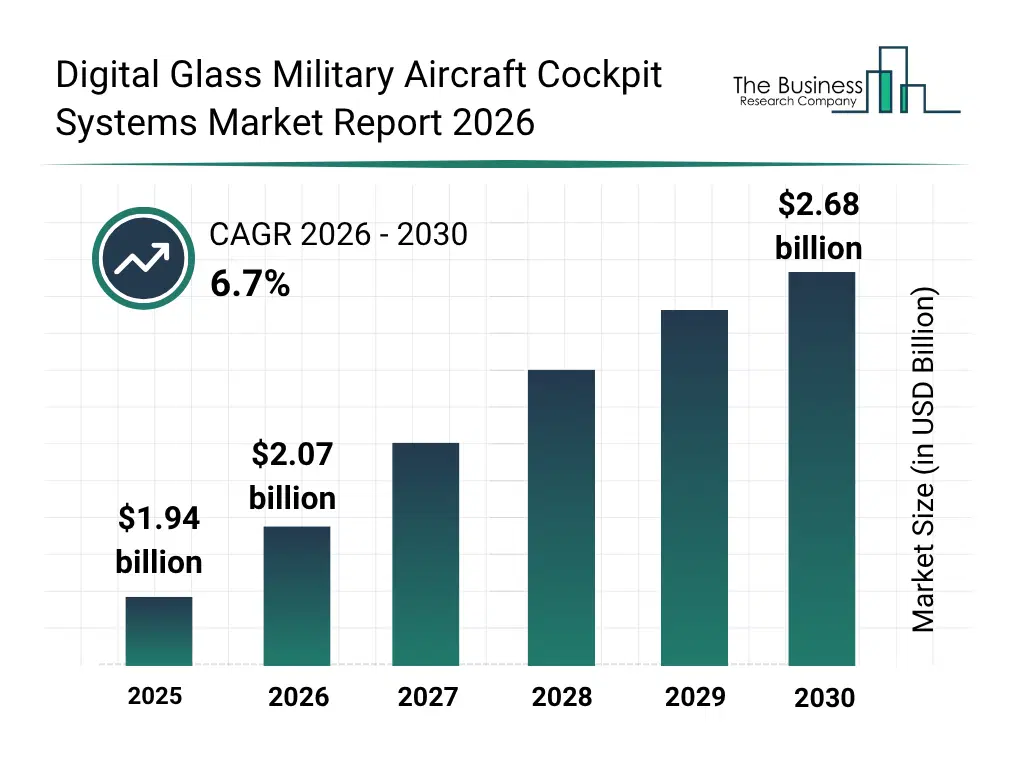
What Is The Digital Glass Military Aircraft Cockpit Systems Market Size and Share 2026?
The digital glass military aircraft cockpit systems market size has grown strongly in recent years.It will grow from $1.94 billion in 2025 to $2.07 billion in 2026 at a compound annual growth rate (CAGR) of 6.5%. The growth in the historic period can be attributed to analog cockpit instrumentation dependency, early glass cockpit adoption in fighter aircraft, post cold war defense modernization programs, incremental avionics digitization, improvement in flight display reliability systems.What Is The Digital Glass Military Aircraft Cockpit Systems Market Growth Forecast?
The digital glass military aircraft cockpit systems market size is expected to see strong growth in the next few years.It will grow to $2.68 billion by 2030 at a compound annual growth rate (CAGR) of 6.7%. The growth in the forecast period can be attributed to AI enabled mission avionics integration, autonomous combat aircraft development programs, rising defense modernization investments, advanced sensor fusion and data interoperability, cybersecurity hardened cockpit architectures.Major trends in the forecast period include Open architecture avionics integration, Modular cockpit upgrade systems, Fly-by-wire system enhancement programs, Real-time mission data fusion platforms, Electromagnetic interference shielding and hardening systems.
Global Digital Glass Military Aircraft Cockpit Systems Market Segmentation
1) By Component: Displays, Sensors, Software, Other Components 2) By Platform: Fighter Aircraft, Transport Aircraft, Military Helicopters, Trainer Aircraft, Unmanned Aerial Vehicles 3) By Installation Type: Line Fit, Retrofit 4) By Application: Navigation, Communication, Surveillance, Other Applications 5) By End-Users: Defense And Aerospace, General Aviation, Commercial Aviation Subsegments: 1) By Displays: Primary Flight Display, Multi Function Display, Head Up Display, Helmet Mounted Display 2) By Sensors: Air Data Sensors, Inertial Navigation Sensors, Position Sensors, Environmental Sensors 3) By Software: Flight Display Management Software, Navigation Management Software, Mission Planning Software, Data Processing Software 4) By Other Components: Control Panels, Switches And Interfaces, Data Storage Units, Power Supply Units, Communication ModulesWhat Is The Driver Of The Digital Glass Military Aircraft Cockpit Systems Market?
The rising global defense expenditure is expected to propel the growth of the digital glass military aircraft cockpit systems industry going forward.Defense expenditure refers to the financial resources allocated by governments for military forces, including the procurement of advanced aircraft and defense equipment and the modernization of military infrastructure.Global defense expenditure is rising due to escalating geopolitical tensions, which heighten security concerns and drive governments to invest more in military capabilities and advanced defense systems.Rising global defense expenditure drives investment in advanced avionics and cockpit modernization, accelerating the adoption of digital glass cockpit systems that enhance situational awareness, mission efficiency, and pilot safety.For instance, in April 2024, according to the Stockholm International Peace Research Institute, a Sweden-based defense research institute, global military expenditure increased from $2.24 trillion in 2022 to $2.44 trillion in 2023, representing an increase of about 6.8%.Therefore, the rising global defense expenditure is driving the growth of the digital glass military aircraft cockpit systems industry.Key Players In The Global Digital Glass Military Aircraft Cockpit Systems Market
Major companies operating in the digital glass military aircraft cockpit systems market are The Boeing Company, Lockheed Martin Corporation, General Dynamics Corporation, Northrop Grumman Corporation, Honeywell International Inc., BAE Systems plc, Safran S. A., Thales S. A., L3Harris Technologies Inc., Elbit Systems Ltd., Dassault Aviation S. A., Saab AB, Kongsberg Defence & Aerospace AS, Moog Inc., Curtiss-Wright Corporation, Mercury Systems Inc., Astronautics Corporation of America, Intellisense Systems Inc., Innovative Solutions and Support Inc., Dynon Avionics Inc., Anodyne Electronics Manufacturing Corp., Thomas Global Systems LLCGlobal Digital Glass Military Aircraft Cockpit Systems Market Trends and Insights
Major companies operating in the digital glass military aircraft cockpit systems market are focusing on the development of real-time mission data systems, such as artificial intelligence (AI)-enabled augmented reality (AR) integrated cockpit systems, to enhance situational awareness, operational efficiency, and flight safety. AI-enabled augmented reality (AR) integrated cockpit systems refer to advanced avionics solutions that combine real-time data processing with intelligent algorithms and immersive visual overlays to support pilot decision-making. For instance, in October 2024, Universal Avionics, a US-based avionics technology company, introduced the Aperture, an augmented-reality cockpit system, designed to provide real-time operational intelligence directly to cockpit displays. The system integrates AI-powered video analysis from multiple aircraft cameras, sensor and ADS-B data fusion, and visual overlays for obstacle detection, taxi guidance, and traffic awareness, enabling pilots to interpret mission-critical information quickly and safely during flight operations.What Are Latest Mergers And Acquisitions In The Digital Glass Military Aircraft Cockpit Systems Market?
In May 2025, Samtel Avionics, an India-based aerospace and defense electronics firm that is involved in digital glass military aircraft cockpit systems, as it provides the digital display technologies, entered into a strategic partnership with Aerospace Technology Systems Corp. (ATSC) to strengthen advanced cockpit avionics and display system capabilities for the Su-30MKM fleet. The partnership aims to enhance operational efficiency and modernization of digital glass cockpit systems through the supply, upgrade, and maintenance of advanced aircraft display technologies. Aerospace Technology Systems Corp. (ATSC) is a Malaysia-based private aerospace company focused on maintenance, repair, and overhaul (MRO) of Russian-made military aircraft.Regional Insights
North America was the largest region in the digital glass military aircraft cockpit systems market in 2025. Asia-Pacific is expected to be the fastest-growing region in the forecast period. The regions covered in this market report are Asia-Pacific, South East Asia, Western Europe, Eastern Europe, North America, South America, Middle East and Africa. The countries covered in this market report are Australia, Brazil, China, France, Germany, India, Indonesia, Japan, Taiwan, Russia, South Korea, UK, USA, Canada, Italy, Spain.What Defines the Digital Glass Military Aircraft Cockpit Systems Market?
The digital glass military aircraft cockpit systems market consists of revenues earned by entities by providing services such as avionics integration, digital cockpit display installation, flight data processing, system diagnostics, and cockpit interface optimization solutions. The market value includes the value of related goods sold by the service provider or included within the service offering. The digital glass military aircraft cockpit systems market also includes sales of advanced cockpit display units, avionics control panels, multifunction flight displays, and head-up display systems. Values in this market are ‘factory gate’ values, that is, the value of goods sold by the manufacturers or creators of the goods, whether to other entities (including downstream manufacturers, wholesalers, distributors, and retailers) or directly to end customers. The value of goods in this market includes related services sold by the creators of the goods.What is the Market Assessment and Strategic Outlook for the Digital Glass Military Aircraft Cockpit Systems Industry?
The digital glass military aircraft cockpit systems market research report is one of a series of new reports from The Business Research Company that provides market statistics, including industry global market size, regional shares, competitors with the market share, detailed market segments, market trends and opportunities, and any further data you may need to thrive in the digital glass military aircraft cockpit systems industry. The market research report delivers a complete perspective of everything you need, with an in-depth analysis of the current and future state of the industry.What is the Market Assessment and Strategic Outlook for the Digital Glass Military Aircraft Cockpit Systems Market Report 2026?
The digital glass military aircraft cockpit systems market research report is one of a series of new reports from The Business Research Company that provides digital glass military aircraft cockpit systems market statistics, including digital glass military aircraft cockpit systems industry global market size, regional shares, competitors with a digital glass military aircraft cockpit systems market share, detailed digital glass military aircraft cockpit systems market segments, market trends and opportunities, and any further data you may need to thrive in the digital glass military aircraft cockpit systems industry. This digital glass military aircraft cockpit systems market research report delivers a complete perspective of everything you need, with an in-depth analysis of the current and future scenario of the industry.Digital Glass Military Aircraft Cockpit Systems Market Report Forecast Analysis
| Report Attribute | Details |
|---|---|
| Market Size Value In 2026 | $2.07 billion |
| Revenue Forecast In 2035 | $2.68 billion |
| Growth Rate | CAGR of 6.7% from 2026 to 2035 |
| Base Year For Estimation | 2025 |
| Actual Estimates/Historical Data | 2020-2025 |
| Forecast Period | 2026 - 2030 - 2035 |
| Market Representation | Revenue in USD Billion and CAGR from 2026 to 2035 |
| Segments Covered | Component, Platform, Installation Type, Application, End-Users |
| Regional Scope | Asia-Pacific, Western Europe, Eastern Europe, North America, South America, Middle East, Africa |
| Country Scope | The countries covered in the report are Australia, Brazil, China, France, Germany, India, Indonesia, Japan, Taiwan, Russia, South Korea, UK, USA, Canada, Italy, Spain. |
| Key Companies Profiled | The Boeing Company, Lockheed Martin Corporation, General Dynamics Corporation, Northrop Grumman Corporation, Honeywell International Inc., BAE Systems plc, Safran S. A., Thales S. A., L3Harris Technologies Inc., Elbit Systems Ltd., Dassault Aviation S. A., Saab AB, Kongsberg Defence & Aerospace AS, Moog Inc., Curtiss-Wright Corporation, Mercury Systems Inc., Astronautics Corporation of America, Intellisense Systems Inc., Innovative Solutions and Support Inc., Dynon Avionics Inc., Anodyne Electronics Manufacturing Corp., Thomas Global Systems LLC |
| Customization Scope | Request for Customization |
| Pricing And Purchase Options | Explore Purchase Options |