
Digital Cable Market Report 2026
Global Outlook – By Component (Hardware, Software, Services), By Transmission Type (Hybrid Fiber-Coaxial (HFC), Fiber Optic Cable Systems, Coaxial Cable Systems), By Application (Television Broadcasting, Internet And Broadband Services, Bundled Services), By End User (Residential, Commercial) – Market Size, Trends, Strategies, and Forecast to 2035
Digital Cable Market Overview
• Digital Cable market size has reached to $233.08 billion in 2025 • Expected to grow to $236.62 billion in 2030 at a compound annual growth rate (CAGR) of 1.8% • Growth Driver: Rising Demand For High-Speed Internet Connectivity Fueling The Growth Of The Market Due To Increasing Use Of Streaming, Cloud, And Data-Intensive Applications • Market Trend: Expansion Of Integrated Broadcast And Digital Content Distribution Strategies • North America was the largest region in 2025 and Asia-Pacific is the fastest growing region.What Is Covered Under Digital Cable Market?
Digital cable is a television content distribution system that transmits audio-visual programming and related digital services over cable networks using digitally encoded signals. It enables improved picture and sound quality, efficient bandwidth utilization, and advanced features such as high-definition channels, interactive television, and video-on-demand services. It enhances consumer viewing experiences by enabling reliable and scalable delivery of digital entertainment content. The main component type of digital cable includes hardware, software and services. Hardware refers to physical components and infrastructure used in digital cable systems, including set-top boxes, receivers, transmission equipment, networking devices, and supporting electronic systems that enable signal delivery, content decoding, and end-user connectivity. The transmission ecosystem includes Hybrid Fiber-Coaxial (HFC) networks, fiber optic cable systems, and coaxial cable systems, supporting key applications such as television broadcasting, internet and broadband services, and bundled service offerings, while serving primary end users including residential and commercial segments.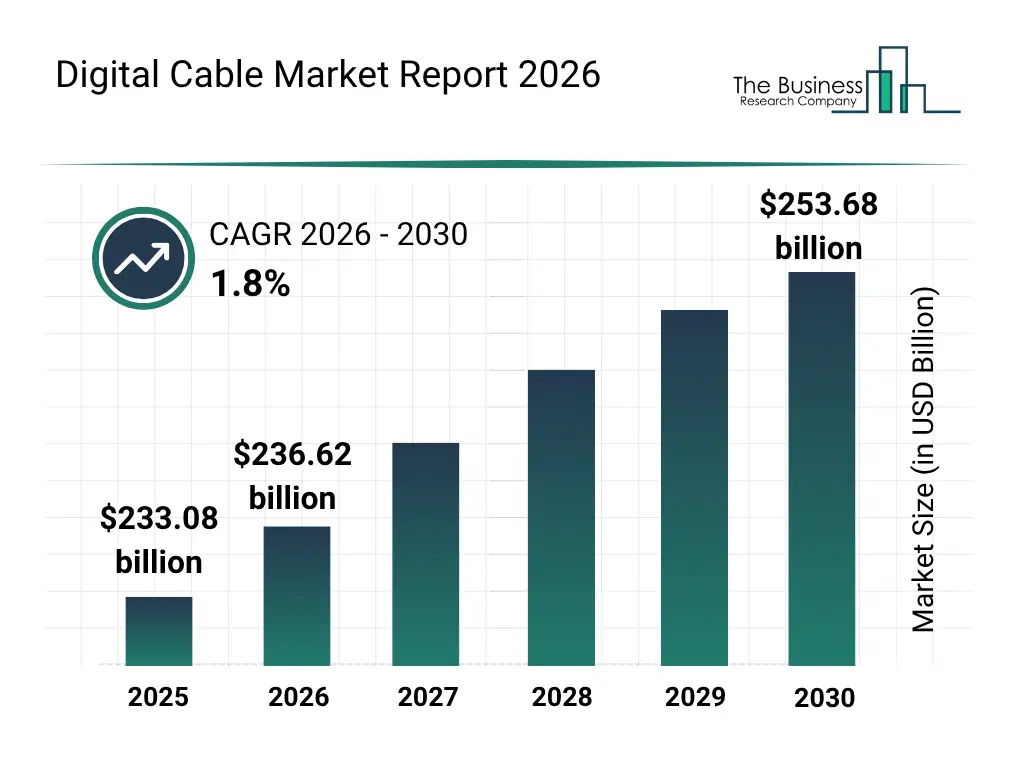
What Is The Digital Cable Market Size and Share 2026?
The digital cable market size has grown marginally in recent years. It will grow from $233.08 billion in 2025 to $236.62 billion in 2026 at a compound annual growth rate (CAGR) of 1.5%. The growth in the historic period can be attributed to analog to digital broadcasting transition, increasing demand for high definition content, expansion of broadband penetration, growth of cable television subscriber base, technological upgrades in set top box infrastructure.What Is The Digital Cable Market Growth Forecast?
The digital cable market size is expected to see marginal growth in the next few years. It will grow to $253.68 billion by 2030 at a compound annual growth rate (CAGR) of 1.8%. The growth in the forecast period can be attributed to rising adoption of hybrid streaming and cable models, increasing demand for personalized content delivery, expansion of fiber optic cable networks, growth in interactive and on demand services, integration of AI based content optimization systems. Major trends in the forecast period include IP-based digital cable delivery transformation, hybrid fiber coaxial (hfc) network upgradation, cloud based video streaming integration with cable networks, AI driven content recommendation and channel optimization, advanced video on demand and interactive tv expansion.
Global Digital Cable Market Segmentation
1) By Component: Hardware, Software, Services 2) By Transmission Type: Hybrid Fiber-Coaxial (HFC), Fiber Optic Cable Systems, Coaxial Cable Systems 3) By Application: Television Broadcasting, Internet And Broadband Services, Bundled Services 4) By End User: Residential, Commercial Subsegments: 1) By Hardware: Set-Top Boxes (STBs), Cable Modems, Cable Modem Termination Systems (CMTS), Remote PHY Devices (RPDs), Hybrid Fiber-Coaxial (HFC) Network Equipment, Amplifiers And Optical Nodes, Encoders And Transcoders, Conditional Access System (CAS) Hardware 2) By Software: Middleware Software, Electronic Program Guide (EPG) Software, Video Content Management Systems (CMS), Conditional Access Software (CAS), Digital Rights Management (DRM) Software, Network Management Software (NMS), Billing And Subscriber Management Software, Video Analytics Software 3) By Services: Installation And Integration Services, Managed Services, Maintenance And Support Services, Consulting Services, Content Delivery And Aggregation Services, Cloud-Based Video Services, Network Optimization ServicesWhat Is The Driver Of The Digital Cable Market?
The rising demand for high-speed internet connectivity is expected to propel the growth of the digital cable market going forward. High-speed broadband refers to internet connectivity that provides fast data transmission speeds, typically enabling smooth access to data-intensive applications such as video streaming, cloud services, online gaming, and remote work. The rising demand for high-speed broadband is driven by the rapid increase in data-intensive digital consumption as users rely on streaming, cloud, gaming, and remote work that require fast, reliable internet. Digital cable enables high-speed internet connectivity by transmitting large volumes of data through advanced broadband infrastructure. It improves network speed, reliability, and bandwidth efficiency, supporting seamless online communication and digital services. For instance, in December 2023, according to Ookla LLC, a US-based network intelligence company, the median 5G download speed saw a significant 20% jump in the third quarter of 2023, rising to 203.04 Mbps from 168.27 Mbps recorded in the third quarter of 2022. Therefore, the rising demand for high-speed internet connectivity is driving the growth of the digital cable industry.Key Players In The Global Digital Cable Market
Major companies operating in the digital cable market are Comcast Corporation; Deutsche Telekom AG; Huawei Technologies Co. Ltd.; Cisco Systems Inc.; Charter Communications Inc.; Vodafone Group Plc; Telefónica S.A.; Nokia Corporation; ZTE Corporation; Rogers Communications Inc.; Altice USA Inc.; Bouygues Telecom; Cox Communications Inc.; Technicolor Creative Studios S.A.; Liberty Global; CommScope Holding Company Inc.; Sagemcom SAS; Versant Media Group Inc.; Vecima Networks; Tata Play Limited.Global Digital Cable Market Trends and Insights
Major companies operating in the digital cable market are focusing on developing integrated linear and streaming platforms to expand content distribution, enhance viewer engagement, and create new monetization opportunities across pay-TV and digital ecosystems. Linear and streaming platforms deliver scheduled, real-time TV content over traditional channels, while streaming platforms provide on-demand or live content over the internet that users can watch anytime. For instance, in November 2025, NBCUniversal Media LLC, a US-based mass media and entertainment company, launched a new 24/7 linear channel, NBC Sports Network, to expand its sports distribution across pay-TV platforms. The network will debut first on YouTube TV, followed by availability on Xfinity and additional distributors. NBCSN will broadcast a diverse portfolio of live sports, including NBA, Premier League, college sports, and Olympic events, alongside studio programming.What Are Latest Mergers And Acquisitions In The Digital Cable Market?
In January 2025, Comcast Corporation, a US-based telecommunications and media company, extended its comprehensive distribution agreements with Paramount Global. This partnership aims to continue carriage of Paramount’s channels on Comcast’s Xfinity digital cable platform while expanding their multi-platform distribution across streaming services, supporting a hybrid cable and streaming ecosystem. Paramount Global is a US-based media company that provides streaming and digital television services.Regional Insights
North America was the largest region in the digital cable market in 2025. Asia-Pacific is expected to be the fastest-growing region in the forecast period. The regions covered in this market report are Asia-Pacific, South East Asia, Western Europe, Eastern Europe, North America, South America, Middle East, Africa. The countries covered in this market report are Australia, Brazil, China, France, Germany, India, Indonesia, Japan, Taiwan, Russia, South Korea, UK, USA, Canada, Italy, Spain.What Defines the Digital Cable Market?
The digital cable market consists of revenues earned by entities by providing services such as subscription-based channel delivery, pay-per-view services, video-on-demand offerings, interactive TV services, content packaging, and customer support services. The market value includes the value of related goods sold by the service provider or included within the service offering. The digital cable market also includes sales of set-top boxes, cable modems, conditional access systems, headend equipment, and signal distribution infrastructure. Values in this market are ‘factory gate’ values, that is, the value of goods sold by the manufacturers or creators of the goods, whether to other entities (including downstream manufacturers, wholesalers, distributors, and retailers) or directly to end customers. The value of goods in this market includes related services sold by the creators of the goods.How is Market Value Defined and Measured?
The market value is defined as the revenues that enterprises gain from the sale of goods and/or services within the specified market and geography through sales, grants, or donations in terms of the currency (in USD unless otherwise specified). The revenues for a specified geography are consumption values that are revenues generated by organizations in the specified geography within the market, irrespective of where they are produced. It does not include revenues from resales along the supply chain, either further along the supply chain or as part of other products.What Key Data and Analysis Are Included in the Digital Cable Market Report 2026?
The digital cable market research report is one of a series of new reports from The Business Research Company that provides market statistics, including industry global market size, regional shares, competitors with the market share, detailed market segments, market trends and opportunities, and any further data you may need to thrive in the digital cable industry. The market research report delivers a complete perspective of everything you need, with an in-depth analysis of the current and future state of the industry.Digital Cable Market Report Forecast Analysis
| Report Attribute | Details |
|---|---|
| Market Size Value In 2026 | $236.62 billion |
| Revenue Forecast In 2035 | $253.68 billion |
| Growth Rate | CAGR of 1.80% from 2026 to 2035 |
| Base Year For Estimation | 2025 |
| Actual Estimates/Historical Data | 2020-2025 |
| Forecast Period | 2026 - 2030 - 2035 |
| Market Representation | Revenue in USD Billion and CAGR from 2026 to 2035 |
| Segments Covered | Component, Transmission Type, Application, End User |
| Regional Scope | Asia-Pacific, Western Europe, Eastern Europe, North America, South America, Middle East, Africa |
| Country Scope | The countries covered in the digital cable market report are Australia, Brazil, China, France, Germany, India, Indonesia, Japan, Taiwan, Russia, South Korea, UK, USA, Canada, Italy, Spain. |
| Key Companies Profiled | Comcast Corporation; Deutsche Telekom AG; Huawei Technologies Co. Ltd.; Cisco Systems Inc.; Charter Communications Inc.; Vodafone Group Plc; Telefónica S.A.; Nokia Corporation; ZTE Corporation; Rogers Communications Inc.; Altice USA Inc.; Bouygues Telecom; Cox Communications Inc.; Technicolor Creative Studios S.A.; Liberty Global; CommScope Holding Company Inc.; Sagemcom SAS; Versant Media Group Inc.; Vecima Networks; Tata Play Limited. |
| Customization Scope | Request for Customization |
| Pricing And Purchase Options | Explore Purchase Options |