
Device Vulnerability Management Market Report 2026

Device Vulnerability Management Market Report 2026
Global Outlook – By Component (Service, Solution), By Functionality (Vulnerability Identification and Scanning, Risk Assessment and Prioritization, Patch Management and Remediation, Configuration and Compliance Management, Threat Intelligence Integration, Continuous Monitoring, Incident Response Support), By Deployment (On-Premise, Cloud), By Application (Small And Medium-Sized Business (SMBS), Large Enterprises), By End-Use (Retail, Banking, Information And Telecom, Financial Services, Government, Healthcare, Defense, Other End-Uses) – Market Size, Trends, Strategies, and Forecast to 2035
Device Vulnerability Management Market Overview
• Device Vulnerability Management market size has reached to $12.41 billion in 2025 • Expected to grow to $23.46 billion in 2030 at a compound annual growth rate (CAGR) of 13.6% • Growth Driver: Rising Cybersecurity Threats Fueling The Growth Of The Market Due To Increasing Digital Transformation And Expanding Network Attack Surfaces • Market Trend: Advanced Endpoint Solutions Enable Rapid Identification And Remediation Of Vulnerabilities • North America was the largest region in 2025 and Asia-Pacific is the fastest growing region.

What Is Covered Under Device Vulnerability Management Market?
Device vulnerability management refers to the continuous process of identifying, assessing, prioritizing, and remediating security vulnerabilities in connected devices such as computers, servers, mobile devices, and network equipment. It involves scanning devices for known weaknesses, misconfigurations, outdated software, and security gaps that could be exploited by cyber threats. It helps to reduce security risks, prevent unauthorized access, ensure compliance with security standards, and maintain the integrity and reliability of IT infrastructure through proactive risk mitigation. The main components of device vulnerability management solutions include services and solutions. Solutions comprise software platforms for identifying vulnerabilities, assessing risks, managing patches, ensuring configuration compliance, integrating threat intelligence, and supporting continuous monitoring. The main deployment modes include on-premise and cloud solutions, offering flexible, scalable, and secure management. The various functionalities include vulnerability identification and scanning, risk assessment and prioritization, Patch Management and remediation, configuration and compliance management, threat intelligence integration, continuous monitoring, and incident response support. These solutions are applied across small and medium-sized businesses (SMBs) and large enterprises, and are used by end users in retail, banking, information and telecom, financial services, government, healthcare, defense, and other sectors, providing proactive security, threat mitigation, and enhanced device protection.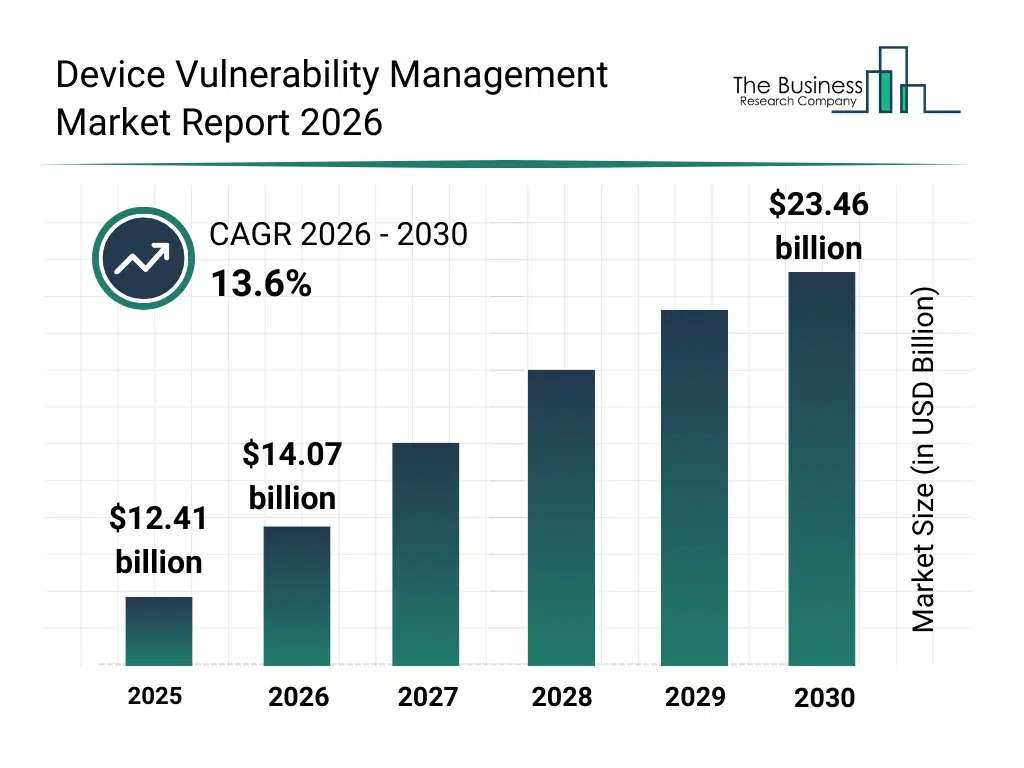
What Is The Device Vulnerability Management Market Size and Share 2026?
The device vulnerability management market size has grown rapidly in recent years. It will grow from $12.41 billion in 2025 to $14.07 billion in 2026 at a compound annual growth rate (CAGR) of 13.4%. The growth in the historic period can be attributed to rising cyberattacks and security breaches, increasing adoption of connected devices and enterprise IT infrastructure, growth in regulatory compliance requirements, rising awareness of cybersecurity risks, expansion of cloud-based IT services.What Is The Device Vulnerability Management Market Growth Forecast?
The device vulnerability management market size is expected to see rapid growth in the next few years. It will grow to $23.46 billion in 2030 at a compound annual growth rate (CAGR) of 13.6%. The growth in the forecast period can be attributed to growing adoption of ai-driven vulnerability management tools, increasing integration of iot devices in enterprises, rising demand for automated risk remediation, expansion of Managed Security Services, increasing regulatory pressure on data security and privacy. Major trends in the forecast period include increasing adoption of continuous vulnerability monitoring services, rising demand for automated patch management solutions, expansion of threat intelligence integration platforms, growing focus on compliance and regulatory reporting solutions, increasing use of risk prioritization and remediation tools.Global Device Vulnerability Management Market Segmentation
1) By Component: Service, Solution 2) By Functionality: Vulnerability Identification and Scanning, Risk Assessment and Prioritization, Patch Management and Remediation, Configuration and Compliance Management, Threat Intelligence Integration, Continuous Monitoring, Incident Response Support 3) By Deployment: On-Premise, Cloud 4) By Application: Small And Medium-Sized Business (SMBS), Large Enterprises 5) By End-Use: Retail, Banking, Information And Telecom, Financial Services, Government, Healthcare, Defense, Other End-Uses Subsegments: 1) By Service: Consulting And Advisory Services, Implementation And Integration Services, Continuous Monitoring Services, Incident Response Services, Training And Support Services 2) By Solution: Vulnerability Assessment Solutions, Patch Management Solutions, Risk Prioritization Solutions, Threat Intelligence Solutions, Compliance Management SolutionsWhat Is The Driver Of The Device Vulnerability Management Market?
The rising cybersecurity threats are expected to propel the growth of the device vulnerability management market going forward. Cybersecurity threats refer to malicious activities or attacks that target computer systems, networks, or data to disrupt operations, steal information, or cause damage. The rising frequency and sophistication of cybersecurity threats are driven by rapid digital transformation, as increased connectivity and cloud adoption expand the attack surface and create more opportunities for advanced cyberattacks. Device vulnerability management helps reduce cybersecurity threats by continuously identifying, assessing, and remediating security weaknesses across endpoints, servers, and network-connected devices. It minimizes the risk of data breaches and system disruptions by enabling timely patching, configuration management, and proactive threat mitigation, thereby strengthening the overall organizational security posture. For instance, in April 2025, according to the Federal Bureau of Investigation, a US-based government law enforcement agency, a total of 859,532 suspected internet crime complaints were filed, with reported losses exceeding $16 billion, reflecting a 33% increase compared to 2023. Therefore, the rising cybersecurity threats are driving the growth of the device vulnerability management industry.Key Players In The Global Device Vulnerability Management Market
Major companies operating in the device vulnerability management market are Microsoft Corporation, Dell Technologies Inc., International Business Machines Corporation, Hewlett Packard Enterprise Company, Fortinet Inc., CrowdStrike Holdings Inc., Check Point Software Technologies Ltd., Fortra Inc., Tenable Inc., Rapid7 Inc., SentinelOne Inc., Qualys Inc., NetSPI LLC, Pentera Ltd., GFI Software Ltd., SecPod Technologies Pvt. Ltd., Eclypsium Inc., Nucleus Security Inc., Greenbone Networks GmbH, and TAC Security Pvt. Ltd.Global Device Vulnerability Management Market Trends and Insights
Major companies operating in the device vulnerability management market are focusing on integrating endpoint vulnerability scanning and breach prevention platforms to enhance security, minimize risks, and improve operational resilience. Endpoint vulnerability scanning and breach prevention platforms refer to systems that continuously identify, assess, and remediate security vulnerabilities across endpoints, networks, and cloud environments while providing automated guidance and threat mitigation. For instance, in April 2025, N-able, a US-based software vendor, introduced built-in vulnerability management for its unified endpoint management solutions, along with Adlumin breach prevention integration for Microsoft 365 within the N-able Ecoverse platform. This new solution focuses on delivering real-time vulnerability detection, risk prioritization, and automated remediation, which helps managed service providers safeguard client systems against identity-based attacks and security breaches. It is engineered to support complex enterprise IT environments, including endpoints, cloud services, and Microsoft 365 ecosystems, ensuring consistent, scalable, and robust protection for mission-critical applications, sensitive data, and compliance requirements.What Are Latest Mergers And Acquisitions In The Device Vulnerability Management Market?
In April 2025, Finite State Inc., a US-based software company, partnered with Somos Inc. This partnership aims to strengthen software supply chain security and enhance cybersecurity risk management across critical telecommunications and digital infrastructure systems. Somos Inc. is a US-based telecommunications services company supporting device vulnerability management and network security.Regional Insights
North America was the largest region in the device vulnerability management market in 2025. Asia-Pacific is expected to be the fastest-growing region in the forecast period. The regions covered in this market report are Asia-Pacific, South East Asia, Western Europe, Eastern Europe, North America, South America, Middle East, Africa. The countries covered in this market report are Australia, Brazil, China, France, Germany, India, Indonesia, Japan, Taiwan, Russia, South Korea, UK, USA, Canada, Italy, Spain.What Defines the Device Vulnerability Management Market?
The device vulnerability management market includes revenues earned by entities through penetration testing, security auditing, incident response support, asset discovery, configuration hardening, compliance reporting, and continuous monitoring services. The market value includes the value of related goods sold by the service provider or included within the service offering. Only goods and services traded between entities or sold to end consumers are included.How is Market Value Defined and Measured?
The market value is defined as the revenues that enterprises gain from the sale of goods and/or services within the specified market and geography through sales, grants, or donations in terms of the currency (in USD unless otherwise specified). The revenues for a specified geography are consumption values that are revenues generated by organizations in the specified geography within the market, irrespective of where they are produced. It does not include revenues from resales along the supply chain, either further along the supply chain or as part of other products.What Key Data and Analysis Are Included in the Device Vulnerability Management Market Report 2026?
The device vulnerability management market research report is one of a series of new reports from The Business Research Company that provides device vulnerability management market statistics, including device vulnerability management industry global market size, regional shares, competitors with a device vulnerability management market share, detailed device vulnerability management market segments, market trends and opportunities, and any further data you may need to thrive in the device vulnerability management industry. This device vulnerability management market research report delivers a complete perspective of everything you need, with an in-depth analysis of the current and future scenario of the industry.Device Vulnerability Management Market Report Forecast Analysis
| Report Attribute | Details |
|---|---|
| Market Size Value In 2026 | $14.07 billion |
| Revenue Forecast In 2035 | $23.46 billion |
| Growth Rate | CAGR of 13.4% from 2026 to 2035 |
| Base Year For Estimation | 2025 |
| Actual Estimates/Historical Data | 2020-2025 |
| Forecast Period | 2026 - 2030 - 2035 |
| Market Representation | Revenue in USD Billion and CAGR from 2026 to 2035 |
| Segments Covered | Component, Functionality, Deployment, Application, End-Use |
| Regional Scope | Asia-Pacific, Western Europe, Eastern Europe, North America, South America, Middle East, Africa |
| Country Scope | The countries covered in the report are Australia, Brazil, China, France, Germany, India, ... |
| Key Companies Profiled | Microsoft Corporation, Dell Technologies Inc., International Business Machines Corporation, Hewlett Packard Enterprise Company, Fortinet Inc., CrowdStrike Holdings Inc., Check Point Software Technologies Ltd., Fortra Inc., Tenable Inc., Rapid7 Inc., SentinelOne Inc., Qualys Inc., NetSPI LLC, Pentera Ltd., GFI Software Ltd., SecPod Technologies Pvt. Ltd., Eclypsium Inc., Nucleus Security Inc., Greenbone Networks GmbH, and TAC Security Pvt. Ltd. |
| Customization Scope | Request for Customization |
| Pricing And Purchase Options | Explore Purchase Options |
Frequently Asked Questions
The Device Vulnerability Management market was valued at $12.41 billion in 2025, increased to $14.07 billion in 2026, and is projected to reach $23.46 billion by 2030.
request a sample hereThe global Device Vulnerability Management market is expected to grow at a CAGR of 13.6% from 2026 to 2035 to reach $23.46 billion by 2035.
request a sample hereSome Key Players in the Device Vulnerability Management market Include, Microsoft Corporation, Dell Technologies Inc., International Business Machines Corporation, Hewlett Packard Enterprise Company, Fortinet Inc., CrowdStrike Holdings Inc., Check Point Software Technologies Ltd., Fortra Inc., Tenable Inc., Rapid7 Inc., SentinelOne Inc., Qualys Inc., NetSPI LLC, Pentera Ltd., GFI Software Ltd., SecPod Technologies Pvt. Ltd., Eclypsium Inc., Nucleus Security Inc., Greenbone Networks GmbH, and TAC Security Pvt. Ltd..
request a sample hereMajor trend in this market includes: Advanced Endpoint Solutions Enable Rapid Identification And Remediation Of Vulnerabilities. For further insights on this market.
request a sample hereNorth America was the largest region in the device vulnerability management market in 2025. Asia-Pacific is expected to be the fastest-growing region in the forecast period. The regions covered in the device vulnerability management market report are Asia-Pacific, South East Asia, Western Europe, Eastern Europe, North America, South America, Middle East, Africa.
request a sample here