
Controlled Environment Agriculture Market 2026

Controlled Environment Agriculture Market 2026
By Component (Hardware, Software And Services), By Growing Method (Hydroponics, Aeroponics, Aquaponics, Other Growing Methods), By Crop Types (Tomato, Leafy Greens, Strawberries, Cucumber, Pepper, Cannabis, Other Crop Types), And By Region, Opportunities And Strategies – Global Forecast To 2035
Controlled Environment Agriculture Market Definition
Controlled Environment Agriculture (CEA) refers to the process of cultivating plants within enclosed or semi-enclosed structures where environmental variables such as temperature, humidity, light, carbon dioxide levels, and nutrient supply are closely monitored and regulated. It is an advanced form of agricultural production that includes greenhouses, vertical farms, indoor farms, and growth chambers. The controlled environment agriculture market consists of sales, by entities (organizations, sole traders, or partnerships), of agricultural products produced within enclosed or semi-enclosed structures where environmental conditions such as light, temperature, humidity, and nutrient levels are precisely managed to optimize crop growth and yield.

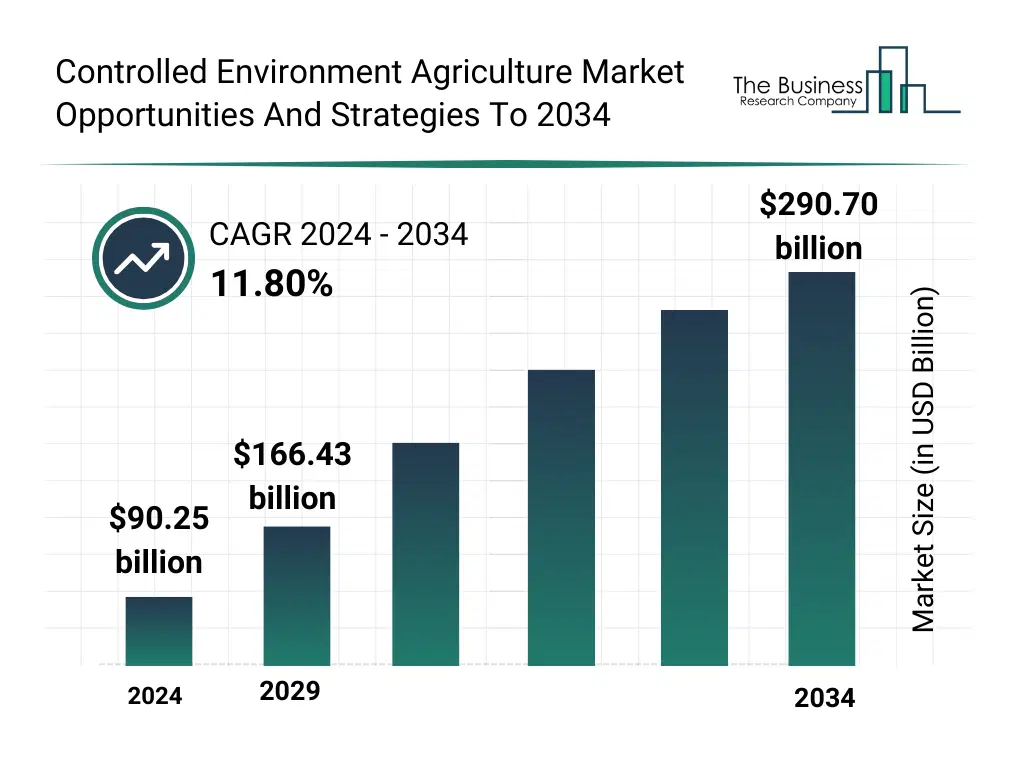
Controlled Environment Agriculture Market Size
The global controlled environment agriculture market reached a value of nearly $90,251.92 million in 2024, having grown at a compound annual growth rate (CAGR) of 9.49% since 2019. The market is expected to grow from $90,251.92 million in 2024 to $166,429.25 million in 2029 at a rate of 13.02%. The market is then expected to grow at a CAGR of 11.80% from 2029 and reach $290,699.89 million in 2034. Growth in the historic period resulted from shift towards plant-based and alternative proteins, growing consumer demand for organic food, growing development of climate-resilient crop varieties and rising water scarcity concerns. Factors that negatively affected growth in the historic period were high initial capital and operational costs and high energy consumption. Going forward, rising awareness of sustainable farming practices, rising climate change patterns, growing uses of precision agriculture practices and increasing awareness to reduce greenhouse gas emissions will drive the growth. Factors that could hinder the growth of the controlled environment agriculture market in the future include skilled labor shortage, limited crop variety viability and impact of trade war and tariff.Controlled Environment Agriculture Market Drivers
The key drivers of the controlled environment agriculture market include: Rising Awareness Of Sustainable Farming Practices Growing awareness of sustainable farming practices is expected to be a major factor driving the expansion of the controlled environment agriculture (CEA) market in the coming years. As global food demand increases and pressure mounts to reduce land and water consumption, CEA offers a highly efficient alternative to conventional farming. By enabling year-round cultivation with closed-loop systems and precise resource management, CEA significantly lowers water, energy, and fertilizer use. Both consumers and corporations are placing greater value on eco-friendly food production methods that minimize waste and environmental impact. In addition, governments and sustainability-oriented organizations are actively supporting the development of resilient food systems by promoting technologies that boost productivity while conserving resources. This growing emphasis on sustainability is directly fueling investment in greenhouse systems, hydroponics, and vertical farming — the core technologies driving the CEA industry forward. The rising awareness of sustainable farming practices growth contribution during the forecast period in 2024 is 1.34%.Controlled Environment Agriculture Market Restraints
The key restraints on the controlled environment agriculture market include: Skilled Labor Shortage The shortage of skilled labor is expected to hinder the growth of the controlled environment agriculture (CEA) market during the forecast period. Unlike traditional farming, CEA operations require specialized expertise in areas such as horticulture, automation, data analytics, and environmental control systems. Workers must be proficient in managing complex technologies that integrate sensors, nutrient delivery systems, software platforms, and lighting controls. However, much of the existing agricultural workforce lacks this technical proficiency, resulting in a significant skills gap between labor availability and operational needs. Training new personnel is both costly and time-intensive, further increasing the overall operational expenses of CEA facilities. The limited availability of qualified technicians, agronomists, and system operators can also lead to inefficiencies, system malfunctions, and lower productivity levels. This persistent shortage of skilled professionals remains a major constraint, slowing adoption in developing markets and restricting the overall expansion potential of the CEA industry. Growth affected by skilled labor shortage production during the forecast period in 2024 is -1.00%Controlled Environment Agriculture Market Trends
Major trends shaping the controlled environment agriculture market include: Expansion Of Academic-Industry Collaboration Networks To Advance CEA Research And Workforce Development Companies in the market are focusing on expanding academic-industry collaboration networks to accelerate innovation in Controlled Environment Agriculture (CEA). These partnerships facilitate advanced research on sustainable production technologies, automation, and resource optimization. By engaging universities and research institutions, companies can access cutting-edge knowledge and skilled talent pipelines. Such collaborations enhance workforce development through specialized training and certification programs. Ultimately, these efforts strengthen industry capabilities, reduce operational costs, and drive the overall growth and competitiveness of the CEA market. For example, in October 2025, University of Wyoming, a US-based land-grant research university, launched the Controlled Environment Agriculture (CEA) Network, a transformative initiative to accelerate workforce development, research and innovation in agriculture’s fastest-growing sectors. The network connects industry partners and other CEA stakeholders so that they can collaborate on projects, share knowledge and engage in joint research and discussions. Participants will help drive CEA workforce development by exposing students to CEA technologies and providing hands-on experiences and internships. Integration Of Artificial Intelligence Assistants To Enhance Operational Efficiency And Decision-Making In Indoor Farming Major players in the CEA market are focusing on integrating Artificial Intelligence (AI) assistants to enhance operational efficiency and data-driven decision-making in indoor farming. AI-powered systems help monitor crop health, optimize resource use, and predict environmental conditions for higher yields. These tools enable real-time analysis of lighting, temperature, and nutrient levels, reducing human error and production costs. By automating routine tasks, AI assistants free up labor for higher-value operations. This technological integration drives productivity, sustainability, and profitability, thereby supporting the overall growth of the Controlled Environment Agriculture market. For example, in July 2025, Square Roots, a US-based indoor farming platform, launched Sage, an artificial intelligence assistant embedded in its farming platform. Designed as a digital copilot, Sage is intended to make complex agricultural tasks more accessible by delivering contextual, task-specific support to Square Roots’ farmers in real time. Sage is available inside the company's Farmer Toolbelt Operating System, a proprietary software platform developed to manage crop production, monitor climate conditions, and guide farm operations. Farmers can interact with Sage to ask questions related to harvesting, equipment handling, system cleaning, and other daily tasks without having to consult lengthy documentation or standard operating procedures.Opportunities And Recommendations In The Controlled Environment Agriculture Market
Opportunities – The top opportunities in the controlled environment agriculture market segmented by component will arise in the hardware segment, which will gain $44,287.44 million of global annual sales by 2029. The top opportunities in the controlled environment agriculture market segmented by growing method will arise in the hydroponics segment, which will gain $32,623.84 million of global annual sales by 2029. The top opportunities in the controlled environment agriculture market segmented by crop types will arise in the tomato segment, which will gain $26,010.24 million of global annual sales by 2029. The controlled environment agriculture market size will gain the most in China at $16,492.22 million. Recommendations- To take advantage of the opportunities, The Business Research Company recommends the controlled environment agriculture companies to focus on integrating ai assistants to improve indoor farming efficiency, focus on energy-efficient lighting to enhance sustainability and productivity, focus on integrated climate control systems to optimize cultivation environments, focus on spectrum-tunable led technologies to enhance crop yield , focus on decentralized direct air capture for onsite co₂ utilization, focus on software and services to drive growth in cea, focus on aeroponics to capture high-growth opportunities in cea, focus on cannabis to drive high-growth opportunities in cea, focus on expanding distribution through academic-industry collaboration, expand in emerging markets, continue to focus on developed markets, provide competitively priced offerings, provide competitively priced offerings, focus on engaging supermarkets and grocery retailers as key end-users.Controlled Environment Agriculture Market Segmentation
The controlled environment agriculture market is segmented by component, by growing method and by crop types.By Component –
The controlled environment agriculture market is segmented by component into:
- a) Hardware
- b) Software
- c) Services
By Growing Method –
The controlled environment agriculture market is segmented by growing method into:
- a) Hydroponics
- b) Aeroponics
- c) Aquaponics
- d) Other Growing Methods
By Crop Types –
The controlled environment agriculture market is segmented by crop types into:
- a) Tomato
- b) Leafy Greens
- c) Strawberries
- d) Cucumber
- e) Pepper
- e) Cannabis
- e) Other Crop Types
By Geography - The controlled environment agriculture market is segmented by geography into:
- • China
- • India
- • Japan
- • Australia
- • Indonesia
- • South Korea
- • Bangladesh
- • Thailand
- • Vietnam
- • Malaysia
- • Singapore
- • Phillipines
- • Hong kong
- • New Zealand
- • USA
- • Canada
- • Mexico
- • Brazil
- • Argentina
- • Chile
- • Colombiia
- • Peru
- • France
- • Germany
- • UK
- • Italy
- • Spain
- • Austria
- • Belgium
- • Denmark
- • Finland
- • Ireland
- • Netherland
- • Norway
- • Portugal
- • Sweden
- • Switzerland
- • Russia
- • Czech Republic
- • Poland
- • Romania
- • Ukraine
- • Saudi Arabia
- • Israel
- • Iran
- • Turkey
- • UAE o Africa
- • Egypt
- • Nigeria
- • South Africa
-
o Asia Pacific