
Connected Airside Personal Protective Equipment (PPE) Market Report 2026
Global Outlook – By Product Type (Smart Helmets, Smart Vests, Smart Glasses, Smart Gloves, Other Product Types), By Connectivity (Bluetooth, Wireless Fidelity (Wi-Fi), Radio-Frequency Identification, Other Connectivities), By Application (Airports, Airlines, Ground Handling, Cargo, Other Applications), By End-User (Ground Staff, Maintenance Crew, Security Personnel, Other End-Users) – Market Size, Trends, Strategies, and Forecast to 2035
Connected Airside Personal Protective Equipment (PPE) Market Overview
• Connected Airside Personal Protective Equipment (PPE) market size has reached to $1.42 billion in 2025 • Expected to grow to $2.67 billion in 2030 at a compound annual growth rate (CAGR) of 13.4% • Growth Driver: Rising Demand For Digital Transformation In Airport Operations Driving The Growth Of The Market Due To Increasing Need For Real-time Monitoring And Enhanced Operational Safety • North America was the largest region in 2025 and Asia-Pacific is the fastest growing region.What Is Covered Under Connected Airside Personal Protective Equipment (PPE) Market?
Connected airside personal protective equipment (PPE) refers to smart safety gear used by airport ground and airside personnel that is embedded with sensors, IoT connectivity, and tracking technologies. Its primary purpose is to enhance worker safety and operational visibility on the airside by enabling real-time hazard alerts, improving situational awareness, and ensuring compliance with airport safety protocols. It also helps optimize incident response and workforce coordination by continuously transmitting safety and location data to airport operations control systems. The main product types of connected airside personal protective equipment (PPE) include smart helmets, smart vests, smart glasses, smart gloves, and other product types. Smart helmets refer to advanced protective headgear integrated with sensors and communication technologies to enhance safety and operational efficiency in airside environments. These products are enabled by connectivity options such as Bluetooth, wireless fidelity (Wi-Fi), radio-frequency identification, and other connectivity's. The key applications of airports, airlines, ground handling, cargo, and others, while the end-use includes ground staff, maintenance crew, security personnel, and others.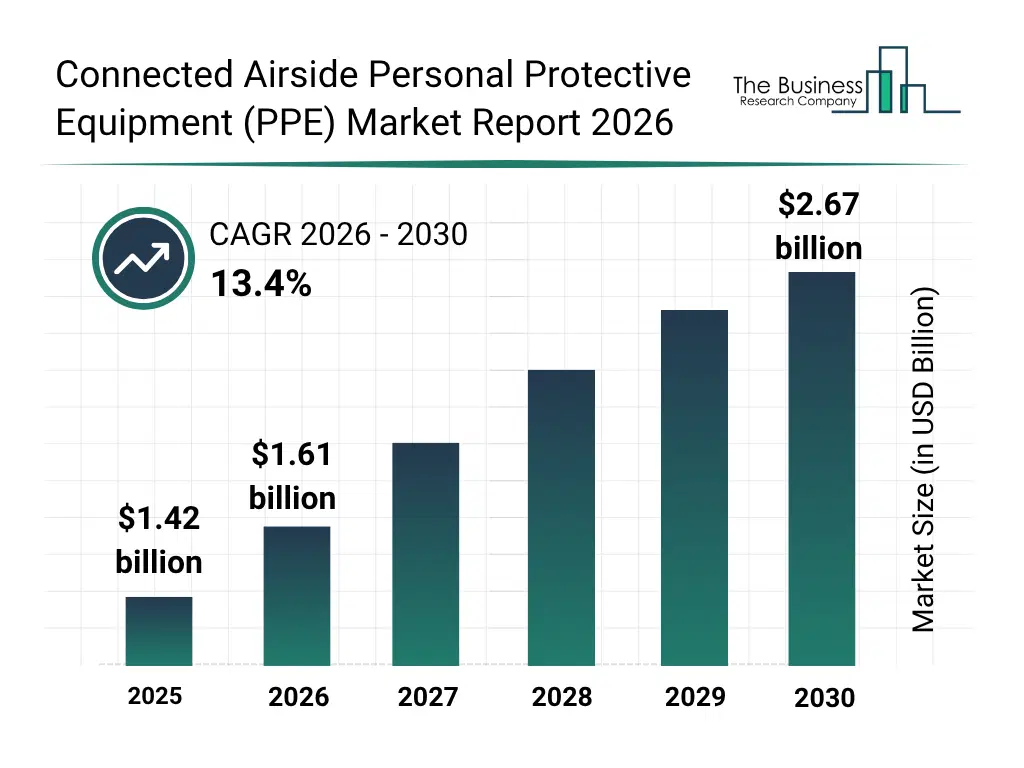
What Is The Connected Airside Personal Protective Equipment (PPE) Market Size and Share 2026?
The connected airside personal protective equipment (PPE) market size has grown rapidly in recent years.It will grow from $1.42 billion in 2025 to $1.61 billion in 2026 at a compound annual growth rate (CAGR) of 13.2%. The growth in the historic period can be attributed to manual airside safety compliance processes, limited adoption of IoT-enabled PPE in airport operations, increasing airside accident and incident rates, early-stage digitization of airport ground operations, basic non-connected personal protective equipment usage.What Is The Connected Airside Personal Protective Equipment (PPE) Market Growth Forecast?
The connected airside personal protective equipment (PPE) market size is expected to see rapid growth in the next few years.It will grow to $2.67 billion by 2030 at a compound annual growth rate (CAGR) of 13.4%. The growth in the forecast period can be attributed to expansion of real-time airside workforce monitoring systems, increasing adoption of IoT-enabled smart PPE across airports, rising demand for predictive safety analytics and incident prevention, growth of integrated airport digital twin and operational visibility platforms, stricter aviation safety regulations and compliance automation requirements.Major trends in the forecast period include enhanced airside safety compliance mandates and audits, real-time geofenced workforce zoning and restricted area enforcement, heat stress and fatigue monitoring for airside personnel via wearables, standardization of connected ppe interoperability and aviation safety certification, incident prevention and rapid emergency response coordination systems.
Global Connected Airside Personal Protective Equipment (PPE) Market Segmentation
1) By Product Type: Smart Helmets, Smart Vests, Smart Glasses, Smart Gloves, Other Product Types 2) By Connectivity: Bluetooth, Wireless Fidelity (Wi-Fi), Radio-Frequency Identification, Other Connectivities 3) By Application: Airports, Airlines, Ground Handling, Cargo, Other Applications 4) By End-User: Ground Staff, Maintenance Crew, Security Personnel, Other End-Users Subsegments: 1) By Smart Helmets: Head Protection, Communication Enabled, Vision Augmented, Environmental Sensing, Impact Resistant 2) By Smart Vests: High Visibility, Impact Absorbing, Temperature Regulating, Health Monitoring, Communication Enabled 3) By Smart Glasses: Augmented Reality, Safety Shield, Vision Correction, Head Up Display, Environmental Sensing 4) By Smart Gloves: Cut Resistant, Heat Resistant, Impact Absorbing, Sensor Enabled, Grip Enhanced 5) By Other Product Types: Smart Boots, Smart Ear Protection, Smart Belts, Smart Jackets, Smart Knee PadsWhat Are The Drivers Of The Connected Airside Personal Protective Equipment (PPE) Market?
The rising demand for digital transformation in airport operations is expected to propel the growth of the connected airside personal protective equipment (PPE) industry going forward.Digital transformation refers to the adoption of advanced technologies and digital systems by airports to replace manual processes, improve efficiency, enhance safety, and increase operational visibility across all airport functions.The increasing demand for digital transformation is due to the rapid recovery of air travel, which has increased passenger volumes and operational complexity, requiring smarter, data-driven solutions.Connected Airside PPE supports digital transformation by enabling real-time monitoring of airside personnel, integrating with airport IT systems, and enhancing safety, efficiency, and operational coordination.For instance, in April 2023, according to Airports Council International (ACI) World, a Canada-based airport trade association, 93% of airports worldwide maintained or increased their IT spending in 2023 compared to 2022, with total IT investment reaching an estimated USD 6.8 billion to accelerate digitalization and streamline operations.Therefore, the rising demand for digital transformation in airport operations is driving the growth of the connected airside personal protective equipment (PPE) industry. The rising air traffic is expected to propel the growth of the connected airside personal protective equipment (PPE) industry going forward.Air traffic refers to the total number of passengers and aircraft movements across domestic and international air transport networks, reflecting the overall demand for air travel.The increase in global air traffic is driven by the recovery of international travel and growing passenger demand, leading to higher aircraft frequency and more complex airport ground operations.Connected airside PPE supports rising air traffic management by enabling real-time monitoring of ground personnel, improving situational awareness, and reducing the risk of accidents in increasingly congested airside environments, thereby ensuring safer and more efficient aircraft turnaround operations.For instance, in September 2023, according to the International Air Transport Association, a Canada-based airline industry association, global air traffic (measured in revenue passenger kilometers) increased by 26.2% in July 2023 compared to July 2022.Therefore, the rising air traffic is driving the growth of the connected airside personal protective equipment (PPE) industry. The rising labor costs are expected to propel the growth of the connected airside personal protective equipment (PPE) industry going forward.Labor costs refer to the total expenses incurred by organizations for employing workers, including wages, benefits, and training costs.The increase in labor costs due to stricter labor regulations is encouraging organizations to adopt advanced technologies that enhance worker productivity and safety while reducing operational inefficiencies.Connected airside personal protective equipment (PPE) reduces labor costs by enabling real-time worker monitoring and automated safety alerts, minimizing manual supervision, preventing incidents, and improving workforce productivity through data-driven operations.For instance, in March 2026, according to the U.S.Bureau of Labor Statistics, a US-based federal agency, unit labor costs in the nonfarm business sector recorded a 4.4% increase in the fourth quarter of 2025, primarily driven by a 6.3% rise in hourly compensation, partially offset by a 1.8% improvement in productivity.Therefore, the rising labor costs are driving the growth of the connected airside personal protective equipment (PPE) industry.Key Players In The Global Connected Airside Personal Protective Equipment (PPE) Market
Major companies operating in the connected airside personal protective equipment (ppe) market are Robert Bosch GmbH, Honeywell International Inc., 3M Company, DuPont de Nemours Inc., MSA Safety Incorporated, Ansell Limited, Samsara Inc., Uvex Group, Bullard Company, Kinexon GmbH, RealWear Inc., Trio Mobil Teknoloji A. Ş., Vuzix Corporation, Triax Technologies, ProGlove GmbH, Guardhat Inc., Globus Group, Carré Technologies Inc., ThirdEye Gen Inc., Kenzen Inc.Regional Insights
North America was the largest region in the connected airside personal protective equipment (PPE) market in 2025. Asia-Pacific is expected to be the fastest-growing region in the forecast period. The regions covered in this market report are Asia-Pacific, South East Asia, Western Europe, Eastern Europe, North America, South America, Middle East and Africa. The countries covered in this market report are Australia, Brazil, China, France, Germany, India, Indonesia, Japan, Taiwan, Russia, South Korea, UK, USA, Canada, Italy, Spain.What Defines the Connected Airside Personal Protective Equipment (PPE) Market?
The connected airside personal protective equipment (PPE) market consists of revenues earned by entities by providing services such as connected safety monitoring, real-time PPE tracking, compliance reporting, and analytics for airside operations. The market value includes the value of related goods sold by the service provider or included within the service offering. The connected airside personal protective equipment (PPE) market also includes sales of wearable sensors, location tracking badges, gas and environmental monitoring devices, biometric wearables, and IoT-enabled communication devices. Values in this market are ‘factory gate’ values, that is, the value of goods sold by the manufacturers or creators of the goods, whether to other entities (including downstream manufacturers, wholesalers, distributors, and retailers) or directly to end customers. The value of goods in this market includes related services sold by the creators of the goods, such as installation, subscription services, and maintenance.What is the Market Assessment and Strategic Outlook for the Connected Airside Personal Protective Equipment (PPE) Industry?
The connected airside personal protective equipment (ppe) market research report is one of a series of new reports from The Business Research Company that provides market statistics, including industry global market size, regional shares, competitors with the market share, detailed market segments, market trends and opportunities, and any further data you may need to thrive in the connected airside personal protective equipment (ppe) industry. The market research report delivers a complete perspective of everything you need, with an in-depth analysis of the current and future state of the industry.What is the Market Assessment and Strategic Outlook for the Connected Airside Personal Protective Equipment (PPE) Market Report 2026?
The connected airside personal protective equipment (PPE) market research report is one of a series of new reports from The Business Research Company that provides connected airside personal protective equipment (PPE) market statistics, including connected airside personal protective equipment (PPE) industry global market size, regional shares, competitors with a connected airside personal protective equipment (PPE) market share, detailed connected airside personal protective equipment (PPE) market segments, market trends and opportunities, and any further data you may need to thrive in the connected airside personal protective equipment (PPE) industry. This connected airside personal protective equipment (PPE) market research report delivers a complete perspective of everything you need, with an in-depth analysis of the current and future scenario of the industry.Connected Airside Personal Protective Equipment (PPE) Market Report Forecast Analysis
| Report Attribute | Details |
|---|---|
| Market Size Value In 2026 | $1.61 billion |
| Revenue Forecast In 2035 | $2.67 billion |
| Growth Rate | CAGR of 13.4% from 2026 to 2035 |
| Base Year For Estimation | 2025 |
| Actual Estimates/Historical Data | 2020-2025 |
| Forecast Period | 2026 - 2030 - 2035 |
| Market Representation | Revenue in USD Billion and CAGR from 2026 to 2035 |
| Segments Covered | Product Type, Connectivity, Application, End-User |
| Regional Scope | Asia-Pacific, Western Europe, Eastern Europe, North America, South America, Middle East, Africa |
| Country Scope | The countries covered in the report are Australia, Brazil, China, France, Germany, India, Indonesia, Japan, Taiwan, Russia, South Korea, UK, USA, Canada, Italy, Spain. |
| Key Companies Profiled | Robert Bosch GmbH, Honeywell International Inc., 3M Company, DuPont de Nemours Inc., MSA Safety Incorporated, Ansell Limited, Samsara Inc., Uvex Group, Bullard Company, Kinexon GmbH, RealWear Inc., Trio Mobil Teknoloji A. Ş., Vuzix Corporation, Triax Technologies, ProGlove GmbH, Guardhat Inc., Globus Group, Carré Technologies Inc., ThirdEye Gen Inc., Kenzen Inc. |
| Customization Scope | Request for Customization |
| Pricing And Purchase Options | Explore Purchase Options |