
Carbon Farming Market Report 2026
Global Outlook – By Offering (Carbon Credit Generation Services, Carbon Monitoring, Reporting, And Verification Solutions, Soil And Biomass Measurement Technologies, Carbon Project Development Services, Advisory And Consulting Services), By Practice Type (Agroforestry, Conservation Tillage And No-Till Farming, Managed Grazing, Crop Rotation And Diversification, Cover Cropping, Composting And Biochar, Wetland And Peatland Restoration), By Carbon Credit Type (Soil Carbon Credits, Forestry Carbon Credits, Livestock Methane Reduction Credits, Biochar And Compost Credits), By Application (Agriculture, Forestry And Land Use), By End-User (Farmers And Ranchers, Government Agencies, Corporations, Non-Profit Organizations) – Market Size, Trends, Strategies, and Forecast to 2035
Carbon Farming Market Overview
• Carbon Farming market size has reached to $1.64 billion in 2025 • Expected to grow to $3.21 billion in 2030 at a compound annual growth rate (CAGR) of 14.4% • Growth Driver: Surge In Demand For Carbon Credits And Climate Mitigation Solutions Fueled The Market Growth Due To Rising Adoption Of Carbon Farming Practices • Market Trend: Advancing Methane-Reduction Practices In Rice Cultivation To Enable Scalable Carbon Credits And Strengthen Low-Carbon Agriculture • North America was the largest region in 2025 and Asia-Pacific is the fastest growing region.What Is Covered Under Carbon Farming Market?
Carbon farming refers to a set of land management practices designed to increase the amount of carbon stored in soil, vegetation, and biomass while reducing greenhouse gas emissions. It involves regenerative techniques such as improved soil management, reforestation, and sustainable agricultural methods that enhance natural carbon sequestration. Carbon farming also enables participation in carbon credit markets by generating measurable and verifiable carbon removal outcomes. The main offerings of carbon farming include carbon credit generation services, carbon monitoring, reporting, and verification solutions, soil and biomass measurement technologies, carbon project development services, and advisory and consulting services. Carbon credit generation services refer to services that calculate, certify, and facilitate the creation of tradable carbon credits from carbon sequestration activities. The practice types include agroforestry, conservation tillage and no-till farming, managed grazing, crop rotation and diversification, cover cropping, composting and biochar, and wetland and peatland restoration. The carbon credit types include soil carbon credits, forestry carbon credits, livestock methane reduction credits, and biochar and compost credits. The applications include agriculture and forestry and land use, catering to key end users such as farmers and ranchers, government agencies, corporations, and non-profit organizations.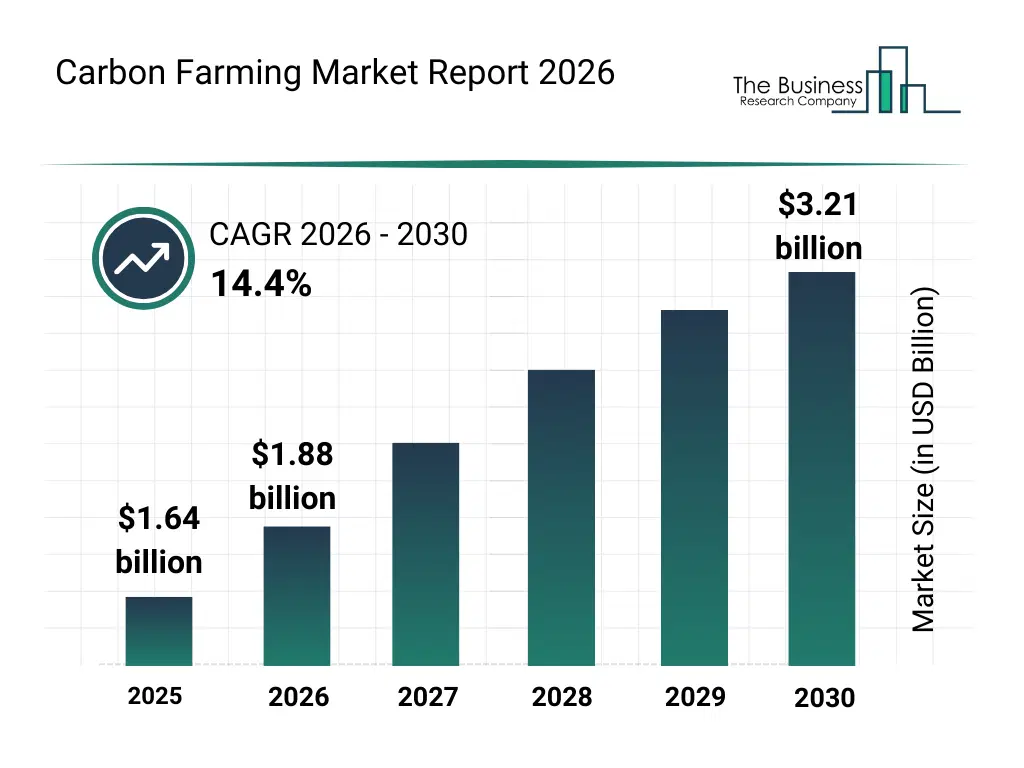
What Is The Carbon Farming Market Size and Share 2026?
The carbon farming market size has grown rapidly in recent years. It will grow from $1.64 billion in 2025 to $1.88 billion in 2026 at a compound annual growth rate (CAGR) of 14.7%. The growth in the historic period can be attributed to growing awareness of soil degradation, rising adoption of regenerative agriculture practices, increasing focus on climate-smart farming, early development of voluntary carbon markets, rising need for sustainable land management.What Is The Carbon Farming Market Growth Forecast?
The carbon farming market size is expected to see rapid growth in the next few years. It will grow to $3.21 billion in 2030 at a compound annual growth rate (CAGR) of 14.4%. The growth in the forecast period can be attributed to increasing demand for high-quality carbon credits, growing investment in carbon measurement technologies, rising government support for climate mitigation programs, expansion of corporate net-zero commitments, increasing adoption of digital carbon monitoring platforms. Major trends in the forecast period include advancements in soil carbon measurement tools, rising development of carbon credit verification technologies, increasing use of remote sensing in carbon monitoring, growing innovation in regenerative agriculture methods, expansion of digital platforms for carbon trading.
Global Carbon Farming Market Segmentation
1) By Offering: Carbon Credit Generation Services, Carbon Monitoring, Reporting, And Verification Solutions, Soil And Biomass Measurement Technologies, Carbon Project Development Services, Advisory And Consulting Services 2) By Practice Type: Agroforestry, Conservation Tillage And No-Till Farming, Managed Grazing, Crop Rotation And Diversification, Cover Cropping, Composting And Biochar, Wetland And Peatland Restoration 3) By Carbon Credit Type: Soil Carbon Credits, Forestry Carbon Credits, Livestock Methane Reduction Credits, Biochar And Compost Credits 4) By Application: Agriculture, Forestry And Land Use 5) By End-User: Farmers And Ranchers, Government Agencies, Corporations, Non-Profit Organizations Subsegments: 1) By Carbon Credit Generation Services: Afforestation and Reforestation Projects, Soil Carbon Sequestration Projects, Improved Agricultural Practice Projects, Agroforestry Projects, Grassland and Wetland Restoration Projects 2) By Carbon Monitoring, Reporting, and Verification Solutions: Remote Sensing Solutions, Satellite Imaging Solutions, Field Sampling Solutions, Carbon Data Analytics Solutions, Verification and Certification Solutions 3) By Soil and Biomass Measurement Technologies: Soil Carbon Sampling Tools, Biomass Assessment Devices, Sensor-Based Soil Monitoring Systems, Laboratory Analysis Technologies, Digital Mapping and Modeling Tools 4) By Carbon Project Development Services: Feasibility Assessment Services, Project Design and Planning Services, Carbon Protocol Compliance Services, Carbon Credit Registration Services, Long-Term Project Management Services 5) By Advisory and Consulting Services: Carbon Offset Strategy Consulting, Sustainable Land Management Consulting, Regulatory and Policy Advisory Services, Financial Modeling and Valuation Services, Training and Capacity Building ServicesWhat Is The Driver Of The Carbon Farming Market?
The rising demand for carbon credits and climate mitigation solutions is expected to propel the growth of the carbon farming market going forward. Carbon credits are certified certificates that represent one ton of carbon dioxide reduced, removed, or avoided through climate mitigation activities. The rising demand for carbon credits and climate mitigation solutions is due to increasing regulatory pressure on companies to reduce their greenhouse gas (GHG) emissions. Carbon farming supports carbon credits and climate mitigation solutions by implementing agricultural practices that capture and store atmospheric carbon in soil and vegetation. It improves environmental outcomes by reducing greenhouse gas emissions, generating tradable carbon credits, and contributing to sustainable climate action. For instance, in December 2023, according to the World Bank, a US-based international financial institution, in 2024, 15 countries are projected to produce more than 24 million carbon credits, rising to as many as 126 million credits by 2028. Therefore, the rising demand for carbon credits and climate mitigation solutions is driving the growth of the carbon farming industry.Key Players In The Global Carbon Farming Market
Major companies operating in the carbon farming market are Anthesis Group Ltd., Indigo Agriculture Inc., Loam Bio Pty Ltd., Agreena ApS, Regrow Agriculture Inc., Green Collar Group Pty Ltd., Soil Capital NV, Landbanking Group Ltd., Truterra LLC, Arva Intelligence Ltd., Agoro Carbon Alliance, Continuum Ag Inc., Boomitra Inc., CIBO Technologies Inc., AgriCapture Inc., Carbon Credit Capital Inc., Carbon Asset Solutions Pty Ltd., AgriProve Pty Ltd., CarbonLink Pty Ltd., Ecosystem Services Market Consortium (ESMC), Varaha ClimateAg Pvt Ltd., InSoil Inc.Global Carbon Farming Market Trends and Insights
Major companies operating in the carbon farming market are focusing on developing advance solutions, such as methane-reduction initiatives in rice cultivation, to reduce agricultural emissions, improve sustainability outcomes, and generate verified carbon credits. Methane-reduction initiatives in rice cultivation are agricultural practices and monitoring frameworks designed to lower methane emissions from flooded paddy fields while enabling measurement, reporting, and verification for participation in voluntary and compliance carbon markets. For instance, in April 2025, Green Carbon Co., Ltd., a Japan-based carbon credit developer, launched a large-scale rice paddy carbon credit project in Nghe An Province, Vietnam. The project was accepted under major international standards, including Gold Standard and Verra, and features the implementation of Alternate Wetting and Drying (AWD) irrigation practices to significantly reduce methane emissions from rice farming. This initiative facilitates registration under recognized carbon standards and supports long-term carbon credit generation linked to sustainable agricultural practices. It provides a scalable and replicable pathway for farmers, project developers, and buyers to support methane mitigation while strengthening the economic viability of low-carbon agriculture.What Are Latest Mergers And Acquisitions In The Carbon Farming Market?
In December 2024, Hempalta Corp., a Canada-based provider of nature-based carbon credit solutions and industrial hemp products, acquired Hemp Carbon Standard Inc. for an undisclosed amount. With this acquisition, Hempalta secured full ownership of HCS’s carbon credit platform, enabling it to streamline operations, scale methodologies for measuring, reporting, and verifying soil carbon sequestration, and expand its reach into certified regenerative agriculture carbon credits. Hemp Carbon Standard Inc. is a Canada-based carbon credit platform that develops end-to-end solutions for generating high-integrity credits from industrial hemp farming and related activities.Regional Insights
North America was the largest region in the carbon farming market in 2025. Asia-Pacific is expected to be the fastest-growing region in the forecast period. The regions covered in this market report are Asia-Pacific, South East Asia, Western Europe, Eastern Europe, North America, South America, Middle East, Africa. The countries covered in this market report are Australia, Brazil, China, France, Germany, India, Indonesia, Japan, Taiwan, Russia, South Korea, UK, USA, Canada, Italy, Spain.What Defines the Carbon Farming Market?
The carbon farming consists of revenues earned by entities by providing services such as carbon credit generation, monitoring, reporting and verification, carbon accounting, project development, technical assistance, regenerative agriculture consulting, digital farming platforms, soil sampling and analysis, farmer enrollment and aggregation, carbon credit trading, assurance and certification, supply chain decarbonization support. The market value includes the value of related goods sold by the service provider or included within the service offering. The carbon farming market also consists of sales of products such as biochar, compost, cover crop seeds, tree saplings, soil amendments, carbon credit certificates, carbon measurement and monitoring tools, precision agriculture equipment, and sustainable farming inputs. Values in this market are ‘factory gate’ values, that is the value of goods sold by the manufacturers or creators of the goods, whether to other entities (including downstream manufacturers, wholesalers, distributors and retailers) or directly to end customers. The value of goods in this market includes related services sold by the creators of the goods.How is Market Value Defined and Measured?
The market value is defined as the revenues that enterprises gain from the sale of goods and/or services within the specified market and geography through sales, grants, or donations in terms of the currency (in USD unless otherwise specified). The revenues for a specified geography are consumption values that are revenues generated by organizations in the specified geography within the market, irrespective of where they are produced. It does not include revenues from resales along the supply chain, either further along the supply chain or as part of other products.What Key Data and Analysis Are Included in the Carbon Farming Market Report 2026?
The carbon farming market research report is one of a series of new reports from The Business Research Company that provides market statistics, including industry global market size, regional shares, competitors with the market share, detailed market segments, market trends and opportunities, and any further data you may need to thrive in the carbon farming industry. The market research report delivers a complete perspective of everything you need, with an in-depth analysis of the current and future state of the industry.Carbon Farming Market Report Forecast Analysis
| Report Attribute | Details |
|---|---|
| Market Size Value In 2026 | $1.88 billion |
| Revenue Forecast In 2035 | $3.21 billion |
| Growth Rate | CAGR of 14.7% from 2026 to 2035 |
| Base Year For Estimation | 2025 |
| Actual Estimates/Historical Data | 2020-2025 |
| Forecast Period | 2026 - 2030 - 2035 |
| Market Representation | Revenue in USD Billion and CAGR from 2026 to 2035 |
| Segments Covered | Offering, Practice Type, Carbon Credit Type, Application, End-User |
| Regional Scope | Asia-Pacific, Western Europe, Eastern Europe, North America, South America, Middle East, Africa |
| Country Scope | The countries covered in the report are Australia, Brazil, China, France, Germany, India, ... |
| Key Companies Profiled | Anthesis Group Ltd., Indigo Agriculture Inc., Loam Bio Pty Ltd., Agreena ApS, Regrow Agriculture Inc., Green Collar Group Pty Ltd., Soil Capital NV, Landbanking Group Ltd., Truterra LLC, Arva Intelligence Ltd., Agoro Carbon Alliance, Continuum Ag Inc., Boomitra Inc., CIBO Technologies Inc., AgriCapture Inc., Carbon Credit Capital Inc., Carbon Asset Solutions Pty Ltd., AgriProve Pty Ltd., CarbonLink Pty Ltd., Ecosystem Services Market Consortium (ESMC), Varaha ClimateAg Pvt Ltd., InSoil Inc. |
| Customization Scope | Request for Customization |
| Pricing And Purchase Options | Explore Purchase Options |