
Brain Bionics Market Report 2026
Brain Bionics Market Report 2026
Global Outlook – By Product Type (Neuroprosthetics, Brain-Machine Interfaces (BMIs), Neuromodulation Devices, Transcranial Magnetic Stimulation Devices), By Technology (Electrodes And Sensors, Software And Algorithms, Cloud-Based Platforms, Wearable Devices), By User Demographics (Adults, Pediatrics, Elderly), By Application (Neurorehabilitation, Cognitive Enhancement, Pain Management, Neurodegenerative Disorders, Acute Interstitial Nephritis Disorders), By End User (Hospitals, Academic And Research Institutes, Home Care Settings, Pharmaceutical And Biotech Companies) – Market Size, Trends, Strategies, and Forecast to 2035
Brain Bionics Market Overview
• Brain Bionics market size has reached to $3.86 billion in 2025 • Expected to grow to $7.35 billion in 2030 at a compound annual growth rate (CAGR) of 13.8% • Growth Driver: Surge In Neurological Disorders Fueling The Growth Of The Market Due To Rising Disease Burden And Increasing Need For Advanced Neurotechnological Interventions • Market Trend: Neurotechnology-enabled Bionic Systems Advance Intuitive Motor Function Restoration • North America was the largest region in 2025 and Asia-Pacific is the fastest growing region.

What Is Covered Under Brain Bionics Market?
Brain bionics refers to the field of technology that integrates electronic devices, computational systems, and biological neural structures to restore, enhance, or replace brain functions. It involves the use of implantable or wearable interfaces that communicate directly with neural circuits to support functions such as movement, sensation, cognition, or neurological regulation. Brain bionics is traditionally applied in medical and rehabilitative contexts, particularly for treating neurological disorders and improving quality of life through advanced neurotechnology. The main product types of brain bionics include neuroprosthetics, brain-machine interfaces (BMIs), neuromodulation devices, and transcranial magnetic stimulation devices. Neuroprosthetics refer to devices that replace or enhance the function of damaged neural circuits to restore motor, sensory, or cognitive functions. These products use technologies such as electrodes and sensors, software and algorithms, cloud-based platforms, and wearable devices. They are applied across user demographics including adults, pediatrics, and elderly populations. They are applied across applications including neurorehabilitation, cognitive enhancement, pain management, neurodegenerative disorders, and acute interstitial nephritis disorders, and are used by end users including hospitals, academic and research institutes, home care settings, and pharmaceutical and biotechnology companies.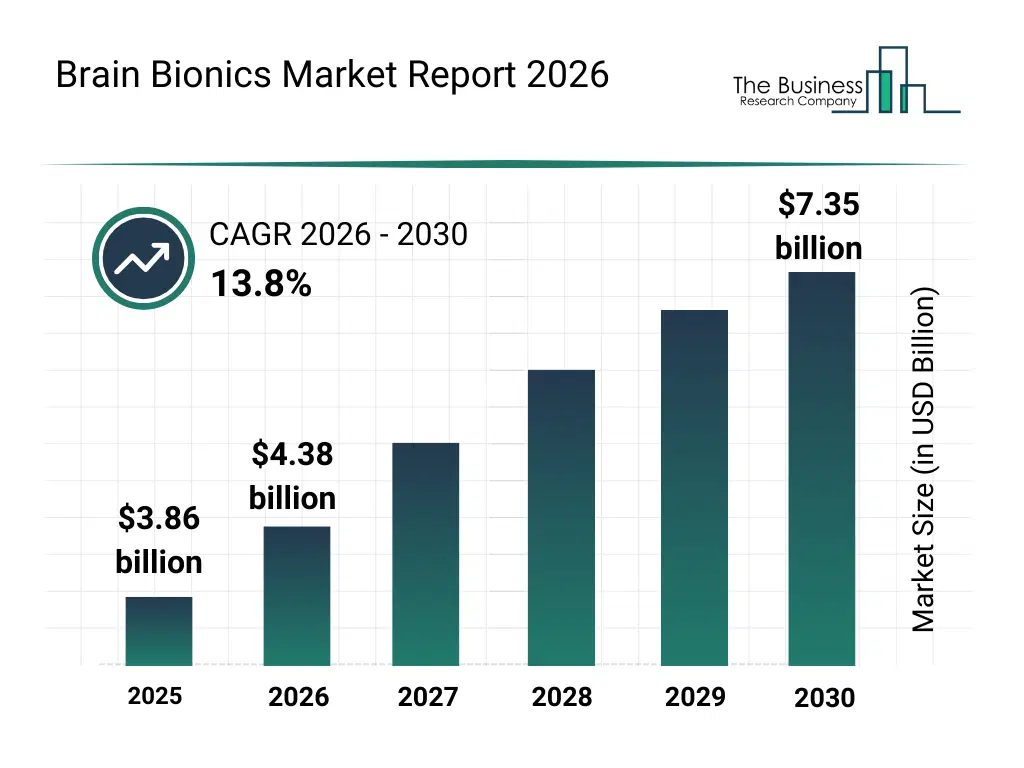
What Is The Brain Bionics Market Size and Share 2026?
The brain bionics market size has grown rapidly in recent years. It will grow from $3.86 billion in 2025 to $4.38 billion in 2026 at a compound annual growth rate (CAGR) of 13.6%. The growth in the historic period can be attributed to advancements in neuroscience research, increasing prevalence of neurological disorders, early clinical adoption of deep brain stimulation, growth in academic neurotechnology programs, rising investments in medical device innovation.What Is The Brain Bionics Market Growth Forecast?
The brain bionics market size is expected to see rapid growth in the next few years. It will grow to $7.35 billion in 2030 at a compound annual growth rate (CAGR) of 13.8%. The growth in the forecast period can be attributed to increasing demand for personalized neurotherapies, expansion of brain-computer interface clinical trials, growing integration of cloud-based neural data platforms, rising adoption of home-based neurofeedback systems, increasing regulatory approvals for implantable neurodevices. Major trends in the forecast period include increasing adoption of implantable neural interfaces, rising integration of AI-driven neural signal processing, growing use of non-invasive brain-computer interfaces, expansion of closed-loop neuromodulation systems, enhanced focus on personalized neurotherapy solutions.Global Brain Bionics Market Segmentation
1) By Product Type: Neuroprosthetics; Brain-Machine Interfaces (BMIs); Neuromodulation Devices; Transcranial Magnetic Stimulation Devices 2) By Technology: Electrodes And Sensors; Software And Algorithms; Cloud-Based Platforms; Wearable Devices 3) By User Demographics: Adults; Pediatrics; Elderly 4) By Application: Neurorehabilitation; Cognitive Enhancement; Pain Management; Neurodegenerative Disorders; Acute Interstitial Nephritis Disorders 5) By End User: Hospitals; Academic And Research Institutes; Home Care Settings; Pharmaceutical And Biotech Companies Subsegments: 1) By Neuroprosthetics: Cochlear Implants; Retinal Implants; Deep Brain Stimulation Implants; Spinal Cord Stimulation Implants; Peripheral Nerve Stimulation Implants 2) By Brain-Machine Interfaces (BMIs): Invasive Brain-Machine Interfaces; Partially Invasive Brain-Machine Interfaces; Non-Invasive Brain-Machine Interfaces; Assistive Communication Brain-Machine Interfaces; Motor Control Brain-Machine Interfaces 3) By Neuromodulation Devices: Deep Brain Stimulation Devices; Spinal Cord Stimulation Devices; Vagus Nerve Stimulation Devices; Sacral Nerve Stimulation Devices; Peripheral Nerve Stimulation Devices 4) By Transcranial Magnetic Stimulation Devices: Repetitive Transcranial Magnetic Stimulation Devices; Deep Transcranial Magnetic Stimulation Devices; Single-Pulse Transcranial Magnetic Stimulation Devices; Paired-Pulse Transcranial Magnetic Stimulation Devices; Portable Transcranial Magnetic Stimulation DevicesWhat Is The Driver Of The Brain Bionics Market?
The rising prevalence of neurological disorders is expected to propel the growth of the brain bionics market going forward. Neurological disorders refer to diseases and conditions that affect the brain, spinal cord, and nerves, leading to impairments in movement, cognition, sensation, or behavior. The prevalence of neurological disorders is increasing primarily due to population aging, it raises the risk of conditions such as Parkinson's disease, epilepsy, stroke, and dementia. Brain bionics supports the management and treatment of neurological disorders by enabling direct interaction between neural circuits and artificial systems to restore lost functions, modulate abnormal brain activity, and enhance rehabilitation outcomes. For instance, in December 2025, according to the Medical Republic, an Australia-based media company, reported that neurological conditions led to over 350,000 hospital admissions and 130,000 emergency department visits during 2023–24. Therefore, the rising prevalence of neurological disorders is driving the growth of the brain bionics industry.Key Players In The Global Brain Bionics Market
Major companies operating in the brain bionics market are NeuroPace Inc., Medtronic plc, BrainsWay Ltd., Boston Scientific Corporation, Kernel Labs Inc., LivaNova plc, Neuronetics Inc., Neuralink Corporation, Synchron Inc., Cala Health Inc., MindMaze SA, Emotiv Inc., Abbott Neuromodulation, MagVenture A/S, Paradromics Inc., Axoft LLC, Neuroelectrics Barcelona S.L.U., Blackrock Neurotech Inc., Soterix Medical Inc., Neurable Inc., Bitbrain Technologies S.L., BrainGate Consortium.Global Brain Bionics Market Trends and Insights
Major companies operating in the brain bionics market are focusing on developing advanced solutions, such as brain-controlled bionic prosthetics, to enhance motor function restoration, improve user control accuracy, and support more natural human–machine interaction. Brain-controlled bionic systems refer to neurotechnology-enabled prosthetic devices that use brain–computer interface (BCI) signals to translate neural activity into precise mechanical movements, allowing users to control artificial limbs through thought rather than physical input. For instance, in October 2025, BrainCo Inc., a US-based neurotechnology company, developed a brain-controlled bionic hand designed to help amputees regain functional hand movements by interpreting brain signals in real time. The bionic hand integrates non-invasive brain-sensing technology with advanced AI algorithms to decode user intent and convert it into smooth, responsive motion. This approach improves control precision, reduces learning time for users, and enables more intuitive interaction compared with traditional myoelectric prosthetics. By combining neuroscience, artificial intelligence, and robotics, the solution supports enhanced rehabilitation outcomes and greater independence for users, reflecting broader market demand for intelligent, brain-driven bionic technologies.What Are Latest Mergers And Acquisitions In The Brain Bionics Market?
In January 2026, Swinburne University of Technology, an Australia-based public university, partnered with the Bionics Institute to advance brain bionics research focused on neural interfaces and next-generation prosthetic control. Through this partnership, Swinburne University of Technology and the Bionics Institute aim to combine engineering, neuroscience, and clinical expertise to accelerate the development and translation of advanced medical and brain-bionics technologies into real-world patient solutions. The Bionics Institute is an Australia-based institute that develops innovative, implantable medical devices to treat brain-related conditions.Regional Insights
North America was the largest region in the brain bionics market in 2025. Asia-Pacific is expected to be the fastest-growing region in the forecast period. The regions covered in this market report are Asia-Pacific, South East Asia, Western Europe, Eastern Europe, North America, South America, Middle East, Africa. The countries covered in this market report are Australia, Brazil, China, France, Germany, India, Indonesia, Japan, Taiwan, Russia, South Korea, UK, USA, Canada, Italy, Spain.What Defines the Brain Bionics Market?
The brain bionics market includes sales of implantable neural interfaces, non-invasive brain-computer interface systems, neural signal acquisition devices, neural stimulation devices, cortical and subcortical implants, brain-controlled prosthetic devices, and neurofeedback systems. Values in this market are ‘factory gate’ values, that is the value of goods sold by the manufacturers or creators of the goods, whether to other entities (including downstream manufacturers, wholesalers, distributors, and retailers) or directly to end customers. The value of goods in this market includes related services sold by the creators of the goods.How is Market Value Defined and Measured?
The market value is defined as the revenues that enterprises gain from the sale of goods and/or services within the specified market and geography through sales, grants, or donations in terms of the currency (in USD unless otherwise specified). The revenues for a specified geography are consumption values that are revenues generated by organizations in the specified geography within the market, irrespective of where they are produced. It does not include revenues from resales along the supply chain, either further along the supply chain or as part of other products.What Key Data and Analysis Are Included in the Brain Bionics Market Report 2026?
The brain bionics market research report is one of a series of new reports from The Business Research Company that provides market statistics, including industry global market size, regional shares, competitors with the market share, detailed market segments, market trends and opportunities, and any further data you may need to thrive in the brain bionics industry. The market research report delivers a complete perspective of everything you need, with an in-depth analysis of the current and future state of the industry.Brain Bionics Market Report Forecast Analysis
| Report Attribute | Details |
|---|---|
| Market Size Value In 2026 | $4.38 billion |
| Revenue Forecast In 2035 | $7.35 billion |
| Growth Rate | CAGR of 13.6% from 2026 to 2035 |
| Base Year For Estimation | 2025 |
| Actual Estimates/Historical Data | 2020-2025 |
| Forecast Period | 2026 - 2030 - 2035 |
| Market Representation | Revenue in USD Billion and CAGR from 2026 to 2035 |
| Segments Covered | Product Type, Technology, User Demographics, Application, End User |
| Regional Scope | Asia-Pacific, Western Europe, Eastern Europe, North America, South America, Middle East, Africa |
| Country Scope | The countries covered in the report are Australia, Brazil, China, France, Germany, India, ... |
| Key Companies Profiled | NeuroPace Inc., Medtronic plc, BrainsWay Ltd., Boston Scientific Corporation, Kernel Labs Inc., LivaNova plc, Neuronetics Inc., Neuralink Corporation, Synchron Inc., Cala Health Inc., MindMaze SA, Emotiv Inc., Abbott Neuromodulation, MagVenture A/S, Paradromics Inc., Axoft LLC, Neuroelectrics Barcelona S.L.U., Blackrock Neurotech Inc., Soterix Medical Inc., Neurable Inc., Bitbrain Technologies S.L., BrainGate Consortium. |
| Customization Scope | Request for Customization |
| Pricing And Purchase Options | Explore Purchase Options |
Frequently Asked Questions
The Brain Bionics market was valued at $3.86 billion in 2025, increased to $4.38 billion in 2026, and is projected to reach $7.35 billion by 2030.
request a sample hereThe global Brain Bionics market is expected to grow at a CAGR of 13.8% from 2026 to 2035 to reach $7.35 billion by 2035.
request a sample hereSome Key Players in the Brain Bionics market Include, NeuroPace Inc., Medtronic plc, BrainsWay Ltd., Boston Scientific Corporation, Kernel Labs Inc., LivaNova plc, Neuronetics Inc., Neuralink Corporation, Synchron Inc., Cala Health Inc., MindMaze SA, Emotiv Inc., Abbott Neuromodulation, MagVenture A/S, Paradromics Inc., Axoft LLC, Neuroelectrics Barcelona S.L.U., Blackrock Neurotech Inc., Soterix Medical Inc., Neurable Inc., Bitbrain Technologies S.L., BrainGate Consortium. .
request a sample hereMajor trend in this market includes: Neurotechnology-enabled Bionic Systems Advance Intuitive Motor Function Restoration. For further insights on this market.
request a sample hereNorth America was the largest region in the brain bionics market in 2025. Asia-Pacific is expected to be the fastest-growing region in the forecast period. The regions covered in the brain bionics market report are Asia-Pacific, South East Asia, Western Europe, Eastern Europe, North America, South America, Middle East, Africa.
request a sample here