
Blue Hydroogen Market 2026
Blue Hydroogen Market 2026
By Technology (Steam Methane Reforming (SMR), Gas Partial Oxidation (POX), Auto Thermal Reforming (ATR)), By Transportation Mode (Pipeline, Cryogenic Liquid Tankers), By End User (Petroleum Refineries, Chemical Industry, Power Generation Facilities, Other End Users), And By Region, Opportunities And Strategies – Global Forecast To 2035
Blue hydrogen Market Definition
Blue hydrogen refers to hydrogen produced from natural gas with the integration of carbon capture and storage (CCS) to significantly reduce carbon dioxide emissions. It is recognized as a low-carbon alternative to conventional hydrogen production methods, supporting industrial decarbonization and clean energy transition. The primary aim of blue hydrogen is to enable large-scale hydrogen production while minimizing carbon emissions and promoting sustainable energy use across industries. The blue hydrogen market consists of sales, by entities (organizations, sole traders, or partnerships), of blue hydrogen systems designed to produce hydrogen from natural gas using processes such as steam methane reforming (SMR), gas partial oxidation (POX), or autothermal reforming (ATR) integrated with carbon capture and storage (CCS) technologies. These systems aim to significantly reduce carbon dioxide emissions during hydrogen production, offering a low-carbon alternative to conventional methods. The market includes related equipment, technologies, and services used for production, storage, transportation, and utilization of blue hydrogen across industries such as refining, chemicals, and power generation.

Blue hydrogen Market Size
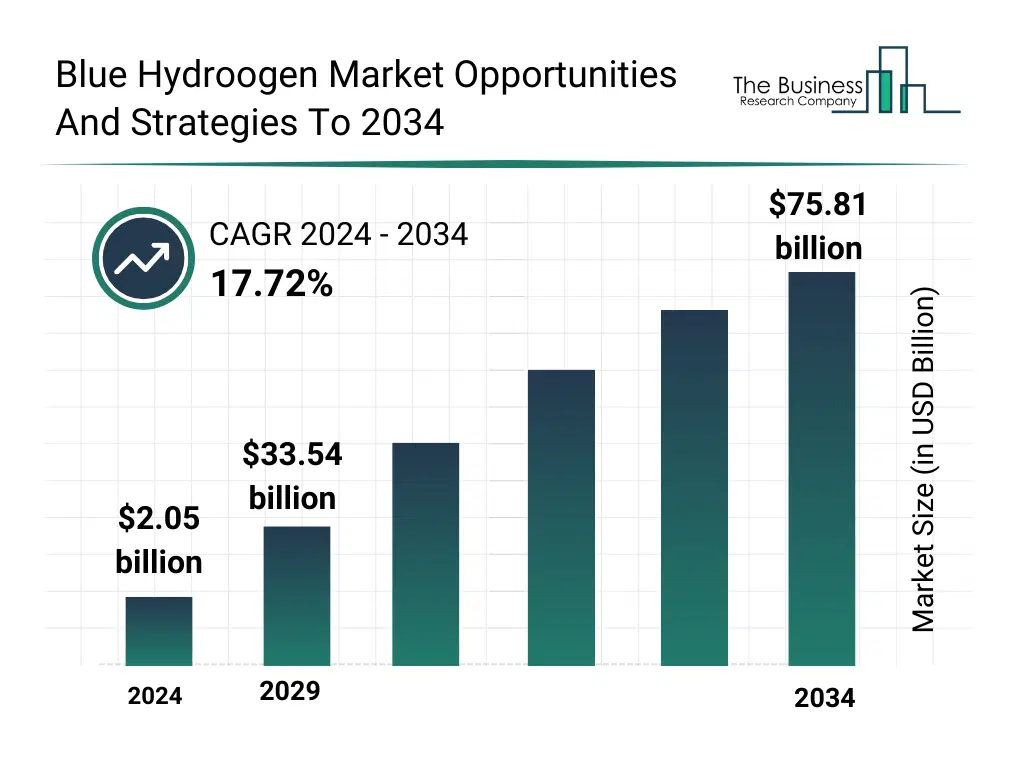
The global blue hydrogen market reached a value of nearly $2,051.92 million in 2024, having grown at a compound annual growth rate (CAGR) of 4.70% since 2019. The market is expected to grow from $2,051.92 million in 2024 to $33,542.02 million in 2029 at a rate of 74.86%. The market is then expected to grow at a CAGR of 17.72% from 2029 and reach $75,814.37 million in 2034. Growth in the historic period resulted from the growing focus on carbon emission reduction targets, expansion of hydrogen demand rising industrial clusters and hydrogen hubs and establishment of hydrogen certification and carbon-intensity standard. Factors that negatively affected growth in the historic period were high production costs and limited Co₂ storage and transportation infrastructure. Going forward, increased demand from chemicals and petrochemicals refining, integration of carbon capture, utilization, and storage (CCUS) infrastructure, increasing adoption of hydrogen-fueled heavy-duty and commercial vehicles and government incentives and policy support will drive growth. Factors that could hinder the growth of the blue hydrogen market in the future include shortage of skilled workforce, environmental concerns and impact of trade war and tariff.Blue hydrogen Market Drivers
The key drivers of the blue hydrogen market include: Increased Demand From Chemicals And Petrochemicals Refining Increased demand from chemicals and petrochemicals refining is expected to be a key driver of the growth of the blue hydrogen market in the forecast period. These industries rely heavily on hydrogen for processes such as hydrocracking, desulfurization, and ammonia production. As global regulations tighten on carbon emissions, refineries and chemical producers are shifting toward lower-carbon feedstocks to maintain competitiveness and sustainability. Blue hydrogen offers an ideal pathway, enabling these industries to continue hydrogen-based operations while significantly reducing their carbon footprint. The integration of blue hydrogen into refining and chemical production processes allows companies to align with global decarbonization targets, maintain compliance with emission standards, and future-proof their operations against environmental regulations. This increasing adoption across industrial applications will sustain large-scale demand and strengthen investment in blue hydrogen production facilities.Blue hydrogen Market Restraints
The key restraints on the blue hydrogen market include: Shortage Of Skilled Workforce Shortage of skilled workforce is restricting the growth of the blue hydrogen market during the forecast period. The technical complexity of integrating hydrogen production with carbon management processes demands experienced engineers, process operators, and safety professionals, which are currently in limited supply globally. This talent gap can delay project development, reduce operational efficiency, and increase dependency on external consultants, ultimately driving up project costs. Furthermore, the limited availability of skilled professionals can slow down the expansion of new facilities and the deployment of digital monitoring systems essential for safe and efficient hydrogen operations. The lack of workforce training and technical education focused on low-carbon hydrogen technologies may therefore hinder the timely execution and scalability of blue hydrogen projects, restricting overall market growth.Blue hydrogen Market Trends
Major trends shaping the blue hydrogen market include: Expansion Of Production Facilities Through Strategic Partnerships Major companies in the blue hydrogen market are focusing on the expansion of production facilities through strategic partnerships to accelerate large-scale hydrogen deployment and strengthen regional supply chains. Collaborations between technology providers, energy companies, and government entities are enabling the creation of integrated blue hydrogen hubs that combine production, storage, and carbon capture infrastructure. These partnerships aim to reduce project risks, enhance cost efficiency, and fast-track commercialization of low-carbon hydrogen. For instance, in May 2025, Equinor, Norwegian multinational energy company, partnered with SSE Thermal to develop large-scale low-carbon hydrogen (also known as blue hydrogen) projects in the UK’s Humber region, including the Hydrogen to Humber (H2H) Saltend project. This collaboration combines Equinor’s reforming and CCS (carbon capture and storage) expertise with SSE Thermal’s operational experience in power generation and hydrogen storage. Together, they aim to deliver low-carbon hydrogen for industrial and power applications, targeting substantial emission reductions across the Humber. This joint development exemplifies how strategic alliances are accelerating the expansion of blue hydrogen infrastructure globally. SSE Thermal is a UK-based company which operates several thermal power stations supplying electricity across many regions. Innovative Blue Hydrogen Initiatives For Decarbonization And Industrial Growth Major companies operating in the blue hydrogen market are advancing projects that integrate innovative technologies to produce low-carbon hydrogen on a scale. These initiatives focus on combining natural gas reforming with carbon capture, utilization, and storage (CCUS) to reduce emissions while supporting industrial, transportation, and energy applications. For example, in February 2024, Trillium H2 Power LLC, a US-based company providing clean energy, selected Shell Catalysts & Technologies, a US-based company that transforms energy, to license the Shell Blue Hydrogen Process (SBHP) for its facility in Pike County, Ohio, producing up to 500 tons per day of blue hydrogen with 1.6 million tons of CO₂ captured annually. The SBHP combines Shell Gas Partial Oxidation (SGP) and ADIP ULTRA solvent technology for efficient large-scale CO₂ capture. The hydrogen will support low-carbon power, sustainable fuels, and other products, while the project is expected to create around 2,000 construction jobs. This initiative also contributes over $346 million to the local economy, advancing clean energy development in Central Appalachia.Opportunities And Recommendations In The Blue Hydrogen Market
Opportunities – The top opportunities in the blue hydrogen markets segmented by technology will arise in the steam methane reforming (SMR) segment, which will gain $19,440.13 million of global annual sales by 2029. The top opportunities in the blue hydrogen markets segmented by transportation mode will arise in the pipeline segment, which will gain $18,637.94 million of global annual sales by 2029. The top opportunities in the blue hydrogen markets segmented by end user will arise in the chemical industry segment, which will gain $13,481.16 million of global annual sales by 2029. The blue hydrogen market size will gain the most in the USA at $14,914.34 million. Recommendations- To take advantage of the opportunities, The Business Research Company recommends the blue hydrogen companies to focus on decentralized blue hydrogen for heavy transport and power, focus on integrated ccus technology deployment at scale, focus on infrastructure integration and cross-border alignment, focus on auto thermal reforming for scalable growth, focus on cryogenic liquid tankers to capture trade-driven growth, expand in emerging markets, continue to focus on developed markets, focus on industrial blue hydrogen hubs through partnerships, focus on advanced blue hydrogen technology for industrial clusters, focus on disciplined value based pricing to scale blue hydrogen, build credibility through evidence-led and policy-aligned promotion, use projects, partnerships and adoption as the core promotional assets, focus on the chemical industry as the primary growth engine.Blue Hydrogen Market Segmentation
The blue hydrogen market is segmented by technology, by transportation mode and end user.By Technology –
The blue hydrogen market is segmented by technology into:
- a) Steam Methane Reforming (SMR)
- b) Gas Partial Oxidation (POX)
- c) Auto Thermal Reforming (ATR)
By Transportation Mode –
The blue hydrogen market is segmented by transportation mode into:
- a) Pipeline
- b) Cryogenic Liquid Tankers
By End-User –
The blue hydrogen market is segmented by end-user into:
- a) Petroleum Refineries
- b) Chemical Industry
- c) Power Generation Facilities
- d) Other End Users
By Geography - The blue hydrogen market is segmented by geography into:
- • China
- • India
- • Japan
- • Australia
- • Indonesia
- • South Korea
- • Bangladesh
- • Thailand
- • Vietnam
- • Malaysia
- • Singapore
- • Phillipines
- • Hong kong
- • New Zealand
- • USA
- • Canada
- • Mexico
- • Brazil
- • Argentina
- • Chile
- • Colombiia
- • Peru
- • France
- • Germany
- • UK
- • Italy
- • Spain
- • Austria
- • Belgium
- • Denmark
- • Finland
- • Ireland
- • Netherland
- • Norway
- • Portugal
- • Sweden
- • Switzerland
- • Russia
- • Czech Republic
- • Poland
- • Romania
- • Ukraine
- • Saudi Arabia
- • Israel
- • Iran
- • Turkey
- • UAE o Africa
- • Egypt
- • Nigeria
- • South Africa
-
o Asia Pacific