
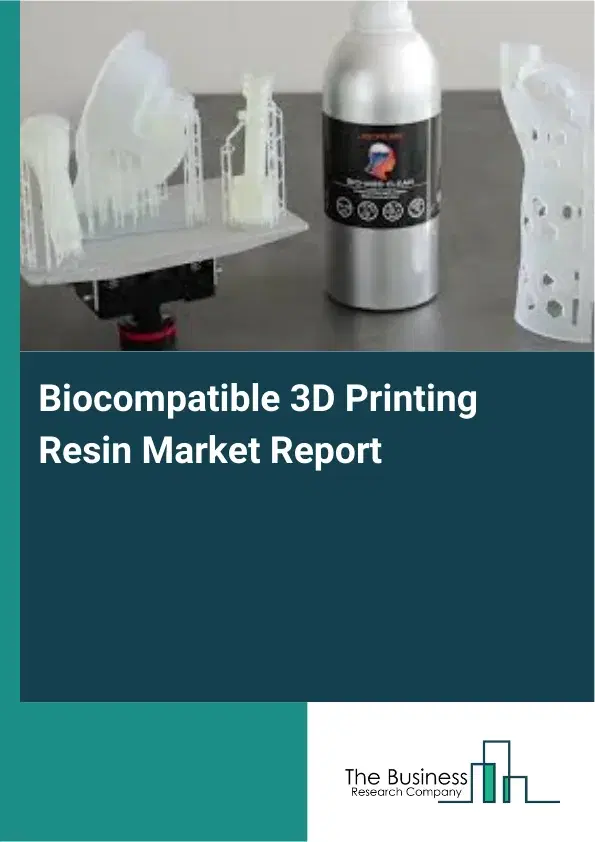
Biocompatible 3D Printing Resin Market Report 2026
Global Outlook – By Product Type (Photo-Curable Resins, Hydrogels And Bio-inks, Thermoplastic Biocompatible Filaments, Other Product Types), By Material Property (Thermoset Resins, Photopolymer Resins, Elastomeric Resins, High-Temperature Resins), By Technology (Stereolithography (SLA), Digital Light Processing (DLP), Continuous Liquid Interface Production (CLIP), PolyJet Technology), By Application (Dental Aligners And Orthodontics,Other Medical Devices), By End-User (Dental Laboratories And Clinics, Hospitals And Surgical Centers, Medical Device Manufacturers, Academic And Research Institutions, Prosthetics And Orthotics Manufacturers) – Market Size, Trends, Strategies, and Forecast to 2035
Biocompatible 3D Printing Resin Market Overview
• Biocompatible 3D Printing Resin market size has reached to $0.35 billion in 2025 • Expected to grow to $0.73 billion in 2030 at a compound annual growth rate (CAGR) of 15.9% • Growth Driver: Growing Demand For Personalized Healthcare Driving The Market Growth Due To Patient-Specific Medical Solutions • Market Trend: Advancements In Biocompatible 3D Printing Resins For Medical And Dental Applications • North America was the largest region in 2025 and Asia-Pacific is the fastest growing region.What Is Covered Under Biocompatible 3D Printing Resin Market?
Biocompatible 3d printing resin is a specialized material designed for additive manufacturing that is safe for direct or indirect contact with biological tissues. It offers precise printing capabilities, high resolution, and mechanical stability suitable for medical and dental applications. It is used to enable the fabrication of safe, patient-specific medical and dental devices with high accuracy and tissue compatibility. The main product types of biocompatible three-dimensional (3D) printing resins include photo-curable resins, hydrogels and bio-inks, thermoplastic biocompatible filaments, and other product types. Photo-curable resins refer to resins that solidify when exposed to specific light sources, enabling precise three-dimensional printing for medical applications. These resins have material properties such as thermoset resins, photopolymer resins, elastomeric resins, and high-temperature resins. They use technologies such as stereolithography (SLA), digital light processing (DLP), continuous liquid interface production (CLIP), and PolyJet technology. They are applied across areas including dental aligners and orthodontics, surgical guides and tools, hearing aid shells, prosthetics and orthotics, implants, anatomical models for pre-surgical planning, and other medical devices, and are used by end users including dental laboratories and clinics, hospitals and surgical centers, medical device manufacturers, academic and research institutions, and prosthetics and orthotics manufacturers.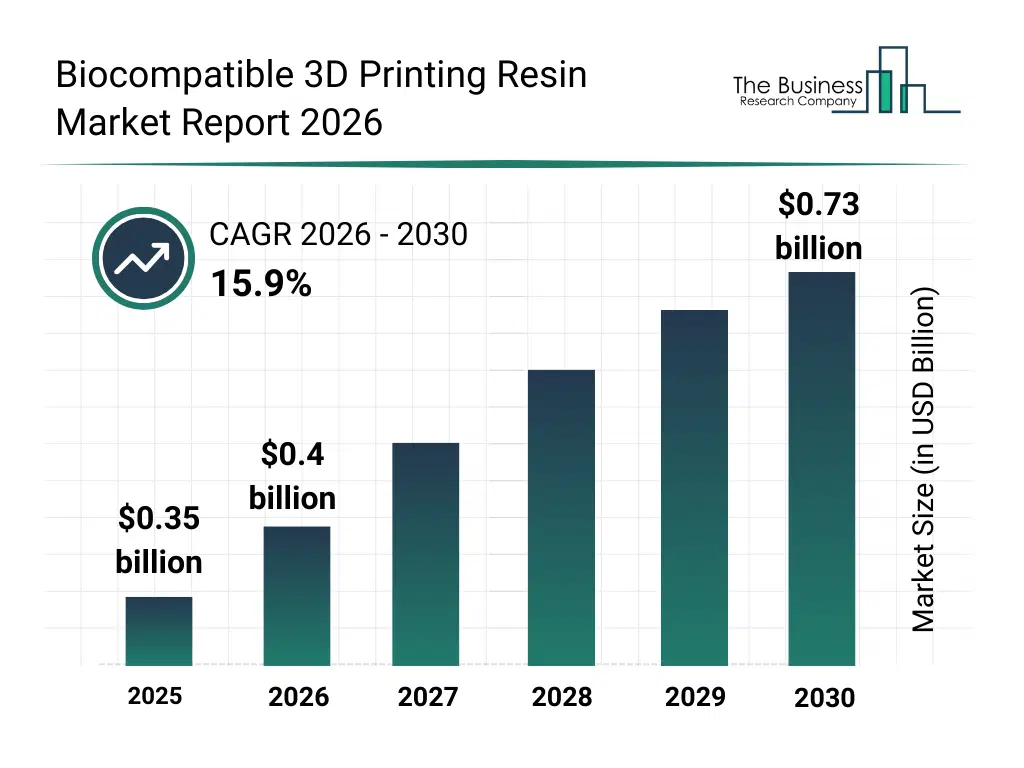
What Is The Biocompatible 3D Printing Resin Market Size and Share 2026?
The biocompatible 3d printing resin market size has grown rapidly in recent years. It will grow from $0.35 billion in 2025 to $0.4 billion in 2026 at a compound annual growth rate (CAGR) of 15.7%. The growth in the historic period can be attributed to expansion of dental and medical 3d printing adoption, increasing use of additive manufacturing in healthcare, availability of certified biocompatible materials, growth of customized medical devices, improvements in printing resolution technologies.What Is The Biocompatible 3D Printing Resin Market Growth Forecast?
The biocompatible 3d printing resin market size is expected to see rapid growth in the next few years. It will grow to $0.73 billion in 2030 at a compound annual growth rate (CAGR) of 15.9%. The growth in the forecast period can be attributed to increasing demand for personalized medical devices, rising adoption of digital dentistry workflows, expansion of biofabrication applications, growing regulatory approvals for printed implants, increasing integration of 3d printing in surgical planning. Major trends in the forecast period include increasing use of patient-specific medical printing materials, growing adoption of high-resolution dental resins, rising demand for tissue-compatible printing materials, expansion of advanced resin formulations, enhanced focus on mechanical strength and accuracy.
Global Biocompatible 3D Printing Resin Market Segmentation
1) By Product Type: Photo-Curable Resins; Hydrogels And Bio-inks; Thermoplastic Biocompatible Filaments; Other Product Types 2) By Material Property: Thermoset Resins; Photopolymer Resins; Elastomeric Resins; High-Temperature Resins 3) By Technology: Stereolithography (SLA); Digital Light Processing (DLP); Continuous Liquid Interface Production (CLIP); PolyJet Technology 4) By Application: Dental Aligners And Orthodontics; Surgical Guides And Tools; Hearing Aid Shells; Prosthetics And Orthotics; Implants; Anatomical Models For Pre-Surgical Planning; Other Medical Devices 5) By End-User: Dental Laboratories And Clinics; Hospitals And Surgical Centers; Medical Device Manufacturers; Academic And Research Institutions; Prosthetics And Orthotics Manufacturers Subsegments: 1) By Photo-Curable Resins: Dental Modeling Resins; Surgical Guide Resins; Hearing Aid Resins; Medical Device Prototyping Resins; Tissue Contact Approved Resins 2) By Hydrogels And Bio-inks: Natural Polymer Hydrogels; Synthetic Polymer Hydrogels; Cell Laden Bio-inks; Extracellular Matrix Based Bio-inks; Composite Hydrogel Materials 3) By Thermoplastic Biocompatible Filaments: Polylactic Acid Filaments; Polycaprolactone Filaments; Polyether Ether Ketone Filaments; Polyamide Biocompatible Filaments; Medical Grade Copolymer Filaments 4) By Other Product Types: Ceramic Filled Biocompatible Resins; Silicone Based Printing Materials; Elastomeric Biocompatible Materials; Composite Biocompatible Resins; Custom Formulated Biocompatible MaterialsWhat Is The Driver Of The Biocompatible 3D Printing Resin Market?
The growing demand for personalized healthcare is expected to propel the growth of the biocompatible 3D printing resin market going forward. Personalized healthcare refers to a medical approach that customizes treatment and care based on an individual’s genetics, lifestyle, and specific health needs. Personalized healthcare is increasing due to advances in genomics and data analytics, which enable treatments and preventive care to be tailored to an individual’s genetic profile, health history, and real-time health data. Biocompatible 3D printing resin helps personalized healthcare by enabling the creation of patient-specific medical devices, implants, and prosthetics that are safely compatible with the human body and tailored to individual needs. For instance, in February 2024, according to the Personalized Medicine Coalition, a US-based non-profit organization, in 2023, the FDA approved 16 new personalized treatments for rare disease patients, up from six in 2022. The newly approved personalized treatments for 2023 also include seven cancer drugs and three for other diseases and conditions. Therefore, the growing demand for personalized healthcare is driving the growth of the biocompatible 3D printing resin industry.Key Players In The Global Biocompatible 3D Printing Resin Market
Major companies operating in the biocompatible 3d printing resin market are BASF SE, Henkel AG & Co. KGaA, Arkema S.A., Dentsply Sirona Inc., Ivoclar Vivadent AG, Stratasys Ltd., 3D Systems Corporation, Formlabs Inc., Carbon Inc., Keystone Industries Inc., GC Corporation, Nano Dimension Ltd., SprintRay Inc., Shining 3D Tech Co. Ltd., Poly-Med Inc., Asiga Limited, Boston Micro Fabrication Precision Technology Co. Ltd., Graphy Inc., Guangzhou HeyGears IMC. Inc., Dreve Dentamid GmbH, DETAX GmbH & Co. KG, Ackuretta Systems Private Limited, Nexa3D Inc., Resyner Technologies S.L.Global Biocompatible 3D Printing Resin Market Trends and Insights
Major companies operating in the biocompatible 3D printing resin market are focusing on developing innovative technologies, such as digital light processing (DLP) bioprinting, to enhance printing precision, accelerate production of complex tissue structures, and expand applications in medical and dental industries. Digital light processing (DLP) bioprinting refers to a 3D printing technology that uses projected light to selectively cure photosensitive biocompatible resins layer by layer, enabling the rapid and precise fabrication of complex tissue scaffolds, medical implants, and other biomedical structures. For instance, in December 2024, BIO INX BV, a Belgium-based company that specializes in creating cell-friendly, high-resolution bio-inks for 3D bioprinting, launched BIORES INX, a gelatin methacrylamide (GelMA)-based bioink resin optimized for DLP 3D printing. It is uniquely characterized by its gelatin-based, highly biocompatible formulation that closely mimics the natural extracellular matrix, enabling improved cell viability and tissue development, while its room-temperature stability removes the need for heated DLP printing systems, and its sterile, plug-and-print design allows seamless integration with DLP 3D bioprinters to achieve high-resolution, reproducible fabrication of complex biological structures for tissue engineering and regenerative medicine applications.What Are Latest Mergers And Acquisitions In The Biocompatible 3D Printing Resin Market?
In April 2023, Stratasys Ltd., a US-based producer of materials, software, and 3D printers, acquired the additive manufacturing materials business of Covestro AG for an undisclosed amount. With this acquisition, Stratasys aimed to significantly expand its polymer materials portfolio with around 60 specialized products and accelerate next-generation innovation for high-performance, end-use 3D printing applications across automotive, dental, and advanced manufacturing sectors. Covestro AG is a Germany-based company that manufactures biocompatible 3D printing resins for use in medical, dental, and other healthcare-oriented additive manufacturing applications.Regional Insights
North America was the largest region in the biocompatible 3D printing resin market in 2025. Asia-Pacific is expected to be the fastest-growing region in the forecast period. The regions covered in this market report are Asia-Pacific, South East Asia, Western Europe, Eastern Europe, North America, South America, Middle East, Africa. The countries covered in this market report are Australia, Brazil, China, France, Germany, India, Indonesia, Japan, Taiwan, Russia, South Korea, UK, USA, Canada, Italy, Spain.What Defines the Biocompatible 3D Printing Resin Market?
The biocompatible 3d printing resin market consists of sales of surgical guides, dental models, dental aligners, implants, prosthetics, tissue engineering scaffolds, and other biocompatible 3D-printed medical devices. Values in this market are ‘factory gate’ values, that is, the value of goods sold by the manufacturers or creators of the goods, whether to other entities (including downstream manufacturers, wholesalers, distributors, and retailers) or directly to end customers. The value of goods in this market includes related services sold by the creators of the goods.How is Market Value Defined and Measured?
The market value is defined as the revenues that enterprises gain from the sale of goods and/or services within the specified market and geography through sales, grants, or donations in terms of the currency (in USD unless otherwise specified). The revenues for a specified geography are consumption values that are revenues generated by organizations in the specified geography within the market, irrespective of where they are produced. It does not include revenues from resales along the supply chain, either further along the supply chain or as part of other products.What Key Data and Analysis Are Included in the Biocompatible 3D Printing Resin Market Report 2026?
The biocompatible 3d printing resin market research report is one of a series of new reports from The Business Research Company that provides market statistics, including industry global market size, regional shares, competitors with the market share, detailed market segments, market trends and opportunities, and any further data you may need to thrive in the biocompatible 3d printing resin industry. The market research report delivers a complete perspective of everything you need, with an in-depth analysis of the current and future state of the industry.Biocompatible 3D Printing Resin Market Report Forecast Analysis
| Report Attribute | Details |
|---|---|
| Market Size Value In 2026 | $0.4 billion |
| Revenue Forecast In 2035 | $0.73 billion |
| Growth Rate | CAGR of 15.7% from 2026 to 2035 |
| Base Year For Estimation | 2025 |
| Actual Estimates/Historical Data | 2020-2025 |
| Forecast Period | 2026 - 2030 - 2035 |
| Market Representation | Revenue in USD Billion and CAGR from 2026 to 2035 |
| Segments Covered | Product Type, Material Property, Technology, Application, End-User |
| Regional Scope | Asia-Pacific, Western Europe, Eastern Europe, North America, South America, Middle East, Africa |
| Country Scope | The countries covered in the report are Australia, Brazil, China, France, Germany, India, ... |
| Key Companies Profiled | BASF SE, Henkel AG & Co. KGaA, Arkema S.A., Dentsply Sirona Inc., Ivoclar Vivadent AG, Stratasys Ltd., 3D Systems Corporation, Formlabs Inc., Carbon Inc., Keystone Industries Inc., GC Corporation, Nano Dimension Ltd., SprintRay Inc., Shining 3D Tech Co. Ltd., Poly-Med Inc., Asiga Limited, Boston Micro Fabrication Precision Technology Co. Ltd., Graphy Inc., Guangzhou HeyGears IMC. Inc., Dreve Dentamid GmbH, DETAX GmbH & Co. KG, Ackuretta Systems Private Limited, Nexa3D Inc., Resyner Technologies S.L. |
| Customization Scope | Request for Customization |
| Pricing And Purchase Options | Explore Purchase Options |