
Automotive Extended Reality Market Report 2026
Global Outlook – By Component (Hardware, Software, Services), By Technology (Augmented Reality, Virtual Reality, Mixed Reality), By Application (Design And Prototyping, Manufacturing And Production, Training And Education, Sales And Marketing, In-Vehicle Applications), By Distribution Channel (Direct Sales, Online), By End User (Automotive Oems, Automotive Suppliers, Dealerships And Retailers, Training Institutes, Fleet Operators) – Market Size, Trends, Strategies, and Forecast to 2035
Automotive Extended Reality Market Overview
• Automotive Extended Reality market size has reached to $30.63 billion in 2025 • Expected to grow to $34.29 billion in 2030 at a compound annual growth rate (CAGR) of 2.3% • Growth Driver: The Rise Of Connected Vehicles Driving The Growth Of The Market Due To Enhanced Safety, Infotainment, And Passenger Experiences • Market Trend: Immersive In-Car Gaming Redefines Passenger Entertainment Through Sensor-Driven Experiences • North America was the largest region in 2025 and Asia-Pacific is the fastest growing region.What Is Covered Under Automotive Extended Reality Market?
Automotive extended reality refers to immersive technologies that integrate virtual and augmented visual content within vehicles to enhance driving, safety, and infotainment experiences. It enables real-time visualization of navigation, sensor data, and surroundings through interactive displays, such as head-up displays and smart glasses. This technology improves situational awareness, reduces driver distraction, and supports advanced vehicle training, simulation, and design processes. The main components of automotive extended reality are hardware, software, and services. Hardware refers to the physical devices, such as headsets, sensors, and display units, used to enable immersive augmented, virtual, and mixed reality experiences in automotive applications. These solutions leverage different technologies, including augmented reality, virtual reality, and mixed reality, and are applied across multiple applications, such as design and prototyping, manufacturing and production, training and education, sales and marketing, and in-vehicle applications. They are distributed through direct sales and online channels and serve various end users, including automotive OEMs, automotive suppliers, dealerships and retailers, training institutes, and fleet operators.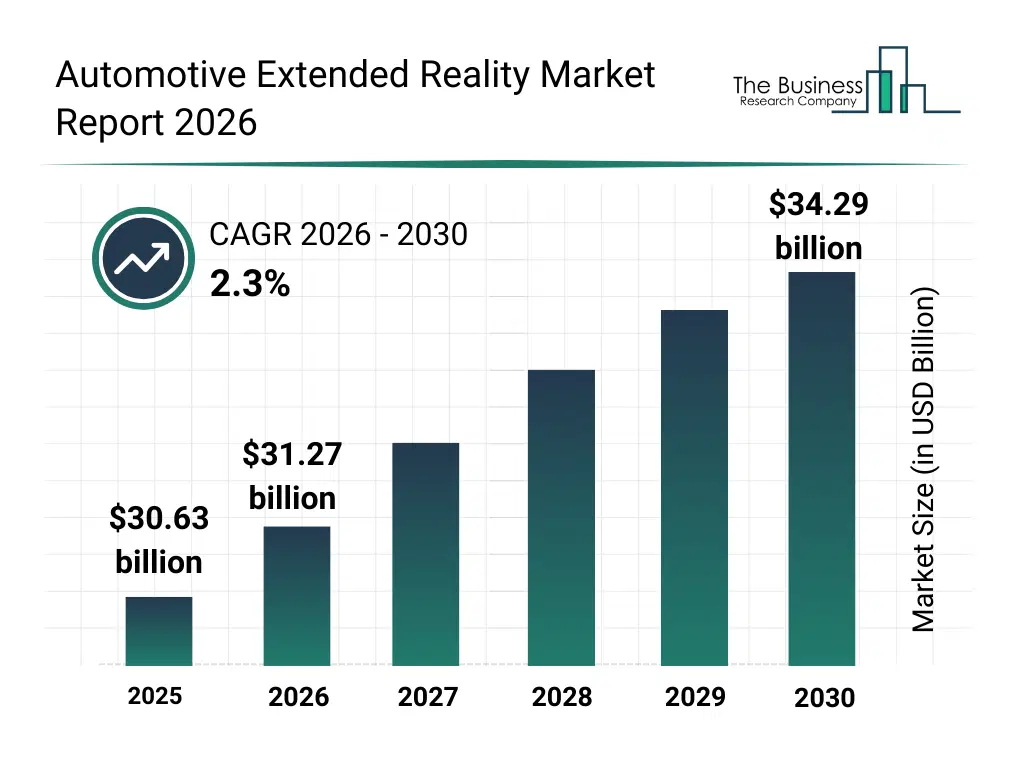
What Is The Automotive Extended Reality Market Size and Share 2026?
The automotive extended reality market size has grown steadily in recent years. It will grow from $30.63 billion in 2025 to $31.27 billion in 2026 at a compound annual growth rate (CAGR) of 2.1%. The growth in the historic period can be attributed to increasing vehicle digitalization, adoption of advanced driver assistance systems, growth in Automotive Simulation tools, expansion of connected vehicle technologies, rising investments in in-vehicle infotainment systems.What Is The Automotive Extended Reality Market Growth Forecast?
The automotive extended reality market size is expected to see steady growth in the next few years. It will grow to $34.29 billion in 2030 at a compound annual growth rate (CAGR) of 2.3%. The growth in the forecast period can be attributed to increasing adoption of autonomous and semi-autonomous vehicles, rising demand for enhanced driver experience technologies, expansion of smart cockpit development, growing investments in immersive automotive software platforms, increasing focus on driver safety and situational awareness. Major trends in the forecast period include increasing integration of ar-based head-up displays, rising adoption of xr for driver assistance systems, growing use of immersive technologies in vehicle design and training, expansion of in-vehicle mixed reality interfaces, enhanced focus on real-time visualization and safety.
Global Automotive Extended Reality Market Segmentation
1) By Component: Hardware; Software; Services 2) By Technology: Augmented Reality; Virtual Reality; Mixed Reality 3) By Application: Design And Prototyping; Manufacturing And Production; Training And Education; Sales And Marketing; In-Vehicle Applications 4) By Distribution Channel: Direct Sales; Online 5) By End User: Automotive Oems; Automotive Suppliers; Dealerships And Retailers; Training Institutes; Fleet Operators Subsegments: 1) By Hardware: Head Mounted Displays; Smart Glasses; Sensors And Cameras; Processing Units; Haptic Devices 2) By Software: Simulation Software; Visualization Software; Content Creation Platforms; Application Development Tools; Data Analytics Software 3) By Services: Consulting Services; System Integration Services; Deployment And Implementation Services; Training And Support Services; Maintenance And Upgradation ServicesWhat Is The Driver Of The Automotive Extended Reality Market?
The rising popularity of connected vehicles is expected to propel the growth of the automotive extended reality market going forward. A connected vehicle is a vehicle equipped with internet and communication technologies that allow it to share data with other vehicles, infrastructure, and external networks to improve safety, traffic efficiency, and user experience. The rising popularity of connected vehicles is due to enhanced convenience and infotainment, as these vehicles offer seamless access to real-time navigation, entertainment, communication, and personalized services that improve the overall driving and passenger experience. Automotive extended reality enhances connected vehicles by seamlessly integrating immersive digital interfaces with real-time vehicle data, enabling safer navigation, interactive passenger experiences, and advanced driver assistance systems. For instance, in December 2024, according to the National Association of Insurance Commissioners, a US-based non-profit organization, the Insurance Institute for Highway Safety anticipates that 4.5 million self-driving vehicles will be on U.S. roads by 2030. Therefore, the rising popularity of connected vehicles is driving the growth of the automotive extended reality industry.Key Players In The Global Automotive Extended Reality Market
Major companies operating in the automotive extended reality market are Siemens AG, Qualcomm Technologies Inc., NVIDIA Corporation, Dassault Systèmes SE, Hexagon AB, Epic Games Inc., Unity Technologies Inc., Robert Bosch GmbH, PTC Inc., Ansys Inc., Magic Leap Inc., dSPACE GmbH, HTC Corporation, Varjo Technologies Oy, EON Reality Inc., RealWear Inc., WayRay AG, Ultraleap Ltd., Lumus Ltd., and Holoride GmbH.Global Automotive Extended Reality Market Trends and Insights
Major companies operating in the automotive extended reality market are focusing on developing innovative solutions, such as immersive in-car gaming, to enhance passenger experiences and streamline vehicle design. Immersive in-car gaming is a digital entertainment experience that blends real-time vehicle surroundings with interactive virtual elements, allowing passengers to play games safely while traveling. For instance, in March 2024, Valeo SA, a France-based automotive technology company, launched the world's first extended reality (XR) in-car gaming experience designed for vehicle passengers. The solution integrates real-time data from the vehicle’s ADAS sensors, including cameras and radar, with digital gaming elements to create an immersive, interactive experience during journeys. Developed in collaboration with Unity, the platform blends live views of the surrounding environment with virtual content rendered in real time. This innovation demonstrates how existing vehicle sensing and computing capabilities can be repurposed to deliver next-generation in-car entertainment.What Are Latest Mergers And Acquisitions In The Automotive Extended Reality Market?
In March 2025, Omnia XR Inc., a US-based extended reality technology company, acquired SpotKwik for an undisclosed amount. With this acquisition, Omnia aims to enhance its spatial computing and extended reality offerings by integrating SpotKwik’s augmented reality R&D and product capabilities into its platform to accelerate the development and adoption of spatial applications across industries. SpotKwik Technologies Private Limited is an India-based technology company that specializes in augmented reality solutions, providing AR-driven social commerce and immersive digital experiences that enable virtual product interactions and spatial computing advancements.Regional Insights
North America was the largest region in the automotive extended reality market in 2025. Asia-Pacific is expected to be the fastest-growing region in the forecast period. The regions covered in this market report are Asia-Pacific, South East Asia, Western Europe, Eastern Europe, North America, South America, Middle East, Africa. The countries covered in this market report are Australia, Brazil, China, France, Germany, India, Indonesia, Japan, Taiwan, Russia, South Korea, UK, USA, Canada, Italy, Spain.What Defines the Automotive Extended Reality Market?
The automotive extended reality market consists of revenues earned by entities by providing services such as installation services, integration services, maintenance and support services, calibration and testing services, software customization services, content development services, system upgrade services, and training and consulting services. The market value includes the value of related goods sold by the service provider or included within the service offering. The automotive extended reality market also includes sales of head-mounted displays, smart glasses, head-up displays, spatial display panels, waveguide lenses, micro display modules, optical sensors, and tracking cameras. Values in this market are ‘factory gate’ values, that is the value of goods sold by the manufacturers or creators of the goods, whether to other entities (including downstream manufacturers, wholesalers, distributors and retailers) or directly to end customers. The value of goods in this market includes related services sold by the creators of the goods.How is Market Value Defined and Measured?
The market value is defined as the revenues that enterprises gain from the sale of goods and/or services within the specified market and geography through sales, grants, or donations in terms of the currency (in USD unless otherwise specified). The revenues for a specified geography are consumption values that are revenues generated by organizations in the specified geography within the market, irrespective of where they are produced. It does not include revenues from resales along the supply chain, either further along the supply chain or as part of other products.What Key Data and Analysis Are Included in the Automotive Extended Reality Market Report 2026?
The automotive extended reality market research report is one of a series of new reports from The Business Research Company that provides market statistics, including industry global market size, regional shares, competitors with the market share, detailed market segments, market trends and opportunities, and any further data you may need to thrive in the automotive extended reality industry. The market research report delivers a complete perspective of everything you need, with an in-depth analysis of the current and future state of the industry.Automotive Extended Reality Market Report Forecast Analysis
| Report Attribute | Details |
|---|---|
| Market Size Value In 2026 | $31.27 billion |
| Revenue Forecast In 2035 | $34.29 billion |
| Growth Rate | CAGR of 2.1% from 2026 to 2035 |
| Base Year For Estimation | 2025 |
| Actual Estimates/Historical Data | 2020-2025 |
| Forecast Period | 2026 - 2030 - 2035 |
| Market Representation | Revenue in USD Billion and CAGR from 2026 to 2035 |
| Segments Covered | Component, Technology, Application, Distribution Channel, End User |
| Regional Scope | Asia-Pacific, Western Europe, Eastern Europe, North America, South America, Middle East, Africa |
| Country Scope | The countries covered in the report are Australia, Brazil, China, France, Germany, India, ... |
| Key Companies Profiled | Siemens AG, Qualcomm Technologies Inc., NVIDIA Corporation, Dassault Systèmes SE, Hexagon AB, Epic Games Inc., Unity Technologies Inc., Robert Bosch GmbH, PTC Inc., Ansys Inc., Magic Leap Inc., dSPACE GmbH, HTC Corporation, Varjo Technologies Oy, EON Reality Inc., RealWear Inc., WayRay AG, Ultraleap Ltd., Lumus Ltd., and Holoride GmbH. |
| Customization Scope | Request for Customization |
| Pricing And Purchase Options | Explore Purchase Options |