
Artificial Intelligence (AI) Materials Product Optimization Market Report 2026
Artificial Intelligence (AI) Materials Product Optimization Market Report 2026
Global Outlook – By Function Or Optimization Type (Material Discovery And Design, Predictive Modeling And Simulation, Process Optimization), By Artificial Intelligence (AI) Technology Used (Machine Learning, Generative Artificial Intelligence, Predictive Simulation, Computer Vision, Natural Language Processing, Hybrid Or Composite Artificial Intelligence), By Application (Materials Discovery And Design, Property Prediction And Optimization, Process Optimization And Manufacturing, Formulation Optimization, Quality Control And Defect Detection, Lifecycle And Sustainability Assessment, Other Applications), By End-User Industry ( Consumer Packaged Goods And Food, Other End-Users) – Market Size, Trends, Strategies, and Forecast to 2035
Artificial Intelligence (AI) Materials Product Optimization Market Overview
• Artificial Intelligence (AI) Materials Product Optimization market size has reached to $2.52 billion in 2025 • Expected to grow to $9.55 billion in 2030 at a compound annual growth rate (CAGR) of 30.5% • Growth Driver: Increasing Adoption Of Artificial intelligence (AI) In Manufacturing Fueling The Growth Of The Market Due To Rising Demand For Optimized Product Design And Enhanced Production Efficiency • Market Trend: Accelerating Materials Discovery With AI-Driven Atomistic Simulation, Predictive Optimization, And Scalable Computational Insights • North America was the largest region in 2025 and Asia-Pacific is the fastest growing region.
%20Materials%20Product%20Optimization%20Market%20Report%202026&content_id=cbbf5ef1-0347-49f9-9eb6-2d3c81c08c54&price=4490&discount=0&image=https%3A%2F%2Fd1lt5802h39cn9.cloudfront.net%2Fcoverimages%2Fartificial_intelligence_ai_materials_product_optimization_market_report.webp)
What Is Covered Under Artificial Intelligence (AI) Materials Product Optimization Market?
Artificial intelligence (AI) materials product optimization is the use of artificial intelligence powered models, simulations and data analytics to design, predict and refine the composition, processing and performance of materials and material-enabled products. Its purpose is to accelerate research and development cycles, reduce physical testing and development costs, and deliver materials with targeted properties such as strength, durability, conductivity and weight that are optimized for product performance and manufacturability. The main function or optimization types of the artificial intelligence materials product optimization include Material Discovery And Design, Predictive Modeling And Simulation, And Process Optimization. Material Discovery and Design refers to AI-driven platforms and algorithms that accelerate the identification, formulation, and development of new materials by analyzing vast datasets, predicting material properties, and suggesting novel compositions. The artificial intelligence (AI) technology used, including Machine Learning, Generative Artificial Intelligence, Predictive Simulation, Computer Vision, Natural Language Processing, and Hybrid or Composite Artificial Intelligence. The application, it serves materials discovery and design, property prediction and optimization, process optimization and manufacturing, formulation optimization, quality control and defect detection, lifecycle and sustainability assessment, and others, and the end-user industries include chemicals and advanced materials, energy and batteries, automotive and aerospace, electronics and semiconductors, pharmaceuticals and life sciences, consumer packaged goods and food, and others.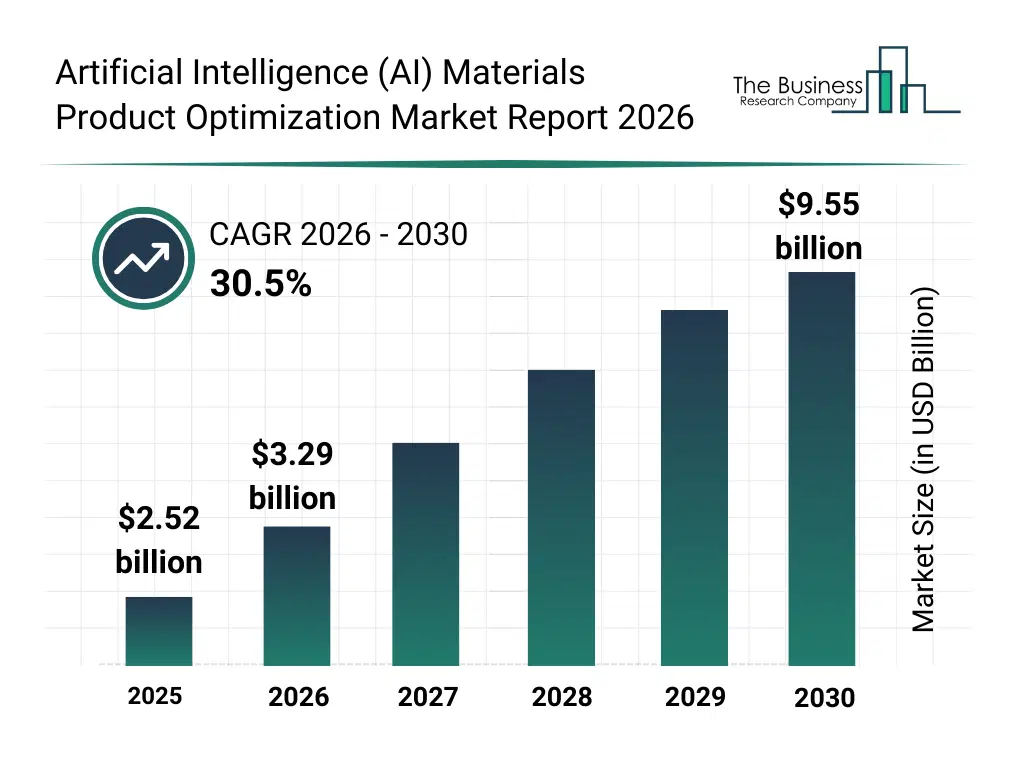
What Is The Artificial Intelligence (AI) Materials Product Optimization Market Size and Share 2026?
The artificial intelligence (AI) materials product optimization market size has grown exponentially in recent years. It will grow from $2.52 billion in 2025 to $3.29 billion in 2026 at a compound annual growth rate (CAGR) of 30.8%. The growth in the historic period can be attributed to growing demand for lightweight and high-strength materials, rising integration of computational modeling for material property prediction, increasing use of data-driven formulation optimization, expanding applications in electronics and automotive sectors, and growing emphasis on sustainability and recyclability in materials.What Is The Artificial Intelligence (AI) Materials Product Optimization Market Growth Forecast?
The artificial intelligence (AI) materials product optimization market size is expected to see exponential growth in the next few years. It will grow to $9.55 billion in 2030 at a compound annual growth rate (CAGR) of 30.5%. The growth in the forecast period can be attributed to increasing demand for cost-effective materials, rising focus on sustainability and circular economy practices, growing regulatory pressure for product safety and compliance, increasing outsourcing to specialized material suppliers, and rising cost pressures driving efficiency measures. Major trends in the forecast period include advancements in artificial intelligence algorithms for materials discovery, innovations in automated experimentation and robotics, development of high-throughput screening methods, research and development collaborations between industry and academia, and integration of machine learning with multiscale modeling.Global Artificial Intelligence (AI) Materials Product Optimization Market Segmentation
1) By Function Or Optimization Type: Material Discovery And Design, Predictive Modeling And Simulation, Process Optimization 2) By Artificial Intelligence (AI) Technology Used: Machine Learning, Generative Artificial Intelligence, Predictive Simulation, Computer Vision, Natural Language Processing, Hybrid Or Composite Artificial Intelligence 3) By Application: Materials Discovery And Design, Property Prediction And Optimization, Process Optimization And Manufacturing, Formulation Optimization, Quality Control And Defect Detection, Lifecycle And Sustainability Assessment, Other Applications 4) By End-User Industry: Chemicals And Advanced Materials, Energy And Batteries, Automotive And Aerospace, Electronics And Semiconductors, Pharmaceuticals And Life Sciences, Consumer Packaged Goods And Food, Other End-Users Subsegments: 1) By Material Discovery And Design: Computational Material Design, Experimental Material Synthesis, High Throughput Screening 2) By Predictive Modeling And Simulation:Predictive Modeling And Simulation 3) By Process Optimization: Workflow Automation, Resource Efficiency Optimization, Quality Control OptimizationWhat Is The Driver Of The Artificial Intelligence (AI) Materials Product Optimization Market?
The increasing adoption of artificial intelligence (AI) in manufacturing is expected to propel the growth of the artificial intelligence (AI) materials product optimization market going forward. Artificial intelligence (AI) in manufacturing refers to the application of artificial intelligence technologies, including machine learning, predictive analytics, and computer vision, to improve production processes, product design, quality control, and operational efficiency. The rise in adoption of artificial intelligence (AI) in manufacturing is due to growing demand for cost reduction, faster product development cycles, improved material utilization, and enhanced product performance. Artificial intelligence (AI) materials product optimization support artificial intelligence (AI) in manufacturing by leveraging artificial intelligence (AI) algorithms to analyze material properties, predict performance outcomes, and recommend design adjustments, resulting in higher-quality products, reduced waste, and accelerated innovation. For instance, in May 2025, according to the National Institute of Standards and Technology (NIST), a US-based federal agency supporting industrial innovation, 55% of United States manufacturers view artificial intelligence as a game changing technology, 46% are already using artificial intelligence tools such as chatbots in manufacturing operations, while 78% expect to increase investments in artificial intelligence over the next two years (2025-2027) and more than 80% anticipate expanding their artificial intelligence usage during (2025-2027). Therefore, the increasing adoption of AI in manufacturing is driving the growth of the artificial intelligence (AI) materials product optimization industry.Key Players In The Global Artificial Intelligence (AI) Materials Product Optimization Market
Major companies operating in the artificial intelligence (AI) materials product optimization market are International Business Machines Corporation, Fujitsu Limited, TDK Corporation, Dassault Systèmes SE, Hitachi High-Tech Corporation, Revvity Inc., Ansys Inc., Schrödinger Inc., Citrine Informatics Inc., QuesTek Innovations LLC, Materials Design Inc., Polymerize Private Limited, Phaseshift Technologies Inc., Kebotix Inc., Tilde Materials Informatics, Enthought Inc., Uncountable Inc., AI Materia Inc., Materials.Zone Ltd., Mat3ra.com Inc., NobleAI Inc.Global Artificial Intelligence (AI) Materials Product Optimization Market Trends and Insights
Major companies operating in the artificial intelligence (AI) materials product optimization market are focusing on technological advancements, such as artificial intelligence (AI)-enabled atomistic simulation platforms, to drive faster discovery, optimization, and deployment of advanced materials for industries ranging from semiconductors and energy to pharmaceuticals. Artificial intelligence (AI)-enabled atomistic simulation is the capability of an intelligent system to model, predict, and optimize materials behavior at the atomic level, generating actionable insights that reduce experimentation time, improve performance outcomes, and lower development costs as research complexity increases. For instance, in July 2025, Matlantis Inc., a US-based computational materials company, announced a major upgrade to its Universal Atomistic Simulator, an AI-powered platform designed to accelerate materials discovery and product optimization. The update debuts Version 8 of PFN’s proprietary PFP (Preferred Potential) AI engine, giving researchers a powerful ML-based interatomic potential that dramatically boosts simulation accuracy to speed discovery and strengthen predictive modeling in materials science. PFP Version 8 is highlighted as the first broadly applicable machine learning interatomic potential (MLIP) trained on datasets generated with the new r2SCAN (restored‑regularized strongly constrained and appropriately normed) functional, advancing the state of the art in atomic‑scale simulation. Matlantis’s platform enables researchers and product teams to explore complex chemical spaces, simulate performance under varied conditions, and iterate designs more efficiently than traditional trial-and-error approaches.What Are Latest Mergers And Acquisitions In The Artificial Intelligence (AI) Materials Product Optimization Market?
In October 2023, Altair Engineering Ltd., a US-based provider of computational science and artificial intelligence (AI) software, acquired OmniQuest Inc. for an undisclosed amount. With this acquisition, Altair strengthened its structural analysis and optimization capabilities, augmenting its ability to support advanced materials and product design workflows under complex design constraints. OmniQuest Inc. is a US-based company that provides material product-optimization and finite-element-based analysis software.Regional Insights
North America was the largest region in the artificial intelligence (AI) materials product optimization market in 2025. Asia-Pacific is expected to be the fastest-growing region in the forecast period. The regions covered in this market report are Asia-Pacific, South East Asia, Western Europe, Eastern Europe, North America, South America, Middle East, Africa. The countries covered in this market report are Australia, Brazil, China, France, Germany, India, Indonesia, Japan, Taiwan, Russia, South Korea, UK, USA, Canada, Italy, Spain.What Defines the Artificial Intelligence (AI) Materials Product Optimization Market?
The artificial intelligence materials product optimization market consists of revenues earned by entities by providing services such as materials discovery and formulation modelling services, simulation and digital twin services, data curation and analytics services, custom algorithm development and integration services, and testing and validation consulting. The market value includes the value of related goods sold by the service provider or included within the service offering. The artificial intelligence materials product optimization market also includes sales of simulation software licenses, materials and property databases, predictive modeling toolkits, sensor and data acquisition hardware, and integrated materials design platforms. Values in this market are ‘factory gate’ values, that is, the value of goods sold by the manufacturers or creators of the goods, whether to other entities (including downstream manufacturers, wholesalers, distributors, and retailers) or directly to end customers. The value of goods in this market includes related services sold by the creators of the goods.How is Market Value Defined and Measured?
The market value is defined as the revenues that enterprises gain from the sale of goods and/or services within the specified market and geography through sales, grants, or donations in terms of the currency (in USD unless otherwise specified). The revenues for a specified geography are consumption values that are revenues generated by organizations in the specified geography within the market, irrespective of where they are produced. It does not include revenues from resales along the supply chain, either further along the supply chain or as part of other products.What Key Data and Analysis Are Included in the Artificial Intelligence (AI) Materials Product Optimization Market Report 2026?
The artificial intelligence (ai) materials product optimization market research report is one of a series of new reports from The Business Research Company that provides market statistics, including industry global market size, regional shares, competitors with the market share, detailed market segments, market trends and opportunities, and any further data you may need to thrive in the artificial intelligence (ai) materials product optimization industry. The market research report delivers a complete perspective of everything you need, with an in-depth analysis of the current and future state of the industry.Artificial Intelligence (AI) Materials Product Optimization Market Report Forecast Analysis
| Report Attribute | Details |
|---|---|
| Market Size Value In 2026 | $3.29 billion |
| Revenue Forecast In 2035 | $9.55 billion |
| Growth Rate | CAGR of 30.8% from 2026 to 2035 |
| Base Year For Estimation | 2025 |
| Actual Estimates/Historical Data | 2020-2025 |
| Forecast Period | 2026 - 2030 - 2035 |
| Market Representation | Revenue in USD Billion and CAGR from 2026 to 2035 |
| Segments Covered | Function Or Optimization Type, Artificial Intelligence (AI) Technology Used, Application, End-User Industry |
| Regional Scope | Asia-Pacific, Western Europe, Eastern Europe, North America, South America, Middle East, Africa |
| Country Scope | The countries covered in the report are Australia, Brazil, China, France, Germany, India, ... |
| Key Companies Profiled | International Business Machines Corporation, Fujitsu Limited, TDK Corporation, Dassault Systèmes SE, Hitachi High-Tech Corporation, Revvity Inc., Ansys Inc., Schrödinger Inc., Citrine Informatics Inc., QuesTek Innovations LLC, Materials Design Inc., Polymerize Private Limited, Phaseshift Technologies Inc., Kebotix Inc., Tilde Materials Informatics, Enthought Inc., Uncountable Inc., AI Materia Inc., Materials.Zone Ltd., Mat3ra.com Inc., NobleAI Inc. |
| Customization Scope | Request for Customization |
| Pricing And Purchase Options | Explore Purchase Options |
Frequently Asked Questions
The Artificial Intelligence (AI) Materials Product Optimization Market Report 2026 market was valued at $2.52 billion in 2025, increased to $3.29 billion in 2026, and is projected to reach $9.55 billion by 2030.
request a sample hereThe expected CAGR for the Artificial Intelligence (AI) Materials Product Optimization market during the forecast period 2025–2030 is 30.5%.
request a sample hereMajor growth driver of the market includes: The increasing adoption of artificial intelligence (AI) in manufacturing is expected to propel the growth of the artificial intelligence (AI) materials product optimization market going forward. Artificial intelligence (AI) in manufacturing refers to the application of artificial intelligence technologies, including machine learning, predictive analytics, and computer vision, to improve production processes, product design, quality control, and operational efficiency. The rise in adoption of artificial intelligence (AI) in manufacturing is due to growing demand for cost reduction, faster product development cycles, improved material utilization, and enhanced product performance. Artificial intelligence (AI) materials product optimization support artificial intelligence (AI) in manufacturing by leveraging artificial intelligence (AI) algorithms to analyze material properties, predict performance outcomes, and recommend design adjustments, resulting in higher-quality products, reduced waste, and accelerated innovation. For instance, in May 2025, according to the National Institute of Standards and Technology (NIST), a US-based federal agency supporting industrial innovation, 55% of United States manufacturers view artificial intelligence as a game changing technology, 46% are already using artificial intelligence tools such as chatbots in manufacturing operations, while 78% expect to increase investments in artificial intelligence over the next two years (2025-2027) and more than 80% anticipate expanding their artificial intelligence usage during (2025-2027). Therefore, the increasing adoption of AI in manufacturing is driving the growth of the artificial intelligence (AI) materials product optimization market. in the Artificial Intelligence (AI) Materials Product Optimization market. For further insights on this market,
request a sample hereThe artificial intelligence (AI) materials product optimization market covered in this report is segmented –
1) By Function Or Optimization Type: Material Discovery And Design, Predictive Modeling And Simulation, Process Optimization
2) By Artificial Intelligence (AI) Technology Used: Machine Learning, Generative Artificial Intelligence, Predictive Simulation, Computer Vision, Natural Language Processing, Hybrid Or Composite Artificial Intelligence
3) By Application: Materials Discovery And Design, Property Prediction And Optimization, Process Optimization And Manufacturing, Formulation Optimization, Quality Control And Defect Detection, Lifecycle And Sustainability Assessment, Other Applications
4) By End-User Industry: Chemicals And Advanced Materials, Energy And Batteries, Automotive And Aerospace, Electronics And Semiconductors, Pharmaceuticals And Life Sciences, Consumer Packaged Goods And Food, Other End-Users Subsegments:
1) By Material Discovery And Design: Computational Material Design, Experimental Material Synthesis, High Throughput Screening
2) By Predictive Modeling And Simulation:Predictive Modeling And Simulation
3) By Process Optimization: Workflow Automation, Resource Efficiency Optimization, Quality Control Optimization
request a sample here1) By Function Or Optimization Type: Material Discovery And Design, Predictive Modeling And Simulation, Process Optimization
2) By Artificial Intelligence (AI) Technology Used: Machine Learning, Generative Artificial Intelligence, Predictive Simulation, Computer Vision, Natural Language Processing, Hybrid Or Composite Artificial Intelligence
3) By Application: Materials Discovery And Design, Property Prediction And Optimization, Process Optimization And Manufacturing, Formulation Optimization, Quality Control And Defect Detection, Lifecycle And Sustainability Assessment, Other Applications
4) By End-User Industry: Chemicals And Advanced Materials, Energy And Batteries, Automotive And Aerospace, Electronics And Semiconductors, Pharmaceuticals And Life Sciences, Consumer Packaged Goods And Food, Other End-Users Subsegments:
1) By Material Discovery And Design: Computational Material Design, Experimental Material Synthesis, High Throughput Screening
2) By Predictive Modeling And Simulation:Predictive Modeling And Simulation
3) By Process Optimization: Workflow Automation, Resource Efficiency Optimization, Quality Control Optimization
Major trend in this market includes: Accelerating Materials Discovery With AI-Driven Atomistic Simulation, Predictive Optimization, And Scalable Computational Insights For further insights on this market,
request a sample hereMajor companies operating in the Artificial Intelligence (AI) Materials Product Optimization market are Major companies operating in the artificial intelligence (AI) materials product optimization market are International Business Machines Corporation, Fujitsu Limited, TDK Corporation, Dassault Systèmes SE, Hitachi High-Tech Corporation, Revvity Inc., Ansys Inc., Schrödinger Inc., Citrine Informatics Inc., QuesTek Innovations LLC, Materials Design Inc., Polymerize Private Limited, Phaseshift Technologies Inc., Kebotix Inc., Tilde Materials Informatics, Enthought Inc., Uncountable Inc., AI Materia Inc., Materials.Zone Ltd., Mat3ra.com Inc., NobleAI Inc.
request a sample hereNorth America was the largest region in the artificial intelligence (AI) materials product optimization market in 2025. Asia-Pacific is expected to be the fastest-growing region in the forecast period. The regions covered in the artificial intelligence (AI) materials product optimization market report are Asia-Pacific, South East Asia, Western Europe, Eastern Europe, North America, South America, Middle East, Africa.
request a sample here