
Arrayed Clustered Regularly Interspaced Short Palindromic Repeats (CRISPR) Screening Market Report 2026

Arrayed Clustered Regularly Interspaced Short Palindromic Repeats (CRISPR) Screening Market Report 2026
Global Outlook – By Product Type (Clustered Regularly Interspaced Short Palindromic Repeats Libraries, Reagents And Consumables, Instruments, Software And Services), By Application (Functional Genomics, Drug Discovery, Disease Modeling, Gene Validation, Other Applications), By End User (Pharmaceutical And Biotechnology Companies, Academic And Research Institutes, Contract Research Organizations, Other End Users) – Market Size, Trends, Strategies, and Forecast to 2035
Arrayed Clustered Regularly Interspaced Short Palindromic Repeats (CRISPR) Screening Market Overview
• Arrayed Clustered Regularly Interspaced Short Palindromic Repeats (CRISPR) Screening market size has reached to $1.52 billion in 2025 • Expected to grow to $3.43 billion in 2030 at a compound annual growth rate (CAGR) of 17.7% • Growth Driver: Rising Focus On Personalized Medicine Drives The Market Growth Due To Advances In Genomics And Tailored Therapeutic • Market Trend: Strategic Partnerships Advance High-Throughput Precision In Arrayed CRISPR Screening • North America was the largest region in 2025 and Asia-Pacific is the fastest growing region.
%20Screening%20Market%20Report%202026&content_id=417d2e14-de40-4c5b-b199-c40277937bf3&price=4490&discount=0&image=https%3A%2F%2Fd1lt5802h39cn9.cloudfront.net%2Fcoverimages%2Farrayed_clustered_regularly_interspaced_short_palindromic_repeats_crispr_screening_market_report.webp)
What Is Covered Under Arrayed Clustered Regularly Interspaced Short Palindromic Repeats (CRISPR) Screening Market?
The arrayed clustered regularly interspaced short palindromic repeats (CRISPR) screening refers to a functional genomics technique in which individual genes are selectively edited or regulated in separate, well-defined cell populations using clustered regularly interspaced short palindromic repeats-based genome editing systems. This approach enables precise assessment of gene function, phenotypic outcomes, and molecular pathways by allowing direct attribution of observed cellular effects to specific genetic perturbations. The main product types of arrayed clustered regularly interspaced short palindromic repeats (CRISPR) screening products include clustered regularly interspaced short palindromic repeats (CRISPR) libraries, reagents and consumables, instruments, and software and services. Clustered regularly interspaced short palindromic repeats (CRISPR) libraries refer to collections of guide ribonucleic acids designed to target and edit specific genes for high-throughput functional screening. These products are applied across areas such as functional genomics, drug discovery, disease modeling, gene validation, and other applications, and are used by end users including pharmaceutical and biotechnology companies, academic and research institutes, contract research organizations, and other end users.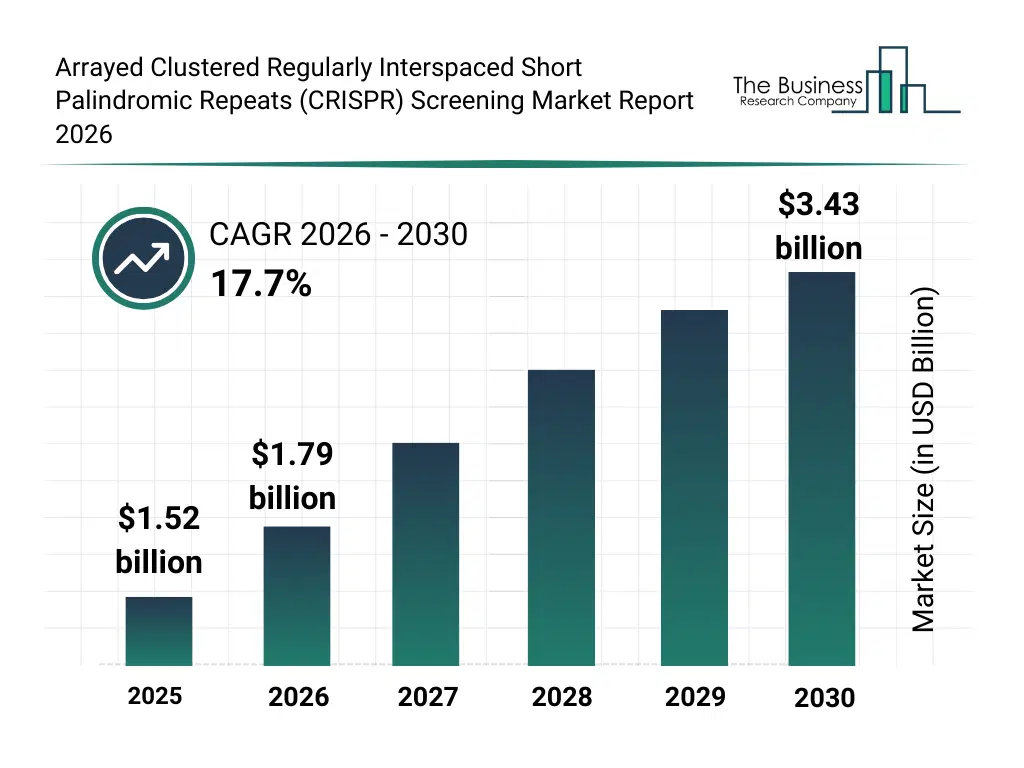
What Is The Arrayed Clustered Regularly Interspaced Short Palindromic Repeats (CRISPR) Screening Market Size and Share 2026?
The arrayed clustered regularly interspaced short palindromic repeats (crispr) screening market size has grown rapidly in recent years. It will grow from $1.52 billion in 2025 to $1.79 billion in 2026 at a compound annual growth rate (CAGR) of 17.5%. The growth in the historic period can be attributed to expansion of functional genomics research, availability of crispr editing reagents, growth of academic screening programs, early adoption of arrayed screening formats, increasing use of cell-based assays.What Is The Arrayed Clustered Regularly Interspaced Short Palindromic Repeats (CRISPR) Screening Market Growth Forecast?
The arrayed clustered regularly interspaced short palindromic repeats (crispr) screening market size is expected to see rapid growth in the next few years. It will grow to $3.43 billion in 2030 at a compound annual growth rate (CAGR) of 17.7%. The growth in the forecast period can be attributed to increasing demand for precision drug discovery, rising investments in Gene Therapy research, expansion of disease modeling applications, growing use of bioinformatics-driven screening, increasing collaboration between academia and industry. Major trends in the forecast period include increasing demand for targeted gene validation screens, rising use of high-throughput arrayed crispr assays, growing integration of phenotypic data analytics, expansion of custom crispr screening services, enhanced focus on functional genomics accuracy.Global Arrayed Clustered Regularly Interspaced Short Palindromic Repeats (CRISPR) Screening Market Segmentation
1) By Product Type: Clustered Regularly Interspaced Short Palindromic Repeats Libraries; Reagents And Consumables; Instruments; Software And Services 2) By Application: Functional Genomics; Drug Discovery; Disease Modeling; Gene Validation; Other Applications 3) By End User: Pharmaceutical And Biotechnology Companies; Academic And Research Institutes; Contract Research Organizations; Other End Users Subsegments: 1) By Clustered Regularly Interspaced Short Palindromic Repeats Libraries: Genome Wide Knockout Libraries; Targeted Gene Libraries; Activation Libraries; Repression Libraries; Custom Designed Libraries 2) By Reagents And Consumables: Guide Ribonucleic Acid Reagents; Cas Enzyme Reagents; Transfection Reagents; Cell Culture Reagents; Assay And Detection Reagents 3) By Instruments: Automated Liquid Handling Systems; High Throughput Screening Systems; Cell Imaging Systems; Flow Cytometry Instruments; Genomic Analysis Instruments 4) By Software And Services: Screening Design Software; Data Analysis Software; Bioinformatics Services; Screening Execution Services; Custom Assay Development ServicesWhat Are The Drivers Of The Arrayed Clustered Regularly Interspaced Short Palindromic Repeats (CRISPR) Screening Market?
The increasing focus on personalized medicine is expected to propel the growth of the arrayed clustered regularly interspaced short palindromic repeats (CRISPR) screening market going forward. Personalized medicine is a medical approach that customizes treatment and prevention strategies based on an individual’s genetic, biological, and lifestyle characteristics. The adoption of personalized medicine is increasing due to advances in genomics and molecular diagnostics, which allow treatments to be tailored to an individual’s genetic profile for better outcomes. Arrayed CRISPR screening helps personalized medicine by systematically testing the effect of specific gene edits on individual cell responses, allowing identification of patient-specific drug targets, predicting treatment responses, and designing tailored therapies based on a person’s genetic and cellular profile. For instance, in February 2024, according to the Personalized Medicine Coalition, a US-based non-profit organization, in 2023, the FDA approved 16 new personalized treatments for rare disease patients, up from six in 2022. The newly approved personalized treatments for 2023 also include seven cancer drugs and three for other diseases and conditions. Therefore, the increasing focus on personalized medicine is driving the growth of the arrayed clustered regularly interspaced short palindromic repeats (CRISPR) screening industry. The rising incidence of genetic diseases is expected to propel the growth of the arrayed CRISPR screening market going forward. Genetic diseases are disorders caused by abnormalities or mutations in an individual’s genes or chromosomes that affect normal body function. The prevalence of genetic diseases is increasing due to advanced parental age, which raises the risk of mutations and chromosomal abnormalities in offspring. Arrayed CRISPR screening aids genetic disease research by testing specific genes individually to pinpoint those responsible for disease and facilitates the development of targeted therapies. For instance, in October 2024, according to the Cystic Fibrosis Trust, a UK-based charity dedicated to supporting people with cystic fibrosis, in 2022, around 11,148 cystic fibrosis (a genetic disorder) patients were registered, and this number grew to 11,318 in 2023, reflecting a 1.5% increase in patient registrations year over year. Therefore, the rising incidence of genetic diseases is driving the growth of the arrayed CRISPR screening market.Key Players In The Global Arrayed Clustered Regularly Interspaced Short Palindromic Repeats (CRISPR) Screening Market
Major companies operating in the arrayed clustered regularly interspaced short palindromic repeats (crispr) screening market are Thermo Fisher Scientific Inc, Merck KGaA, GE HealthCare Technologies Inc, Applied Biological Materials Inc, Agilent Technologies Inc, Charles River Laboratories International Inc, Integrated DNA Technologies Inc, GenScript Biotech Corporation, Synthego Holdings LLC, Santa Cruz Biotechnology Inc, Creative Biolabs Inc, VectorBuilder Inc, Admera Health LLC, Addgene Inc, Ncardia, BioCat GmbH, Cellecta Inc, GeneCopoeia Inc, Creative Biogene Inc, and Aelian Biotechnology.Global Arrayed Clustered Regularly Interspaced Short Palindromic Repeats (CRISPR) Screening Market Trends and Insights
Major companies operating in the arrayed clustered regularly interspaced short palindromic repeats (CRISPR) screening market are focusing on adopting strategic partnerships to enhance high-throughput phenotypic screening precision. A strategic partnership is a formal collaboration in which organizations combine resources, knowledge, or technologies to achieve shared objectives that support quicker innovation, reduced risk, and broader market reach without requiring a merger or acquisition. For instance, in November 2023, AstraZeneca Plc, a UK-based science-led biopharmaceutical company, partnered with the Medical Research Council (MRC), a UK-based government agency, and the Milner Therapeutics Institute (MTI) at the University of Cambridge, a UK-based biomedical research institute, to launch a Functional Genomics Screening Laboratory (FGSL), a state-of-the-art facility advancing drug discovery. Its purpose is to map gene-phenotype links in chronic conditions such as cardiovascular and metabolic disorders, advancing UK genomics leadership via open academic collaborations. Advantages include high-throughput automation for precise imaging and phenotyping in organoids or iPSCs, outperforming pooled methods; benefits encompass free access for researchers, faster target validation, and shared expertise to expedite therapies.nan
Regional Insights
North America was the largest region in the arrayed clustered regularly interspaced short palindromic repeats (CRISPR) screening market in 2025. Asia-Pacific is expected to be the fastest-growing region in the forecast period. The regions covered in this market report are Asia-Pacific, South East Asia, Western Europe, Eastern Europe, North America, South America, Middle East, Africa. The countries covered in this market report are Australia, Brazil, China, France, Germany, India, Indonesia, Japan, Taiwan, Russia, South Korea, UK, USA, Canada, Italy, Spain.What Defines the Arrayed Clustered Regularly Interspaced Short Palindromic Repeats (CRISPR) Screening Market?
The arrayed clustered regularly interspaced short palindromic repeats (CRISPR) screening market includes revenues earned by entities through custom arrayed clustered regularly interspaced short palindromic repeats screening services, target gene validation services, functional genomics screening services, assay development services, phenotypic data analysis services, bioinformatics and data interpretation services and genome editing experimental design services, and cell line engineering services. The market value includes the value of related goods sold by the service provider or included within the service offering. Only goods and services traded between entities or sold to end consumers are included.How is Market Value Defined and Measured?
The market value is defined as the revenues that enterprises gain from the sale of goods and/or services within the specified market and geography through sales, grants, or donations in terms of the currency (in USD unless otherwise specified). The revenues for a specified geography are consumption values that are revenues generated by organizations in the specified geography within the market, irrespective of where they are produced. It does not include revenues from resales along the supply chain, either further along the supply chain or as part of other products.What Key Data and Analysis Are Included in the Arrayed Clustered Regularly Interspaced Short Palindromic Repeats (CRISPR) Screening Market Report 2026?
The arrayed clustered regularly interspaced short palindromic repeats (crispr) screening market research report is one of a series of new reports from The Business Research Company that provides market statistics, including industry global market size, regional shares, competitors with the market share, detailed market segments, market trends and opportunities, and any further data you may need to thrive in the arrayed clustered regularly interspaced short palindromic repeats (crispr) screening industry. The market research report delivers a complete perspective of everything you need, with an in-depth analysis of the current and future state of the industry.Arrayed Clustered Regularly Interspaced Short Palindromic Repeats (CRISPR) Screening Market Report Forecast Analysis
| Report Attribute | Details |
|---|---|
| Market Size Value In 2026 | $1.79 billion |
| Revenue Forecast In 2035 | $3.43 billion |
| Growth Rate | CAGR of 17.5% from 2026 to 2035 |
| Base Year For Estimation | 2025 |
| Actual Estimates/Historical Data | 2020-2025 |
| Forecast Period | 2026 - 2030 - 2035 |
| Market Representation | Revenue in USD Billion and CAGR from 2026 to 2035 |
| Segments Covered | Product Type, Application, End User |
| Regional Scope | Asia-Pacific, Western Europe, Eastern Europe, North America, South America, Middle East, Africa |
| Country Scope | The countries covered in the report are Australia, Brazil, China, France, Germany, India, ... |
| Key Companies Profiled | Thermo Fisher Scientific Inc, Merck KGaA, GE HealthCare Technologies Inc, Applied Biological Materials Inc, Agilent Technologies Inc, Charles River Laboratories International Inc, Integrated DNA Technologies Inc, GenScript Biotech Corporation, Synthego Holdings LLC, Santa Cruz Biotechnology Inc, Creative Biolabs Inc, VectorBuilder Inc, Admera Health LLC, Addgene Inc, Ncardia, BioCat GmbH, Cellecta Inc, GeneCopoeia Inc, Creative Biogene Inc, and Aelian Biotechnology. |
| Customization Scope | Request for Customization |
| Pricing And Purchase Options | Explore Purchase Options |
Frequently Asked Questions
The Arrayed Clustered Regularly Interspaced Short Palindromic Repeats (CRISPR) Screening market was valued at $1.52 billion in 2025, increased to $1.79 billion in 2026, and is projected to reach $3.43 billion by 2030.
request a sample hereThe global Arrayed Clustered Regularly Interspaced Short Palindromic Repeats (CRISPR) Screening market is expected to grow at a CAGR of 17.7% from 2026 to 2035 to reach $3.43 billion by 2035.
request a sample hereSome Key Players in the Arrayed Clustered Regularly Interspaced Short Palindromic Repeats (CRISPR) Screening market Include, Thermo Fisher Scientific Inc, Merck KGaA, GE HealthCare Technologies Inc, Applied Biological Materials Inc, Agilent Technologies Inc, Charles River Laboratories International Inc, Integrated DNA Technologies Inc, GenScript Biotech Corporation, Synthego Holdings LLC, Santa Cruz Biotechnology Inc, Creative Biolabs Inc, VectorBuilder Inc, Admera Health LLC, Addgene Inc, Ncardia, BioCat GmbH, Cellecta Inc, GeneCopoeia Inc, Creative Biogene Inc, and Aelian Biotechnology. .
request a sample hereMajor trend in this market includes: Strategic Partnerships Advance High-Throughput Precision In Arrayed CRISPR Screening. For further insights on this market.
request a sample hereNorth America was the largest region in the arrayed clustered regularly interspaced short palindromic repeats (CRISPR) screening market in 2025. Asia-Pacific is expected to be the fastest-growing region in the forecast period. The regions covered in the arrayed clustered regularly interspaced short palindromic repeats (crispr) screening market report are Asia-Pacific, South East Asia, Western Europe, Eastern Europe, North America, South America, Middle East, Africa.
request a sample here