
AI In Talent Acquisition Market 2026
AI In Talent Acquisition Market 2026
By Componenet (Solution, Services), By Application (Candidate Sourcing, Resume Screening, Interview Scheduling, Candidate Engagement, Other Applications), By Industry Vertical (Information Technology (IT) And Telecommunication, Banking Financial Services And Insurance (BFSI), Healthcare, Retail And E-Commerce, Manufacturing, Other Industry Verticals), And By Region, Opportunities And Strategies – Global Forecast To 2035
AI In Talent Acquisition Market Definition
Artificial intelligence (AI) in talent acquisition refers to the use of advanced algorithms, machine learning, natural language processing, and data analytics to optimize and automate various stages of the hiring process. It is designed to assist human resource teams in identifying, sourcing, screening, and engaging potential candidates more efficiently. The artificial intelligence (AI) in talent acquisition market consists of sales, by entities (organizations, sole traders, or partnerships), of AI-powered software and solutions that automate and enhance recruitment processes, including candidate sourcing, screening, interviewing, engagement, and onboarding.

AI In Talent Acquisition Market Size
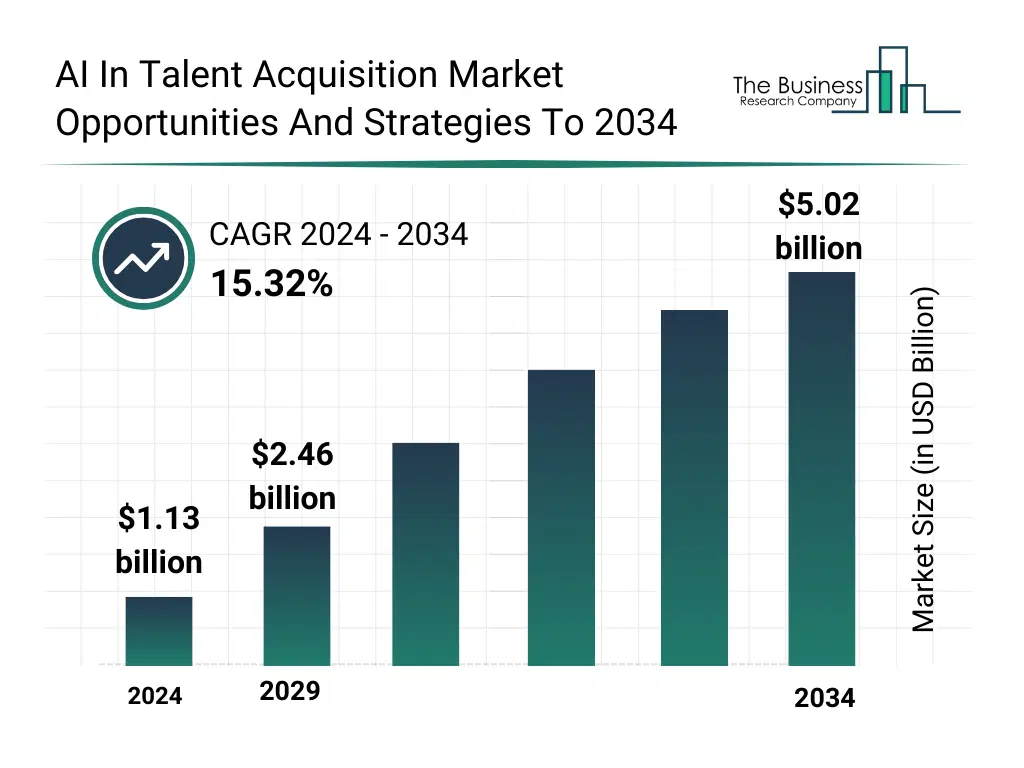
The global meditation market reached a value of nearly $7,981.79 million in 2024, having grown at a compound annual growth rate (CAGR) of 21.24% since 2019. The market is expected to grow from $7,981.79 million in 2024 to $17,329.36 million in 2029 at a rate of 16.77%. The market is then expected to grow at a CAGR of 12.54% from 2029 and reach $31,289.48 million in 2034. Growth in the historic period resulted from rising remote and hybrid work adoption, rising skills gaps across industries, growing demand for time-efficient solutions and increasing volume of job applications. Factors that negatively affected growth in the historic period were the ethical AI challenges and integration challenges. Going forward, adoption of predictive workforce analytics, increasing need for internal mobility, growth in the Gig economy and flexible talent models and stricter compliance requirements in hiring processes will drive growth. Factors that could hinder the growth of the AI in talent acquisition market in the future include were limited availability of high-quality training data, regulatory and compliance uncertainties and impact of trade war and tariff.AI In Talent Acquisition Market Drivers
The key drivers of the AI in talent acquisition market include: Adoption Of Predictive Workforce Analytics Adoption of predictive workforce analytics is expected to be a key driver of the growth of the artificial intelligence (AI) in talent acquisition market in the forecast period. As businesses sought deeper visibility into skill requirements, workforce gaps, and future talent needs, they moved beyond traditional recruitment metrics toward data-driven forecasting. Predictive analytics enabled employers to anticipate hiring demand, identify emerging roles, and measure candidate success probabilities with greater accuracy. This shift required advanced AI tools capable of analyzing large datasets, integrating with HR systems, and generating actionable insights for recruiters. The need to align hiring strategies with broader workforce planning initiatives made AI-powered analytics a critical capability. As organizations recognized the strategic advantage of proactively shaping their talent pipelines rather than reacting to vacancies, the demand for predictive AI solutions accelerated, contributing to the market’s strong historic growth. The adoption of predictive workforce analytics growth contribution during the forecast period in 2024 is 1.25%.AI In Talent Acquisition Market Restraints
The key restraints on the AI in talent acquisition market include: Limited Availability Of High-Quality Training Data Limited availability of high-quality training data is restricting the growth of the artificial intelligence (AI) in talent acquisition market during the forecast period. However, many organizations struggle to provide datasets that accurately reflect diverse hiring scenarios, job roles, industries, and candidate backgrounds. Incomplete, outdated, or inconsistent data can result in artificial intelligence (AI) models that produce unreliable recommendations, inaccurate match scores, or weak predictive insights. Companies lacking robust HR data infrastructure face additional challenges in integrating and cleaning historical information before feeding it into AI systems. The scarcity of well-structured training datasets limits model performance and increases the risk of inaccurate outcomes, discouraging organizations from fully adopting artificial intelligence (AI) technologies. As a result, market expansion is slowed by the need for extensive data preparation, validation, and continuous model retraining to maintain accuracy and relevance. Growth affected by limited availability of high-quality training data across regions during the forecast period in 2024 is -2.00%.AI In Talent Acquisition Market Trends
Major trends shaping the AI in talent acquisition market include: Implementation Of Ethical AI Frameworks For Bias-Free Recruitment Major companies in the artificial intelligence (AI) in talent acquisition market are focusing on implementing ethical AI frameworks to ensure fairness, transparency, and responsible use of algorithms across recruitment workflows. These initiatives aim to reduce discriminatory outcomes, strengthen auditability, protect candidate privacy, and increase trust in AI-driven hiring systems. For instance, in April 2025, AMS, a UK-based talent acquisition and advisory firm, introduced a comprehensive ethical-AI framework designed specifically for recruitment processes. The framework outlines mandatory guidelines for algorithm audits, bias-mitigation testing, candidate explainability, and human-in-the-loop intervention for high-impact hiring decisions. AMS stated that the framework was developed to help global employers adopt artificial intelligence (AI) responsibly while ensuring transparency for candidates throughout the hiring process. The company also emphasized that the standards would support future regulatory alignment as artificial intelligence (AI) governance laws evolve worldwide. Integration Of Predictive Analytics For Enhanced Hiring Accuracy Companies operating in the artificial intelligence (AI) in talent acquisition are focusing on embedding predictive analytics into recruitment workflows to enhance role-fit accuracy, forecast candidate success, and optimize long-term workforce planning. These efforts aim to shift hiring from reactive screening to proactive matching and performance forecasting. These innovations are helping organizations reduce mismatches, lower time-to-hire, improve retention rates, and align talent acquisition with strategic business outcomes. For example, in August 2024, Workday, Inc, a US-based provider of enterprise cloud applications, launched its “HiredScore AI for Recruiting” and “HiredScore AI for Talent Mobility” solutions via its platform, enabling organizations to identify candidates whose skills and experience closely match roles, rediscover former applicants, and utilize artificial intelligence (AI) to surface future openings for them. The rollout reported measurable outcomes including a 25% increase in recruiter capacity and a 34% faster hiring-manager review time.Opportunities And Recommendations In The AI In Talent Acquisition Market
Opportunities – The top opportunities in the artificial intelligence (AI) in talent acquisition market segmented by component will arise in the solution segment, which will gain $852.11 million of global annual sales by 2029. The top opportunities in the AI in talent acquisition market segmented by application will arise in the candidate sourcing segment, which will gain $437.65 million of global annual sales by 2029. The top opportunities in the artificial intelligence (AI) in talent acquisition market segmented by industry vertical will arise in the information technology (IT) and telecommunication segment, which will gain $384.32 million of global annual sales by 2029. The AI in talent acquisition market size will gain the most in the USA at $506.94 million. Recommendations- To take advantage of the opportunities, The Business Research Company recommends the AI in talent acquisition companies to focus on AI-driven personalization to accelerate talent acquisition, focus on implementing ethical AI frameworks in talent acquisition, focus on leveraging predictive analytics to improve hiring outcomes, focus on deploying generative AI to enhance recruitment efficiency, focus on advanced AI recruitment engines to improve sourcing and screening, focus on the fastest-growing services segment in AI talent acquisition, expand in emerging markets, continue to focus on developed markets, focus on value-based pricing to optimize revenue and adoption, focus on targeted digital campaigns to drive awareness and engagement, focus on strategic partnerships and thought leadership for market penetration, focus on candidate engagement to capture fastest growth in AI talent acquisition, focus on healthcare to capture fastest growth across industry verticals.AI In Talent Acquisition Market Segmentation
The AI in talent acquisition market is segmented by component, by application, and by industry vertical.By Component–
The AI in talent acquisition market is segmented by component into:
- a) Solution
- b) Services
By Application–
The AI in talent acquisition market is segmented by application into:
- a) Candidate Sourcing
- b) Resume Screening
- c) Interview Scheduling
- d) Candidate Engagement
- e) Other Applications
By Industry Vertical–
The AI in talent acquisition market is segmented by industry vertical into:
- a) Information Technology (IT) And Telecommunication
- b) Banking Financial Services And Insurance (BFSI)
- c) Healthcare
- d) Retail And E-Commerce
- e) Manufacturing
- f) Other Industry Verticals
By Geography - The AI in talent acquisition market is segmented by geography into:
- • China
- • India
- • Japan
- • Australia
- • Indonesia
- • South Korea
- • USA
- • Canada
- • Brazil
- • France
- • Germany
- • UK
- • Italy
- • Spain
- • Russia
-
o Asia Pacific
o Africa