
Adoption Analysis Of 5G In Aviation Market Report 2026
Global Outlook – By Component (Hardware, Software, Services), By Technology (Enhanced Mobile Broadband (eMBB), Ultra-Reliable Low Latency Communications (URLLC), Massive Machine Type Communications (mMTC), Fixed Wireless Access (FWA) ), By Communication Infrastructure (Small Cell, Distributed Antenna Systems), By Application (Aircraft Communication And Connectivity, Airport Operations And Automation, Real-Time Data Analytics, Air Traffic Management, Predictive Maintenance, Passenger Experience Enhancement), By End-User (Airlines, Airports, Air Navigation Service Providers) – Market Size, Trends, Strategies, and Forecast to 2035
Adoption Analysis Of 5G In Aviation Market Overview
• Adoption Analysis Of 5G In Aviation market size has reached to $1.43 billion in 2025 • Expected to grow to $5.14 billion in 2030 at a compound annual growth rate (CAGR) of 29% • Growth Driver: Expansion Of Airport Digital Infrastructure Fueling The Growth Of The Market Due To Rising Need For High-Speed, Low-Latency Aviation Connectivity • Market Trend: • North America was the largest region in 2025 and Asia-Pacific is the fastest growing region.What Is Covered Under Adoption Analysis Of 5G In Aviation Market?
Adoption analysis of 5G in aviation refers to the systematic assessment of how 5G technology is being integrated across various aviation operations and infrastructures. It examines the drivers, challenges, readiness levels, and technological advancements influencing the uptake of 5G within the sector. This analysis also evaluates the potential impact of 5G on efficiency, safety, connectivity, and innovation in aviation environments. The main components of the adoption analysis of the 5g in aviation include hardware, software, and services. Hardware refers to physical equipment such as 5g antennas, network routers, and onboard communication modules that enable seamless connectivity and data transmission in aviation environments. The technology into enhanced mobile broadband (embb), ultra-reliable low latency communications (urllc), massive machine type communications (mmtc), and fixed wireless access (fwa). The communication infrastructure, it includes small cell and distributed antenna systems. There application, 5g is applied to aircraft communication and connectivity, airport operations and automation, real-time data analytics, air traffic management, predictive maintenance, and passenger experience enhancement, and the key end-users include airlines, airports, and air navigation service providers.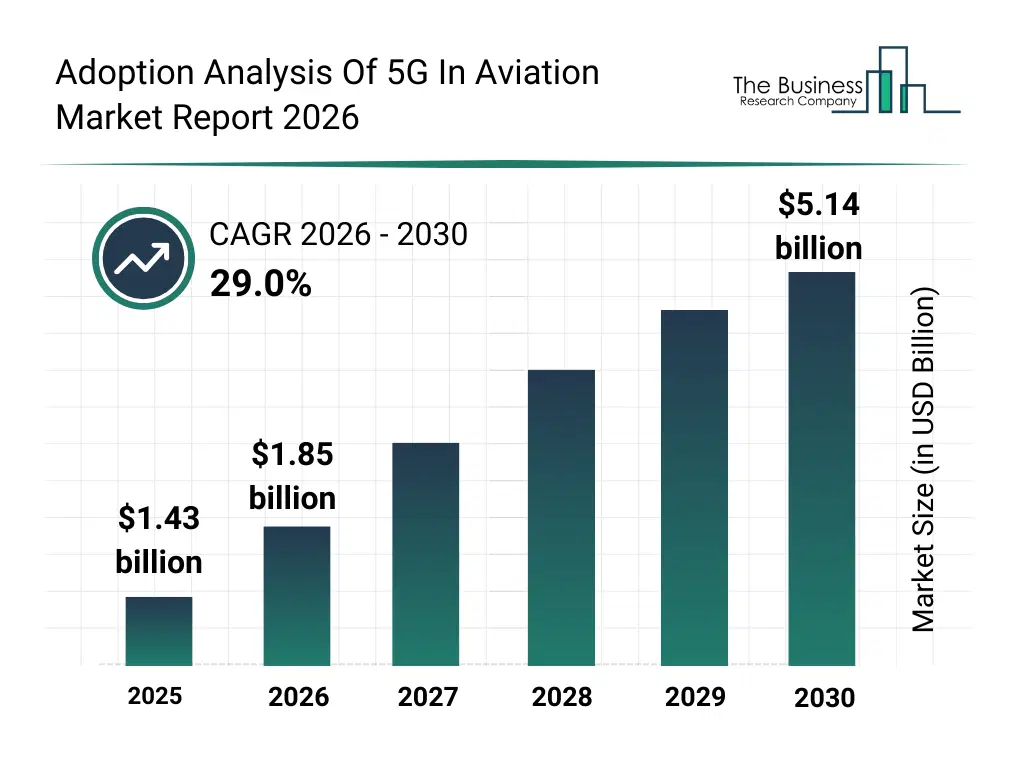
What Is The Adoption Analysis Of 5G In Aviation Market Size and Share 2026?
The adoption analysis of the 5G in aviation market size has grown exponentially in recent years. It will grow from $1.43 billion in 2025 to $1.85 billion in 2026 at a compound annual growth rate (CAGR) of 29.3%. The growth in the historic period can be attributed to increasing demand for high-speed aviation communication, rising modernization of airport infrastructure, growing adoption of digital aviation systems, increasing focus on real-time aircraft data transmission, and rising investments in telecommunications upgrades.What Is The Adoption Analysis Of 5G In Aviation Market Growth Forecast?
The adoption analysis of the 5G in aviation market size is expected to see exponential growth in the next few years. It will grow to $5.14 billion in 2030 at a compound annual growth rate (CAGR) of 29.0%. The growth in the forecast period can be attributed to expanding deployment of 5g-supported aviation networks, rising focus on autonomous airport operations, increasing need for ultra-low latency communication, accelerating investments in smart airport technologies, and growing emphasis on predictive maintenance connectivity. Major trends in the forecast period include advancement of intelligent air traffic communication systems, innovation in 5g-enabled aircraft connectivity, integration of edge computing in aviation networks, advancement of smart airport automation ecosystems, and innovation in real-time aviation analytics platforms.
Global Adoption Analysis Of 5G In Aviation Market Segmentation
1) By Component: Hardware, Software, Services 2) By Technology: Enhanced Mobile Broadband (eMBB), Ultra-Reliable Low Latency Communications (URLLC), Massive Machine Type Communications (mMTC), Fixed Wireless Access (FWA) 3) By Communication Infrastructure: Small Cell, Distributed Antenna Systems 4) By Application: Aircraft Communication And Connectivity, Airport Operations And Automation, Real-Time Data Analytics, Air Traffic Management, Predictive Maintenance, Passenger Experience Enhancement 5) By End-User: Airlines, Airports, Air Navigation Service Providers Subsegments: 1) By Hardware: Radio Access Equipment, Network Communication Modules, Aircraft Connectivity Devices, Sensor And Monitoring Devices, Edge Computing Devices 2) By Software: Network Management Platforms, Data Analytics Platforms, Communication Control Systems, Cybersecurity Management Systems, Aviation Operation Optimization Platforms 3) By Services: Installation And Integration Services, Maintenance And Support Services, Network Planning Services, System Upgrade Services, Training And Consulting ServicesWhat Are The Drivers Of The Adoption Analysis Of 5G In Aviation Market?
The expansion of airport digital infrastructure is expected to propel the growth of the adoption analysis of 5G in aviation market going forward. Airport digital infrastructure refers to the deployment of advanced digital systems such as high-speed connectivity, smart sensors, automated operations, and data-driven platforms across airports to improve efficiency, safety, and passenger experience. The rise in airport digital infrastructure expansion is due to increasing air passenger traffic and the need for real-time data exchange for airside and landside activities. The adoption of 5G in aviation supports airport digital infrastructure by enabling ultra-low latency communication, high data throughput, and reliable connectivity for applications such as smart airports, connected aircraft, autonomous ground operations, and enhanced passenger services. For instance, in February 2024, according to Société Internationale de Télécommunications Aéronautiques (SITA), a Switzerland based air transport information technology solutions provider, biometrics adoption is accelerating to reduce congestion with 70% of airlines expecting biometric identity management by 2026 and 90% of airports investing in major programs or research and development, while over 90% of airlines plan to deploy information technology systems by 2026 to improve flight operations and aircraft turnaround efficiency, supported by rising information technology spending that reached an estimated $34.5 billion in 2023. Therefore, the expansion of airport digital infrastructure is driving the growth of the adoption analysis of 5G in aviation industry. The growing demand for faster in-flight connectivity is expected to propel the growth of the adoption analysis of 5G in aviation market going forward. Faster in-flight connectivity refers to the ability to provide high-speed, low-latency internet access on aircraft for passengers, crew, and operational systems during flight. The demand for faster in-flight connectivity is rising due to passengers' expectations for seamless connectivity. The adoption of 5G in aviation supports faster in-flight connectivity by enabling ultra-high-speed data transmission, reduced latency, and improved network reliability, which enhances passenger experience, supports real-time aircraft operations, and enables advanced aviation applications such as predictive maintenance and smart cabin services. For instance, in December 2024, according to Viasat Inc., a US-based global satellite communications and connectivity provider, Lufthansa selected Viasat to equip more than 150 additional aircraft across its Lufthansa, SWISS and Austrian Airlines fleets with the European Aviation Network in flight connectivity solution, while Royal Jordanian also chose Viasat’s in flight connectivity solution to equip more than 40 aircraft, underscoring rising airline adoption of advanced onboard connectivity systems. Therefore, the growing demand for faster in-flight connectivity is driving the growth of the adoption analysis of 5G in aviation industry.Key Players In The Global Adoption Analysis Of 5G In Aviation Market
Major companies operating in the adoption analysis of 5g in aviation market are Huawei Technologies Co. Ltd., Panasonic Avionics Corporation, Cisco Systems Inc., Honeywell International Inc., NTT DATA Corporation, Fujitsu Limited, Telefonaktiebolaget LM Ericsson, Nokia Corporation, ZTE Corporation, Telstra Corporation Limited, Hewlett Packard Enterprise Company, Viasat Inc., Intelsat S.A, Gogo Business Aviation LLC, Boingo Wireless Inc., Eutelsat OneWeb Ltd., Inmarsat Global Limited, Airspan Networks Holdings Inc., Qualcomm Incorporated, Samsung Electronics Co.ltdWhat Are Latest Mergers And Acquisitions In The Adoption Analysis Of 5G In Aviation Market?
In May 2023, Viasat Inc., a US-based global communications company offering broadband, satellite internet, and advanced connectivity solutions, acquired Inmarsat plc for approximately $7.3 billion. With this acquisition, Viasat integrated Inmarsat’s broad satellite portfolio, including Ka-, L- and S-band spectrum assets and a network of 19 operational satellites to strengthen its multi-band, multi-orbit capabilities and expand its connectivity offerings across aviation, maritime, government, and commercial markets. Inmarsat plc is a UK-based satellite communications provider that delivers in-flight connectivity, safety-critical communication services, and the adoption and implementation of 5G in aviation.Regional Insights
North America was the largest region in the adoption analysis of the 5G in aviation market in 2025. Asia-Pacific is expected to be the fastest-growing region in the forecast period. The regions covered in this market report are Asia-Pacific, South East Asia, Western Europe, Eastern Europe, North America, South America, Middle East, Africa. The countries covered in this market report are Australia, Brazil, China, France, Germany, India, Indonesia, Japan, Taiwan, Russia, South Korea, UK, USA, Canada, Italy, Spain.What Defines the Adoption Analysis Of 5G In Aviation Market?
The adoption analysis of the 5G in aviation market consists of revenues earned by entities by providing services such as network deployment support, integration of 5G-enabled aviation systems, connectivity solutions, infrastructure modernization, and technological consulting. The market value includes the value of related goods sold by the service provider or included within the service offering. The adoption analysis of the 5G in aviation market also includes sales of radio units, remote radio heads, network switches, edge computing servers, aviation-grade routers, and aviation-grade modems. Values in this market are ‘factory gate’ values, that is, the value of goods sold by the manufacturers or creators of the goods, whether to other entities (including downstream manufacturers, wholesalers, distributors, and retailers) or directly to end customers. The value of goods in this market includes related services sold by the creators of the goods.How is Market Value Defined and Measured?
The market value is defined as the revenues that enterprises gain from the sale of goods and/or services within the specified market and geography through sales, grants, or donations in terms of the currency (in USD unless otherwise specified). The revenues for a specified geography are consumption values that are revenues generated by organizations in the specified geography within the market, irrespective of where they are produced. It does not include revenues from resales along the supply chain, either further along the supply chain or as part of other products.What Key Data and Analysis Are Included in the Adoption Analysis Of 5G In Aviation Market Report 2026?
The adoption analysis of 5g in aviation market research report is one of a series of new reports from The Business Research Company that provides market statistics, including industry global market size, regional shares, competitors with the market share, detailed market segments, market trends and opportunities, and any further data you may need to thrive in the adoption analysis of 5g in aviation industry. The market research report delivers a complete perspective of everything you need, with an in-depth analysis of the current and future state of the industry.Adoption Analysis Of 5G In Aviation Market Report Forecast Analysis
| Report Attribute | Details |
|---|---|
| Market Size Value In 2026 | $1.85 billion |
| Revenue Forecast In 2035 | $5.14 billion |
| Growth Rate | CAGR of 29.3% from 2026 to 2035 |
| Base Year For Estimation | 2025 |
| Actual Estimates/Historical Data | 2020-2025 |
| Forecast Period | 2026 - 2030 - 2035 |
| Market Representation | Revenue in USD Billion and CAGR from 2026 to 2035 |
| Segments Covered | Component, Technology, Communication Infrastructure, Application, End-User |
| Regional Scope | Asia-Pacific, Western Europe, Eastern Europe, North America, South America, Middle East, Africa |
| Country Scope | The countries covered in the report are Australia, Brazil, China, France, Germany, India, ... |
| Key Companies Profiled | Huawei Technologies Co. Ltd., Panasonic Avionics Corporation, Cisco Systems Inc., Honeywell International Inc., NTT DATA Corporation, Fujitsu Limited, Telefonaktiebolaget LM Ericsson, Nokia Corporation, ZTE Corporation, Telstra Corporation Limited, Hewlett Packard Enterprise Company, Viasat Inc., Intelsat S.A, Gogo Business Aviation LLC, Boingo Wireless Inc., Eutelsat OneWeb Ltd., Inmarsat Global Limited, Airspan Networks Holdings Inc., Qualcomm Incorporated, Samsung Electronics Co.ltd |
| Customization Scope | Request for Customization |
| Pricing And Purchase Options | Explore Purchase Options |