
3D Scanning Market 2026
3D Scanning Market 2026
By Type (Optical Scanner, Laser Scanner, Structured Light Scanner, Other Types), By Offering (Hardware, Software, Services), By Application (Automotive, Entertainment And Media, Aerospace And Defense, Healthcare, Civil And Architecture, Industrial Manufacturing, Other Applications), And By Region, Opportunities And Strategies – Global Forecast To 2035
3D Scanning Market Definition
3D scanning is a technology that captures the physical geometry and surface details of an object or environment to create a precise three-dimensional digital model. It uses techniques such as laser scanning, structured light, or photogrammetry to collect spatial data points (point clouds) that represent the object’s exact size, shape and texture. The primary purpose of 3D scanning is to enable accurate digital reconstruction, measurement and analysis for use in design, manufacturing, quality inspection, healthcare, construction and cultural preservation. The 3D scanning market consists of sales, by entities (organizations, sole traders, or partnerships), of 3D scanning that provide scanning hardware, software and related services used to capture and process three-dimensional data. It plays a central role in applications such as reverse engineering, quality inspection, as-built documentation, medical modeling and content creation for entertainment and media.

3D Scanning Market Size
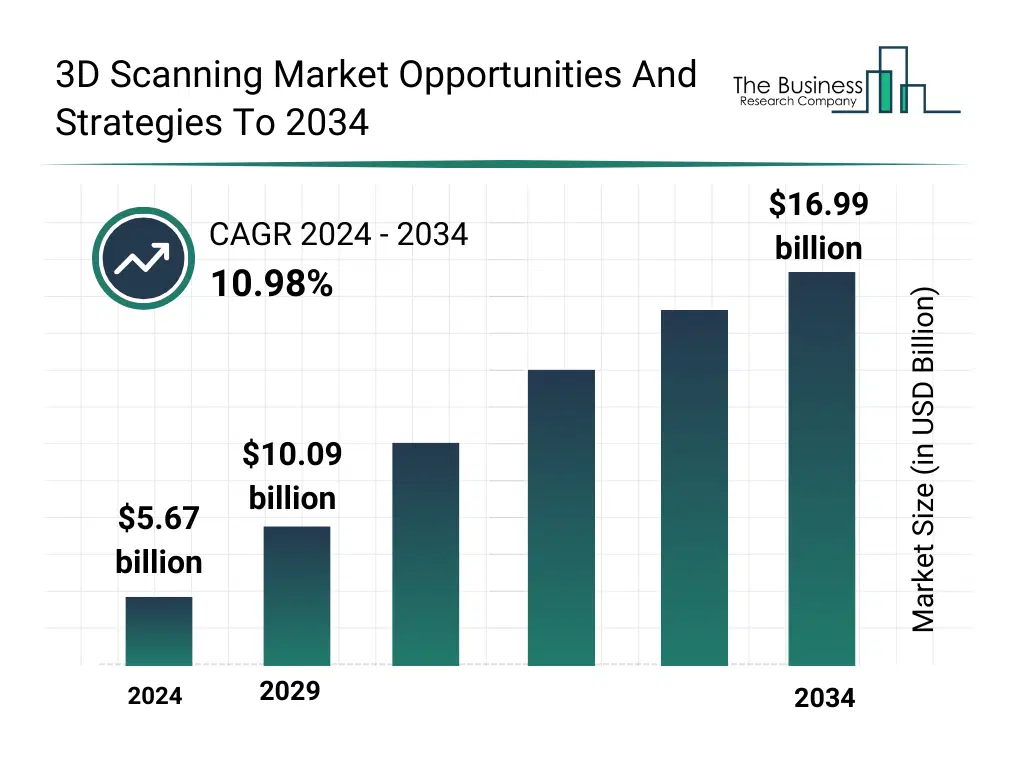
The global 3D scanning market reached a value of nearly $5,673.99 million in 2024, having grown at a compound annual growth rate (CAGR) of 8.40% since 2019. The market is expected to grow from $5,673.99 million in 2024 to $10,089.15 million in 2029 at a rate of 12.20%. The market is then expected to grow at a CAGR of 10.98% from 2029 and reach $16,985.93 million in 2034. Growth in the historic period resulted from the rising demand from automotive and aerospace sector, expansion of industrial automation and smart factory initiatives, growth in telehealth and digital health records and rise in infrastructure investments. Factors that negatively affected growth in the historic period were lack of skilled personnel and competition from alternative technologies. Going forward, the rise of the global construction and engineering sector, rise of the metaverse and digital twins, rising medical imaging and diagnostics and growth of the entertainment and media industry will drive the growth. Factors that could hinder the growth of the 3D scanning market in the future include high initial investment costs, cybersecurity and data privacy concerns and impact of trade war and tariff.3D Scanning Market Drivers
The key drivers of the 3d scanning market include: Rise Of The Global Construction And Engineering Sector During the forecast period, the expansion of the global construction and engineering sector is expected to significantly propel the growth of the 3D scanning market. As urbanization accelerates and infrastructure projects become more complex, the demand for precise and efficient measurement technologies like 3D scanning is increasing. These technologies offer enhanced accuracy, reduced project timelines and improved safety, making them indispensable in modern construction practices. Notably, regions like Asia-Pacific are expected to lead this expansion due to rapid urban development and rising demand for smart, climate-resilient infrastructure. This surge in construction activities is anticipated to drive the adoption of 3D scanning technologies, as they play a crucial role in ensuring precision and efficiency in large-scale projects. Consequently, the 3D scanning market is poised for significant growth, aligning with the broader expansion of the global construction and engineering sector. The rise of the global construction and engineering sector contribution during the forecast period in 2024 is 2.00%.3D scanning Market Restraints
The key restraints on the 3d scanning market include: High Initial Investment Costs High initial investment costs are expected to restrict the growth of the 3D scanning market during the forecast period. Professional-grade 3D scanners, essential for applications in manufacturing, construction and design, require substantial upfront investments, including the cost of hardware, specialized software and operator training. Many advanced 3D scanning systems are priced at tens of thousands of dollars, making them less accessible for small and medium-sized enterprises (SMEs). Moreover, the rapid pace of technological advancement can render equipment obsolete within a few years, raising concerns about long-term return on investment. As a result, organizations may defer purchases or rely on outsourced 3D scanning services, which, while more affordable, can limit control over data accuracy and project timelines. Consequently, the high cost of acquiring and maintaining 3D scanning systems is likely to slow the expansion of the 3D scanning market. Growth affected by high initial investment costs during the forecast period in 2024 is -2.00%.3D Scanning Market Trends
Major trends shaping the 3d scanning market include: Simplified 3D Reality Capture with Automated Workflows Major companies in the 3D scanning market are focusing on developing user-friendly 3D reality capture solutions that combine high-quality visualization with automated workflows to simplify data acquisition and processing. These innovations aim to make 3D scanning more accessible to a broader range of users while improving efficiency and output quality. For instance, in April 2025, FARO Technologies, a US-based leader in 3D measurement and imaging solutions, launched FARO Blink, a cutting-edge 3D reality capture system integrated with the FARO Sphere® XG Digital Reality Platform. This platform is specifically designed to offer intuitive operation, allowing users to capture, process and visualize high-fidelity 3D data with minimal training. The system’s streamlined workflows automate much of the scanning and data processing tasks, enabling professionals to efficiently generate digital twins, inspection-ready models, or immersive visualizations. FARO Blink exemplifies the company’s commitment to democratizing 3D reality capture, making advanced scanning technology practical for both commercial and professional applications and reflecting the broader trend in the industry toward simplifying 3D scanning while maintaining high-quality outputs. Handheld 3D Scanning for Manufacturing Major companies in the 3D scanning market are developing advanced handheld scanners that combine speed, accuracy and high throughput to meet the growing demands of modern manufacturing environments. These innovations aim to provide flexible and efficient solutions for quality control, inspection and production processes. For instance, in January 2025, FARO Technologies, a US-based leader in 3D measurement and imaging solutions, introduced the FARO Leap ST, a next-generation handheld scanner that establishes a new category of portable 3D scanning devices. The FARO Leap ST enhances FARO’s existing product portfolio while strengthening its footprint in the manufacturing sector by offering a solution tailored to industrial applications. With its combination of high-speed scanning, precise measurement and user-friendly operation, the Leap ST enables engineers and technicians to perform accurate inspections and quality checks directly on the shop floor, streamlining workflows and reducing overall production cycle times. This launch reflects FARO’s ongoing commitment to delivering high-performance, industry-focused scanning solutions that meet the complex demands of contemporary manufacturing and industrial inspection processes.Opportunities And Recommendations In The 3D Scanning Market
Opportunities – The top opportunities in the 3D scanning markets segmented by type will arise in the laser scanner segment, which will gain $2,042.98 million of global annual sales by 2029. The top opportunities in the 3D scanning markets segmented by offering will arise in the hardware segment, which will gain $2,409.75 million of global annual sales by 2029. The top opportunities in the 3D scanning markets segmented by application will arise in the automotive segment, which will gain $1,355.38 million of global annual sales by 2029. The 3D scanning market size will gain the most in the USA at $1,025.65 million. Recommendations- To take advantage of the opportunities, The Business Research Company recommends the 3D scanning companies to focus on user-friendly reality capture with automated workflows, focus on advanced handheld solutions for industrial workflows, focus on scalable handheld 3d scanning for industrial use, focus on flexible high-precision optical scanning solutions, focus on high-precision and versatile 3d scanning solutions, focus on high-precision terrestrial scanning for large-scale applications, focus on structured light scanning solutions, focus on software-led growth in 3d scanning, expand in emerging markets, continue to focus on developed markets, focus on expanding multi-channel distribution reach, focus on value-based and segment-specific pricing, focus on industry-specific value communication, focus on data-driven digital promotion, focus on healthcare end-user engagement.3D Scanning Market Segmentation
The 3d scanning market is segmented by type, by offering, and by application.By Type –
The 3d scanning market is segmented by type into:
- a) Optical Scanner
- b) Laser Scanner
- c) Structured Light Scanner
- d) Other Types
By Offering –
The c market is segmented by offering into:
- a) Hardware
- b) Software
- c) Services
By Application –
The 3d scanning market is segmented by application into:
- a) Automotive
- b) Entertainment And Media
- c) Aerospace And Defense
- d) Healthcare
- e) Civil And Architecture
- f) Industrial Manufacturing
- g) Other Applications
By Geography - The 3d scanning market is segmented by geography into:
- • China
- • India
- • Japan
- • Australia
- • Indonesia
- • South Korea
- • Bangladesh
- • Thailand
- • Vietnam
- • Malaysia
- • Singapore
- • Phillipines
- • Hong kong
- • New Zealand
- • USA
- • Canada
- • Mexico
- • Brazil
- • Argentina
- • Chile
- • Colombiia
- • Peru
- • France
- • Germany
- • UK
- • Italy
- • Spain
- • Austria
- • Belgium
- • Denmark
- • Finland
- • Ireland
- • Netherland
- • Norway
- • Portugal
- • Sweden
- • Switzerland
- • Russia
- • Czech Republic
- • Poland
- • Romania
- • Ukraine
- • Saudi Arabia
- • Israel
- • Iran
- • Turkey
- • UAE o Africa
- • Egypt
- • Nigeria
- • South Africa
-
o Asia Pacific