
As industries worldwide continue to adopt automation, the autonomous systems sector is becoming a defining force across transportation, agriculture, construction, defense, and logistics. Global Market Model analyzed several autonomous technology markets to assess their current size and forecasted growth trends. This analysis explores the adoption and innovation trends across key autonomous sectors, highlighting which markets are mature, which are emerging rapidly.
Exploring the Future of Automation: Market Insights into Autonomous Markets
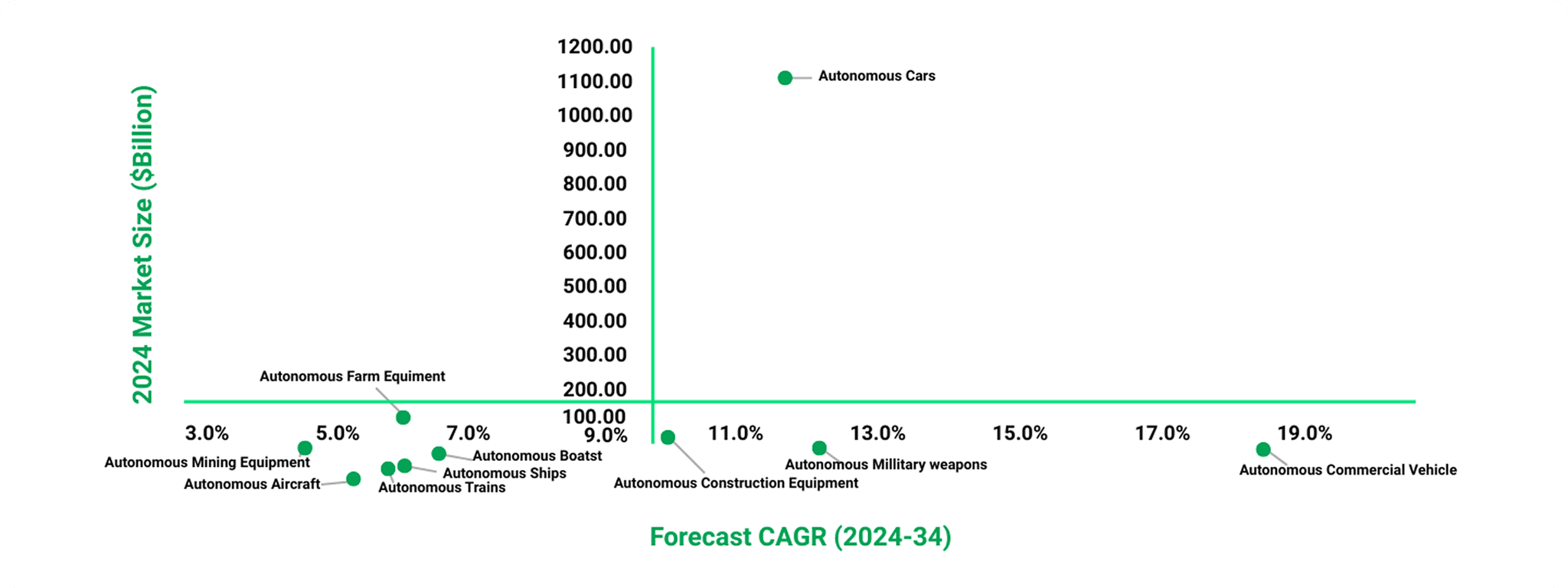
This Market Size and Growth Comparison offers insights into the evolution of autonomous technologies across transportation, defence, agriculture, and infrastructure. The comparison helps identify high-value markets, rapid-growth sectors, and areas of steady innovation:
- Autonomous Cars are positioned far above all other markets, reflecting their clear lead in adoption, scale, and integration into everyday life.
- Autonomous Commercial Vehicles show the fastest growth trajectory among all segments, indicating rapidly rising demand and increasing momentum in goods movement and logistics automation.
- Autonomous Military Weapons and Autonomous Construction Equipment also show strong forward movement, signalling steady growth as these technologies become more embedded in defense and infrastructure operations.
- Autonomous Farm Equipment is progressing steadily and stands out within the mid-range group, highlighting widespread application in agriculture and large-scale farming.
- Other markets such as Autonomous Trains, Autonomous Aircraft, Autonomous Mining Equipment, Autonomous Ships, and Autonomous Boats are developing at a more gradual pace.
Explore our comprehensive market reports in the autonomous industry

Transport: Autonomous Cars - The Largest Market
With a market size of $1,176.9 billion, autonomous cars stand well ahead of all other segments in terms of overall adoption and value. Their large market size is driven by the fact that autonomy is being integrated across a vast global passenger car base. Even entry-level and mid-range vehicles today often include Level 1 and Level 2 autonomous features like adaptive cruise control, lane-keeping assist, and automatic emergency braking. As automakers steadily move toward higher levels of autonomy (Levels 3–4), autonomous functionality is no longer limited to luxury models, it’s becoming a mainstream expectation in everyday vehicles, which is significantly expanding the overall market footprint.

Chemicals: Autonomous Commercial Vehicles - The Fastest Growing
While still smaller in size at $9.85 billion, this market is seeing the most rapid growth, with a forecast CAGR of 18.6%, the highest among all segments. Rising demand for automated logistics, warehouse integration, and last-mile delivery is pushing companies to adopt autonomous delivery vans, freight trucks, and service robots. These vehicles offer cost savings and help address ongoing driver shortages. As e-commerce continues to boom and cities explore smart delivery infrastructure, the need for commercial automation is expanding quickly, leading to the segment’s standout growth.

Pharmaceuticals: Autonomous Military Weapons - High Growth with Specialized Demand
The defence sector is actively investing in unmanned ground vehicles (UGVs), aerial drones, and surveillance systems that can operate with reduced human involvement. Valued at $16.36 billion and growing at 11.1% CAGR, this market is among the fastest growing, fuelled by national defense strategies worldwide that are accelerating the adoption of autonomous systems for both strategic and operational purposes. Its high growth is driven by strong government funding and a shift towards modern, tech-driven defense systems that reduce risk to personnel.

Machinery: Autonomous Construction Equipment - Automating Infrastructure
Construction automation is gaining traction as companies aim to reduce labor costs, increase site safety, and improve project timelines. The segment is valued at $15.41 billion, is growing at a CAGR of 9.4%, driven by rising investment in smart construction. Bulldozers, excavators, and loaders equipped with sensors and navigation systems are increasingly being used on large-scale and remote infrastructure projects. While adoption is still building up, the efficiency benefits and rising investment in smart construction are driving the market's growth.

Electrical and Electronics: Autonomous Farm Equipment - A Large and Steadily Growing Market
Autonomous technology in agriculture has seen wide adoption, especially for large-scale farming. With a market size of $81.41 billion, this market is one of the most established areas of autonomy after autonomous cars. Farmers use GPS-guided tractors, robotic sprayers, and harvesters to work with greater precision, reduce input waste, and deal with labor shortages. This contributes to the segment’s relatively large market size. The growth, however, is steady rather than rapid, as adoption often depends on long equipment replacement cycles and the high upfront costs associated with advanced machinery.

Aerospace & Defense: Autonomous Trains – Stable Adoption In Controlled Environments
Autonomous train systems, especially in metro and light rail networks, have been implemented in several countries, particularly in cities with advanced public transit infrastructure. The market is valued at $10.49 billion, is growing steadily at a CAGR of 6.7%. These systems benefit from running on fixed tracks in controlled environments, making automation easier to implement. While new projects continue to emerge, growth remains steady rather than explosive, as expansion depends on large-scale planning, significant capital investment, and lengthy development timelines.

Retail and Wholesale: Autonomous Ships and Boats – Early Stage But Promising
Automation in marine transport is still evolving. The market for autonomous ships is valued at $7.82 billion, growing at a CAGR of 6.8%, while autonomous boats account for $1.28 billion with a growth rate of 7.2%. Ships and boats with autonomous navigation systems are being tested and deployed for cargo, surveillance, and environmental monitoring. These systems reduce crew requirements and can optimize fuel usage. Though currently niche, the potential for expansion is strong, especially in commercial shipping and port operations.

Hospitality: Autonomous Mining Equipment – Focused on Safety and Efficiency
Mining was among the first industries to adopt automation, primarily to improve safety in high-risk environments. While the sector was quick to adopt automation, its market size is valued at $2.96 billion, growing at a CAGR of 5.6%. Driverless haul trucks, drills, and loaders are used in hazardous environments to reduce human exposure. The market remains specialized but important, with steady growth driven by the need for operational efficiency and reduced downtime.

Food and Beverages: Autonomous Aircraft – Niche But Emerging
Autonomous aircraft technology is still in the early stages, currently focused on applications like cargo drones and pilotless air taxis being tested in controlled environments. With a market size of $1.06 billion and a growth rate of 6.1%, this is the smallest segment within the autonomous systems landscape. However, interest is growing in areas such as logistics, aerial surveillance, and emergency response. Regulatory challenges remain a major restraint, but the long-term outlook is promising as drone corridors, air traffic systems, and urban air mobility solutions gradually evolve.
As industries worldwide continue to adopt automation, the autonomous systems sector is becoming a defining force across transportation, agriculture, construction, defense, and logistics. From market leaders like autonomous cars to specialized segments like autonomous aircraft, the scope of automation is expanding. These advancements highlight the technology's potential to improve safety, efficiency, and sustainability across the global economy.
Unlock Industry Insights with The Global Market Model
World's most comprehensive database of integrated market information
Our database provides forecasts for over 30,000+ markets, updated semi-annually to reflect the latest economic, geopolitical, and sector-specific developments. The most recent forecast, updated in January 2026, builds upon the previous insights from July 2025, ensuring unparalleled accuracy and relevance.
Leverage The Global Market Model to stay ahead, ensuring informed decisions in a rapidly evolving market.